


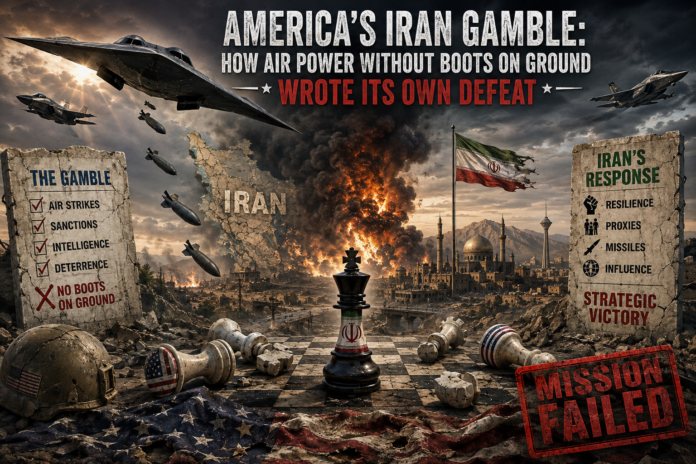
washington and Tel Aviv assumed decapitating Iran’s leadership would be a much easier task and it would trigger the same unraveling seen elsewhere, where the US had invaded those sovereign nations.
A Misconception Borrowed from Other Wars
Saddam’s Iraq was a Sunni minority ruling a Shia majority with no succession plan; Gaddafi’s Libya had no heir either and both states fractured into anarchy once their leaders fell. In Venezuela, the second tier of leadership reportedly abandoned their president the moment the US moved against him. Planners extrapolated this pattern onto Iran, believing that removing its top leadership – and neutralising its nuclear programme – would force capitulation. But these were the stated goals, not necessarily the real ones.

Misreading Iran’s Culture Proved Fatal
The strike that killed Ayatollah Ali Khamenei – 86, ailing, meeting openly rather than hiding in a bunker – also wiped out his son’s entire family, including a two-year-old granddaughter. Rather than destabilising the regime, the strike made an instant martyr of a man whose hardline record and restrictions on women could otherwise have been used against Iran in the information war. As head of Velayat-e Faqih, roughly a Shia equivalent of the papacy, his death united Shia populations across the region rather than dividing them.
Rather than fracturing the regime, killing Iran’s top leadership backfired – turning a hardline figure into a unifying martyr across Shia populations from Bahrain to Iraq to Saudi Arabia, risking unrest along old colonial-era fault lines
That unity carries strategic risk for the Gulf’s Sunni-led states with large Shia populations – Bahrain (around 70%), Iraq (around 60%), even Saudi Arabia (around 7%) – all potential fault lines Iran could exploit for influence or unrest as the war drags on, with colonial-era borders coming under renewed strain. Meanwhile, American planners banked on sanctions, propaganda and “colour revolution”-style unrest to fracture Iran internally, missing that the country is over 90% Shia and functions as a unified civilisational and theological state, distinct from its Arab neighbours – not as a patchwork of restless minorities waiting to break away.
Two Allies, Two Different Wars
The stated aims – regime change, destroying fissile material – were never fully realistic or fully sincere. Washington’s deeper goal was long-term destabilisation of the Middle East to squeeze OPEC supply and spike oil prices, damaging China’s cheap Iranian oil access while making American shale more competitive and pulling business away from an “unsafe” Middle East toward the US. All of this was calculated to strengthen the petrodollar and ease America’s debt pressures – even at the cost of the security guarantees underpinning that system.
Israel’s aims ran deeper and longer: eliminating Iran as the one regional power capable of challenging its dominance; clearing Palestinians from Gaza and the West Bank to secure nearby gas and oil reserves; and capturing Shia-dominated southern Lebanon’s energy fields under the pretext of fighting Hezbollah, with Syrian oil fields near the Golan Heights as a further target – all framed as fulfilling a “Greater Israel” vision.

Washington and Tel Aviv were fighting different wars under the same banner: the US chasing oil-market leverage and petrodollar stability, Israel pursuing a far larger “Greater Israel” ambition – a split that undercut unified strategy
However, this created a split: the US wanted a short war it could afford, while Israel wanted a longer one it couldn’t sustain without American backing. A separate Israeli ambition – the Ben Gurion Canal, a rival to the Suez Canal that would cut Asia-Europe transit time by roughly 40% – sits at the center of the India-Middle East-Europe corridor, but would badly hurt Egypt and Turkey and depends entirely on continued US support.
Old Playbook, New Battlefield
The US stuck to a Desert Storm-era template of concentrated air bombardment, despite sharing no land border with Iran or its allies. But Iran, hardened by decades of sanctions, had buried its offensive and defensive systems underground, shielding them from strikes and complicating detection.

Decoys, Terrain and a Losing ISR War
Iran appears to have studied the Kosovo conflict closely, where Serbian forces fooled NATO with cardboard tank cutouts rigged with heat sources and decommissioned radar systems mimicking real air-defence signatures – burning through expensive precision munitions on fake targets. Applied across terrain eighty times the size of Kosovo, with real targets underground, distinguishing decoys from genuine threats became nearly impossible for US-Israeli forces.
Mountainous terrain and mobile launchers forced reliance on MQ-9 Reaper and Hermes-900 drones for surveillance – until Iran’s SA-67 loitering surface-to-air systems began shooting them down, blinding the targeting grid. Iran, by contrast, could strike fixed, pre-surveyed targets: airfields and hangars where aircraft, including costly F-35s, had to sit in climate-controlled maintenance. With real-time targeting data reportedly flowing from Russia and China, Iran effectively won the surveillance war by exploiting the platforms its opponents depended on.
Supply Lines and the Interceptor Trap
American weapons systems – THAAD, F-35s, ATACMS – had to be resupplied from production bases over 10,000 km away, sustained only by strained air bridges. Iran’s supply chain, by comparison, ran through its own territory or just across the Caspian into Russia, making a prolonged conflict a logistical and economic burden for the US.
Ultimately, the campaign was structurally doomed: air power without any viable invasion route or land border meant the war’s stated objectives were unreachable from the start, ending in stalemate and a negotiated settlement
Israel’s missile defences compounded the problem. Densely packed THAAD and Arrow batteries overlapped each other’s coverage by 50-70%, wasting capacity and burning through interceptors at unsustainable rates.
Iron Dome’s AI logic, tuned to prioritise threats to population centres, was reportedly studied and exploited by Iran during the June 2025 twelve-day war: Shahed drones were flown low toward unpopulated areas before pivoting to real targets, while interceptors costing up to $1.5 million each were squandered on cheap drones and rockets.
Ballistic missiles fitted with cluster munitions further overwhelmed the targeting logic, leaving the AI system unable to engage each scattered bomblet – and eventually leaving Israeli and American forces short on interceptors altogether.
No Endgame, No Ground Force
Washington and Tel Aviv never built a real escalation matrix beyond intensifying airstrikes in phases – military, then population centres, then industry. Munitions ran low, aircrews fatigued flying multi-hour sorties from bases 1,500 km away, and by mid-2026 a peace agreement was signed as the campaign stalled.
The deeper failure was structural: air power alone cannot hold ground, and neither the US nor Israel shares a land border with Iran. Turkey, Pakistan and Iraq are the only theoretical invasion routes, and each is politically or logistically unworkable. Without boots on the ground, the campaign’s stated objectives were arguably unattainable from the outset – a strategic miscalculation which baked-in well, even before the first strike.

The writer is an Indian Air Force veteran and published author who has been a Navigation and Missile Instructor alongside being a weapon system evaluator. At present, he is a performance instructor for the Boeing 737. The views expressed are personal and do not necessarily carry the views of Raksha Anirveda





