


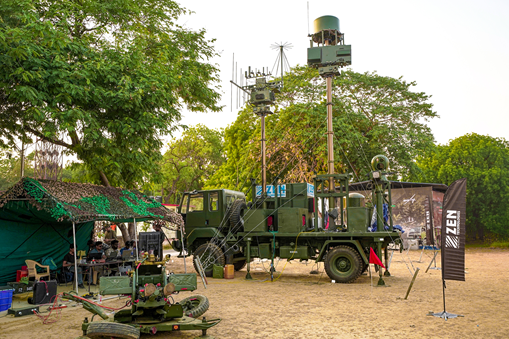
Prayagraj: In a significant step towards strengthening India’s counter-drone capabilities, Zen Technologies has unveiled an advanced artificial intelligence-powered anti-drone system designed to detect, track and neutralise aerial threats, including coordinated drone swarms.
The system, launched at the North Tech Symposium 2026 in Prayagraj, is being described as India’s first fully integrated, AI-driven counter-unmanned aerial system (C-UAS). It comes amid rising global concerns over the use of low-cost drones and swarm tactics in modern warfare, particularly in conflict zones where such threats have proven difficult to counter.

According to the company, the new platform combines surveillance, electronic warfare and kinetic response into a single modular architecture. It is capable of simultaneously tracking more than 100 drones, a feature that positions it as a critical tool against swarm attacks—an emerging challenge for militaries worldwide.
The system offers wideband frequency coverage ranging from 70 MHz to 12 GHz, enabling it to detect and disrupt a broad spectrum of drone communication channels. It can identify threats at distances beyond 15 kilometres, while its indigenous radar is capable of detecting smaller drones at ranges of up to 20 kilometres.
A key highlight of the platform is its layered “soft kill” and “hard kill” capability. Soft-kill measures include radio frequency (RF) jamming, global navigation satellite system (GNSS) jamming and spoofing to disrupt drone operations. For more direct neutralisation, the system integrates with remote-controlled weapon stations equipped with 7.62 mm and 12.7 mm guns, air defence artillery and even loitering interceptors.
The modular design allows the system to be deployed in multiple configurations, including vehicle-mounted, man-portable and fixed installations. This flexibility ensures it can be used for a range of missions—from protecting military bases and critical infrastructure to securing borders and high-value events.

The unveiling reflects a broader shift in defence priorities as drone warfare becomes increasingly central to modern conflicts. From reconnaissance missions to precision strikes, drones—especially first-person-view (FPV) variants—have emerged as low-cost yet highly effective tools, forcing militaries to invest heavily in countermeasures.
For India, the development is also aligned with the government’s push for defence indigenisation under initiatives such as “Make in India” and the Indigenous Design, Development and Manufacturing (IDDM) framework. The company emphasised that the system has been developed entirely within the country, underscoring efforts to reduce dependence on foreign defence technologies.

Industry analysts note that the ability to handle swarm threats—where multiple drones attack simultaneously—is particularly significant. Traditional air defence systems are often not optimised for such scenarios, making AI-driven solutions that can process large volumes of data and respond in real time increasingly essential.
Zen Technologies, which has a long track record in defence training systems and counter-drone solutions, has been expanding its footprint in this segment. The company recently secured licences to manufacture air defence cannons and continues to build capabilities across the anti-drone ecosystem, indicating a strategic focus on this rapidly growing domain.
As drone threats evolve in scale and sophistication, the introduction of such AI-powered systems signals a move towards integrated, multi-layered air defence architectures—an area likely to shape the future of warfare and homeland security.






