


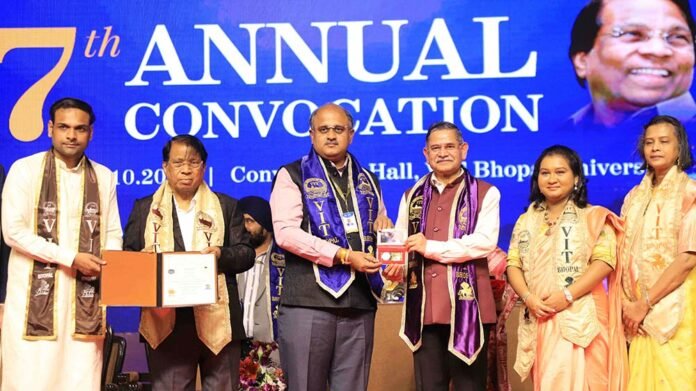
Bhopal. Former Chief of the Army Staff and Architect of Operation Sindoor, General Upendra Dwivedi, PVSM, AVSM (Retd.), addressed the 7th Annual Convocation at VIT Bhopal University as the Chief Guest on the occasion. A total of 3,571 students across undergraduate, postgraduate and doctoral programmes were conferred degrees.
Addressing the graduating students, General Upendra Dwivedi spoke about the evolving role of technology, the importance of human judgement, and the role young graduates will play in shaping India’s future. He emphasised that knowledge becomes meaningful when it is translated into action with the added element of entrepreneurship.

“Vidya, that is, knowledge, is not enough. Knowledge is only the potential; when you add entrepreneurship, it becomes power.”
On AI and Human Decision-Making
Speaking about the role of AI in Operation Sindoor, General Dwivedi emphasised that technology and artificial intelligence do not work in isolation, with human experience and judgement continuing to play a central role. He said, “In this, the artificial intelligence did not work alone. It was the experience which worked with it. So, what is important is that together, we become powerful, the machine cues data and then humans decide. So, the machine is there to support you, but humans are the ones who will decide when to act, where to act, and when to stop.”
He also spoke about how the pace of planning and execution is changing with AI, saying, “Earlier, we used to look at 80 per cent of planning. Once you finish planning, then you look at execution. But in view of the artificial intelligence, your pace is so fast that you have to have concurrent planning and execution.”
Connecting this shift to the adaptability of the younger generation, General Dwivedi said, “You are 36 crore Generation Z who are going to take this India forward. So, you don’t have to just know AI. You have to ride the AI like a horse rider, and AI and humans have to collaborate, for which Indians are always the best adapters.”

On the Vision of Viksit Bharat 2047
Speaking about the future of national security and the role of young technology professionals, General Dwivedi said that a future Operation Sindoor would require collaboration between the armed forces and civil professionals.
“As far as Operation Sindoor is concerned, now, if you are looking at 2.0, whenever it comes in the future, it will be a combination of the uniformed warriors and the civil warriors like you. The next war will not have any borders. It will be there in the economic field. It will also be addressing your aircraft, airlines, airports, railway stations, and banking,” he said.

He further highlighted the role of technology graduates in securing digital infrastructure. “Besides helping the Indian Army, you will be fighting the UPI in case somebody is carrying out an attack on that. So, payments defects and, of course, the affordable solutions to counter the drones. The smartphone will be the front line, and your code will be a shield or a coverage. So, Viksit Bharat 2047 will be in labs and startups which you are going to create in the future.”
General Dwivedi also highlighted VIT Bhopal University’s STARS programme, saying, “If there are people from such a wide variety of backgrounds, then my kudos to VIT, which has brought everyone together. And that’s why I must compliment the STARS (Support the Advancement of Rural Students) Scheme programme of VIT, through which so many students from different places are studying here.”
He also appreciated the university’s approach to creativity and alternative approaches, referring to its No-Bag Day. “That is something great. It was something very creative, and I have never seen it at any college or university.”
The address concluded with General Dwivedi urging the graduating students to translate their knowledge into action and innovation. He emphasised that the next phase of India’s growth will be shaped by young professionals who can combine technology, entrepreneurship and human judgement to build solutions for the country. His message placed the graduating students at the centre of India’s journey towards Viksit Bharat 2047.






