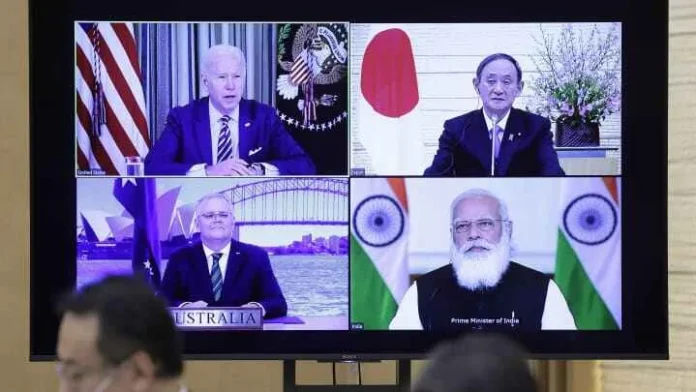
Washington: As a follow up to the historical first virtual Summit of QUAD in March, the United States is looking to convene an in-person summit of the leaders of Quad this fall, Kurt Campbell, who is President Joe Biden’s Indo-Pacific czar, said lending a certain degree of specificity to a general understanding among member countries that it will be held sometime later in the year. The summit will be focused on infrastructure, he added.

The in-person summit was supposed to take place on the sidelines of the G-7 meet in the UK in June but an announcement of a specific date by the White House in April never came.
The plan to hold it in the UK, which was being pushed by Japan’s Prime Minister Yoshihide Suga, fell apart in a way when Prime Minister Narendra Modi announced earlier this month his inability to attend the G-7 meeting because of the devastating second wave of Covid-19 tearing across India. Though not a member of the G-7, Modi, Australia’s Scott Morrison and South Korea’s Moon Jae-in were to join the summit as special invitees of UK Prime Minister Boris Johnson.
“We want to look this fall to convene an in-person Quad and the hope will be to make a similar kind of engagement on infrastructure more generally,” Campbell said at a virtual event hosted by Stanford University.
An in-person summit was always on the cards as announced in the statement issued by the four countries after their March summit. But, the timing had never been firmed and officials have been working towards sometime later in the year, sources said adding that even if one was held on the sidelines of the G-7 meet, it would not have foreclosed the possibility of a stand-alone in-person summit.

The Covid-19 pandemic was the focus of the virtual summit held in March and the four countries announced a joint initiative to fund, make and distribute more than 1 billion doses of Covid-19 vaccines to Indo-Pacific countries. They had also set up task forces on climate change, emerging technologies and critical resources, giving legs, for the first time, to a group that previously had only joint statements to show for outcomes.
The focus on infrastructure as indicated by Campbell points to a need felt by the four countries to harness their resources to counter China’s “Belt and Road Initiative” that is creating dependencies among vulnerable nations through the use of predatory financing mechanisms.

Campbell also made clear the United States has truly abandoned its strategy of engagement with China, continuing a break from the past US strategy spelt out explicitly first by the Trump administration. “A period that had been broadly described as engagement has come to an end,” he said, adding, “The dominant paradigm is going to be competition. Our goal is to make that a stable, peaceful competition that brings out the best in us.”