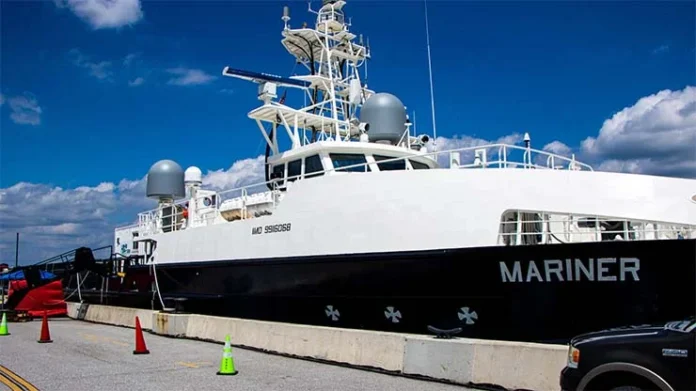
Annapolis: In what is said to be unusual ship, the Mariner, is the US Navy’s latest research and development ship, an unmanned surface vessel (USV), designed to sail autonomously. There is a button which if pressed should anything start to go wrong will stop everything the ship is doing and return manual control to the captain within approximately two seconds.

Navy officials say they’ve found the button is used most frequently by newer captains, who have less faith in the software, but building trust in the technology among the fleet is part of the ship’s job.
Mariner is tied up at the US Naval Academy where Navy officials are providing tours in an effort to show key figures on Capitol Hill, in Washington DC think tanks and the midshipmen at the academy — as well as a small group of Navy-focused reporters — that the technology is no longer just an idea on paper; it is real and it is a critical part of the future fleet. As an R&D vessel, Mariner at its core is meant to help the Navy iron out any questions it may have about how it should build and use USVs moving forward, before spending serious cash on advancing major programs of record like the Large Unmanned Surface Vessel.
As such, the ship’s label as an “unmanned surface vessel” is somewhat misleading, and it’s more accurately described as “optionally-manned.” It currently has a small commercial crew aboard working with the Navy to transit it from place to place and experiment with its autonomous capabilities as necessary.
“We’re testing a variety of different commercial systems in terms of perception, in terms of engineering control [and] autonomy control,” said Rear Adm. Casey Moton, a senior officer overseeing the service’s unmanned maritime programs, who was present during the tours this week.

Prior to arriving at the academy on August 19, Mariner was at Joint Expeditionary Base Little Creek-Fort Story in Virginia Beach and when it leaves Annapolis, the ship will continue to undergo a variety of testing before making its way to Unmanned Surface Vessel Division One on the West Coast sometime next year. Following the tours, the ship was scheduled for a christening ceremony — a largely celebratory affair that famously involves the vessel’s sponsor breaking a bottle of champagne on the hull.
The Mariner is the direct result of the Strategic Capabilities Office’s Project Overlord. That program produced two similar prototype USVs now commonly known as Nomad and Ranger, which made appearances at this year’s Rim of the Pacific exercise.

Mariner is effectively a sister ship, built at Gulf Craft in Louisiana with Leidos as its prime contractor, and purchased directly by the Navy. Another sister vessel, dubbed Vanguard, is being produced by L3Harris Technologies. Mariner’s basic design mimics commercial ships used to support oil rigs. How exactly the Navy chooses to use vessels like this in future wars though is a question of broader speculation. Mariner is designed for containerized payloads, meaning if it can be transported in a box and set down on the ship’s deck, then the ship is in business to undertake the mission.
While Nomad and Ranger were designed by the SCO — and have subsequently been turned over to the service for further use — the Navy purchased Mariner while it was still under construction and was able to influence some design choices, such as its ability to be a mothership for other unmanned vessels.
“We can take two of our USVs and go out and do multi-vessel ops… and not necessarily have to take [a destroyer] off of actual fleet operations to go do that,” Moton said.
On Mariner, all the payloads are containerized, meaning they can be placed on the ship’s deck and quickly begin operating, as opposed to something such as the Aegis Combat System, which must be integrated into the ship itself. The Navy officials said Mariner was capable of holding two 20-foot-long coned boxes in the front as well as four 40-foot-long boxes in the back. The payloads aboard the ship during the tour included one to hold spare parts and another to be used as an office space for the crew, but future missions could take advantage of anything from intelligence, reconnaissance and surveillance assets to electronic warfare packages.
Like the Mariner, most of the Navy’s unmanned surface vessel programs have produced “optionally-manned ships,” meaning they contain living spaces and are safe for humans to embark, but are capable of autonomous transit.