


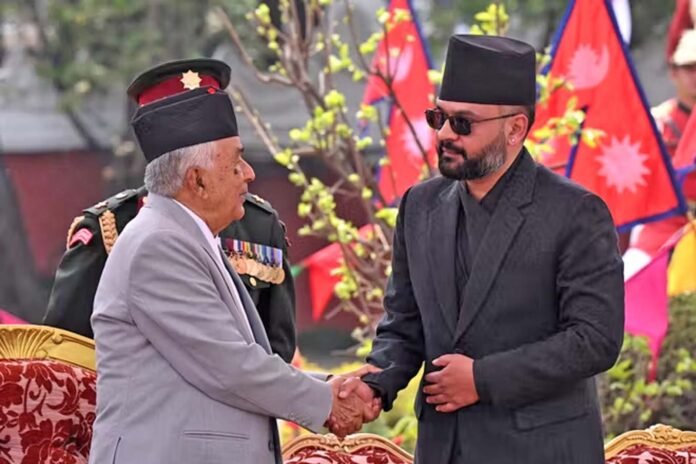
Following the appointment of Balendra Shah, nick-named Balen, as the Prime Minister of Nepal, Prime Minister Narendra Modi congratulated him and invited him to visit India, which he accepted. But soon after, Nepal officially objected to India’s decision to resume the Kailash Mansarovar Yatra through Lipulekh Pass in Uttarakhand, which Nepal claims is its own. Nepal’s foreign ministry statement said, “Government of Nepal is fully clear and firm on the fact that, according to the Sugauli Treaty of 1816, Limpiyadhura, Lipulekh and Kalapani, located east of the Mahakali River, are integral parts of Nepal.”
India has dismissed Nepal’s territorial claims, saying India has consistently maintained that such claims are unjustified, historically baseless and lack evidence, and that such unilateral enlargement of territorial claims is untenable. Lipulekh in the Kalapani area is one of the two tri-junctions that Nepal has with India and China. For India, the Kalapani area, including Limpiyadhura and Lipulekh, is part of India.

The Kailash Mansarovar Yatra through the Lipulekh Pass in Uttarakhand has been a designated route for pilgrims since 1954. After being suspended from 2020 due to COVID-19 and border tensions, the Yatra via Lipulekh was set to resume in the 2025-2026 season.
India has dismissed Nepal’s territorial claims, saying India has maintained that such claims are unjustified, historically baseless and lack evidence. Lipulekh in the Kalapani area is one of the two tri-junctions that Nepal has with India and China. For India, the Kalapani area, including Limpiyadhura and Lipulekh, is in India
Nepal’s statement further said, “in line with the spirit and sentiment of close and friendly relations between Nepal and India, Govt of Nepal remains committed to solving border issues through diplomatic means based on historical treaties, agreements, facts, maps and evidence.” India responded by saying that it remains open to constructive interaction with Nepal on all issues in the bilateral relationship, including on resolving the agreed outstanding boundary issues through dialogue and diplomacy.
Whether Nepal issued this statement in consultation with China remains unknown, but after US President Donald Trump’s tariff tsunami, India and China opened border trade through Nathu La Pass in Sikkim, Shipki La in Himachal Pradesh and Lipulekh Pass in Uttarakhand. China’s foreign ministry has not commented on the stand now taken by the Balen regime.
It may be recalled that in June 2020, the KP Sharma Oli-led Nepalese Parliament passed a new map showing Lipulekh, Kalapani and all areas north of the river Kuthi Yangti up to its source at Limpiyadhura on the main Himalayan watershed (totalling about 370 sq km) in Nepal’s territory. These areas fall in the Pithoragarh district of Uttarakhand, and India has held posts in the Kalapani area since 1962. Late Major General Randhir Sinh of the Indian Army had recalled:

The Kailash Mansarovar Yatra passes through the Lipulekh Pass in Uttarakhand, and it has been a designated route for pilgrims since 1954. After being suspended from 2020 due to COVID-19 and border tensions, the Yatra via Lipulekh was set to resume in the 2025-2026 season
- He commanded his battalion 4/3 Gr, in the area.
- Nepal claims the 1816 Treaty of Sugauli with the British gave it all the territory East of the River Kali.
- Kali River, as it comes down from the watershed, consists of two channels. The western channel called Kuthi Yankti is the main channel originating near Lampiya Dhura and joins the other channel at Gunji.
- Kali River originates at Lipulekh.
- From Gunji to Kalapani, the last post before Lipulekh, is an easy 15 km walk.
- Nepal claims that before 1860, the Kuthi Yankti was ‘supposed’ to be the boundary with Nepal and hence the controversy.
At the same time, how much the Mahakali River and its tributaries have changed course over the last two centuries plus has also been glossed over. What raised the commotion in Nepal was the inauguration of the 75 km trekking route, made motorable from Tawaghat to Lipulekh Pass on the India-Tibet border by Defence Minister Rajnath Singh on May 8, 2020, amid media publicity that has become the norm with Indian politicians! Nepal called this a violation of its sovereignty, even though the road is on the West bank of the Kali River.
KP Sharma Oli is a known Chinese stooge, and this new map of Nepal was passed without any discussion, even with the Indian mission in Kathmandu, on obvious advice from China since the then Chinese ambassador to Nepal Hou Yangi exercised enormous influence over Oli, and Oli also profited financially through dubious deals with China through Yangi. China probably suggested quoting the Treaty of Sugaulj with the British, while itself debunking the McMahon Line agreed between the British and Tibet at the 1914 Simla Convention, contending that Tibet was not a sovereign state with the authority to conclude treaties.

During KP Sharma Oli’s tenure as prime minister, Chinese President Xi Jinping visited Nepal in 2019. During his visit, the Nepal-China partnership was elevated from ‘Nepal-China Comprehensive Partnership of Cooperation Featuring Ever-lasting Friendship’ to ‘Strategic Partnership of Cooperation Featuring Ever-lasting Friendship for Development and Prosperity’
During Oli’s prime ministerial tenure, Chinese President Xi Jinping visited Nepal on October 12-13, 2019, the first Chinese President to visit Nepal after 1996. During Xi’s visit, the Nepal-China bilateral partnership was elevated from ‘Nepal-China Comprehensive Partnership of Cooperation Featuring Ever-lasting Friendship’ to ‘Strategic Partnership of Cooperation Featuring Ever-lasting Friendship for Development and Prosperity’. Both sides inked 18 agreements, and two letters of understanding; the most significant was intensifying execution of the MoU (signed in June 2018) under the Belt and Road Initiative to enhance connectivity, encompassing vital components of ports, roads, railways, aviation and communications within the overarching framework of Trans-Himalayan Multi-Dimensional Connectivity Network. Moreover, whenever Kathmandu came under communist rule, Pakistan’s ISI made bigger inroads in Nepal. Now Nepalese officers are being trained at the Pakistan Military Academy. Nepal permitted China’s oil drilling in the Terai region bordering India, and 30 Chinese NGOs to penetrate Nepal’s social sector.
In May 2022, Balen was elected mayor of Kathmandu as an independent and won instant praise from fellow Nepalese by putting up a map of ‘Greater Nepal’ in his office, stretching from Sutlej to Teesta; the map of Greater Nepal included parts of Uttarakhand, Sikkim and Himachal Pradesh.
Leaked files have revealed that the US funded the Gen-Z shadow army of Nepalese youth in the run-up to a violent coup, controlled by a leader chosen through an informal social media poll. In addition to the covert machinations of the CIA, America’s overt agencies involved in regime changes around the world comprise USAID, National Endowment for Democracy (NED) and International Republican Institute (IRI). America’s NED spent hundreds of thousands of dollars to train scores of Nepalese youths in strategies and skills before the mob violence that overthrew the government of Nepal in September 2025.
The inauguration of the 75 km trekking route, made motorable from Tawaghat to Lipulekh Pass on the India-Tibet border by Defence Minister Rajnath Singh on May 8, 2020, raised uproar in Nepal. Kathmandu called this a violation of its sovereignty, even though the road is on the West bank of the Kali River
‘Hami Nepal’, a popular NGO run by Sudan Gurung, is funded and controlled by Barbara Foundation (run by Leftist Sanduk Ruit and lawyer Mohna Ansari defending radical Islamists. With the CIA controlling the digital media and NGO’s, what could be better for the CIA-ISI nexus with hashtags like #PoliticiansNepoBabyNepal, #NepoKids, and #NepoBaby on social media inciting the revolt, as well as an anti-India toolkit with hashtags like #BackoffIndia and #GoBackIndia running since India’s prolonged blockade of the India-Nepal border during 2015-2016 that pushed Nepal into China’s lap. Nepalese social media is divided over India’s approach towards Nepal. Nearly 1/5th of Nepalese (aged 15-24) are unemployed, and the GDP per capita is $1,447 according to the World Bank, making the task easy for the CIA-ISI.
Not surprisingly, then, in the Gen Z violence, protesters attempted to vandalise/burn the Pashupatinath Temple, set ablaze vehicles of the temple board, vandalised check posts on the Indo-Nepal border, burnt in Jhapa and Kakarbhitta areas, a Custom Office was vandalised, Indian trucks carrying goods were looted, and a tourist bus carrying Indians was attacked and looted near Kathmandu, leaving many injured.
Balen has initiated a ‘Nepal First’ policy and ordered probes into the Nepal-China deals under the previous governments. But the latter is more to deal with the endemic corruption and to fix political opponents. How much he succeeds in this remains to be seen, but China will continue to increase its influence in Nepal and the region, notwithstanding the disruptive activities of the US, with Pakistan already sitting in its lap.
India’s decision to stop regular recruitment of Nepalese in the Indian Army broke the decades-old bond between the armies of India and Nepal, denying some 1,300 Nepalese Gorkhas service in the Indian Army as regulars. China, which already has Tibetans in the PLA, would likely recruit Nepalese
In addition to dealing with the endemic corruption, the Balen government faces the problem of burgeoning unemployment. Some 9,00,000 Nepalese move abroad annually (excluding those migrating to India or without documentation), and 2,000+ working-age citizens leave Nepal on an average daily basis. The Indian government’s decision to stop regular recruitment in the army broke the decades-old bond between the armies of India and Nepal, denying some 1,300 Nepalese Gorkhas service in the Indian Army as regulars. China, which already has Tibetans in the PLA, would likely recruit Nepalese, especially with its slowing population rate.
The 1,751 km-long India-Nepal border is porous, allowing free movement. The border spans five Indian states: Uttarakhand, Uttar Pradesh, Bihar, West Bengal, and Sikkim. The coup in Nepal came as a surprise to India and Indian intelligence agencies, just like the coups in Sri Lanka and Bangladesh, despite India’s “Neighbour’s First” policy. The situation is certainly not comfortable, including with China planning a new SAARC.
There is no denying that Nepal’s economic development is closely linked to connectivity with India, while India’s regional stability depends on a stable and friendly Nepal, especially in the current geopolitical environment surrounding India. Both India and Nepal agree that dialogue is the best way to address the territorial issue. But whether the acrimony can be controlled and the issue amicably resolved will depend on China’s intent and influence over the Balen government, as well as the mood inside Nepal, which is under the influence of foreign-controlled digital media. This became more than evident with the cancellation of Foreign Secretary Vikram Misri’s visit to Nepal because Balen refused to meet him. Did Nepal view this as India’s ‘Big Brother’ attitude, not deputing at least the External Affairs Minister S Jaishankar to discuss the issue? Does Balen want discussions only at the prime ministerial level?

The author is an Indian Army veteran. The views expressed are of the author and do not necessarily reflect the views of Raksha Anirveda





