

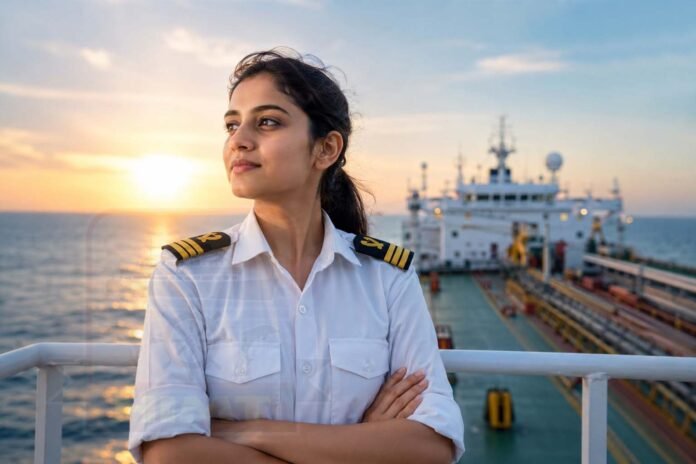
In 1923, the Indian shipping industry observed an important development with the appointment of Sumati Morarjee in the managing agency of the Scindia Steam Navigation Company at the age of 14 years only. The company’s co-founder entrusted her with an administrative role and admired her passion for learning. With time, Sumati Morarjee demonstrated exceptional leadership and determination and by 1946, took complete charge of the company.
In 1956, the nation witnessed a historical moment when Sumati Morarjee became president of the Indian National Steamship Owners’ Association, the first woman to lead a major shipowners’ organisation. Significantly, raising the company’s fleet to 43 shipping vessels, totalling 552,000 tonnes of dead weight.

Despite such remarkable achievements, women’s involvement in the maritime industry has been significantly underrepresented. According to the 2021 Women in Maritime Survey report, less than 2% of Indian seafarers are female. However, there has been a positive inclination of women’s representation in leadership. Currently, 32% of board positions in Indian maritime corporations are held by women, greater than in several other leading maritime nations.
Furthermore, the introduction of gender-inclusive initiatives by government, international partnerships and programmes such as IMO’s ‘Women in Maritime’ programme has been crucial in ensuring women’s representation in the maritime sector. These initiatives highlight the significance of gender equality as a catalyst for innovation, safety, and sustainability within the global maritime framework, and promote women’s participation in seafaring, port operations, and maritime education.
In 1956, India witnessed a historic moment when Sumati Morarjee became president of the Indian National Steamship Owners’ Association, the first woman to lead a major shipowners’ organisation, raising the company’s fleet to 43 vessels, totalling 552,000 tonnes of deadweight
Recognition of Women’s Expanding Roles in National Security
The recent Operation Sindoor was launched as a concerted and coordinated counter-terrorism initiative to dismantle terrorist networks operating along the Line of Control (LoC) and Pakistan-occupied Kashmir (PoK). This operation proved to be a crucial moment in the reflection of women’s participation in India’s defence and security framework.
Throughout the operation and during the media briefing, Colonel Sofia Qureshi and Wing Commander Vyomika Singh demonstrated excellent leadership and precision, making India’s defence forces feel proud. As the first female commander of a battalion-sized tactical combat force, Colonel Qureshi led counter-infiltration operations along the Line of Control while engaging in low-casualty, strategic warfare to neutralise major terror bases. The distinguished fighter pilot Wing Commander Vyomika Singh commanded a squadron of Mirage-2000 aircraft that carried out a precision strike on terrorist targets. For her remarkable skills in mid-air refuelling and aerial target acquisition and for setting up an exceptional standard for women in India’s aerial warfare operations by leading many high-risk flights with poise under duress and achieving an astounding 97% target success rate, Wing Commander Vyomika earned commendation from the defence minister.

The operation’s command structure included gender-responsive support measures, such as integrated counselling services and enhanced communication accessibility for female staff. This forward-thinking strategy strengthened the institutional commitment to gender inclusivity within India’s security architecture, thereby enhancing operational efficiency.
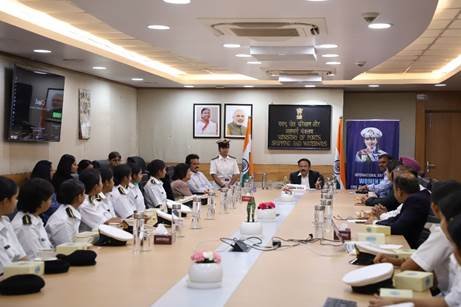

Defence Minister Rajnath Singh, while speaking at the ICG Commanders’ Conference in New Delhi on September 29, 2025, recognised the tremendous advancements accomplished in the field of women’s empowerment. He underlined that female armed forces officers now lead as front-line warriors in addition to serving in supporting roles within. As a reflection of their growing involvement and leadership in a range of operational and strategic domains, women officers are now being trained and deployed as pilots, observers, hovercraft operators, air traffic controllers, logistics officers, and law enforcement officers.
Defence Minister Rajnath Singh, while speaking at the ICG Commanders’ Conference in New Delhi last year, recognised the tremendous accomplishments in women’s empowerment. He underlined that female armed forces officers lead as front-line warriors in addition to serving in supporting roles within
Women’s Engagement and Contributions in Coastal and Maritime Security Operations
In September, 2025, two Indian Navy female officers, Lt Cdr Roopa A and Lt Cdr Dilna K, embarked on Navika Sagar Parikrama II, an extraordinary circumnavigation of the globe onboard INSV Tarini, representing a significant milestone of women’s participation in India’s Naval history. The all-women crew of INSV Tarini stands as a proud testament to the Navy’s vision of inclusivity, resilience, and excellence in ocean sailing.
The Indian Armed Forces launched a Tri-Services All-Women Circumnavigation Sailing Expedition, Samudra Pradakshina, from Mumbai to Seychelles and back on April 7, 2025. The expedition featured a 12-member all-women crew from the Indian Army, Indian Navy, and Indian Air Force aboard IASV Triveni, undertaking a 55-day, 4,000-nautical-mile voyage. The mission highlighted the principles of women’s equality and empowerment in marine operations, embodying the spirit of Nari Shakti. To improve endurance and required operational expertise, the officers underwent a two-year challenging training programme and took part in several maritime missions.
In fisheries planning and management, major initiatives, directives and policies have been passed to women’s right to participate in decision-making and leadership roles. At present, fisherwomen make up about 44% of the total fishing population and are actively engaged in various fisheries-related activities. The highest population of coastal fisherwomen is found in Tamil Nadu, followed by Kerala and Odisha. In the inland sector, Bihar accounts for the largest proportion of fisherwomen (28%), followed by Uttar Pradesh (17.8%) and West Bengal (11.92%). Notably, Kerala has the highest number of fisherwomen (67% of the total full-time fisherwomen) engaged in marine fisheries as their primary occupation, followed by Maharashtra and Karnataka.
Maritime Women-centric Policy and Initiatives
The International Maritime Organisation (IMO) has implemented a strategic approach that promotes the contributions of women as crucial maritime stakeholders through its Women in Maritime programme, which functions under the slogan ‘Training-Visibility-Recognition’ within the context of maritime development. IMO continues to promote the inclusion of women in both shore-based and sea-going positions.
The International Maritime Organisation has implemented a strategic approach that promotes the contributions of women as crucial maritime stakeholders through its Women in Maritime programme. IMO continues to promote the inclusion of women in both shore-based and sea-going positions
In 1988, the IMO launched its gender programme with only a few maritime training facilities accepting female students. Since then, an institutional framework for integrating gender equality into IMO policies and procedures has been established through the organisation’s gender and capacity-building programme. This has facilitated women in the maritime industry to have access to training and career opportunities.
Currently, the IMO, with eight Women in Maritime Associations (WIMAs) consisting of 490 members, have been established in Africa, Arab States, Asia, the Caribbean, Latin America, and the Pacific, including over 152 nations and dependent territories. Members of these regional maritime associations for women have a forum to discuss a broad spectrum of issues, covering not only gender-specific ones but also technical issues.
The Women’s International Shipping and Trading Association (WISTA International) is a global networking organisation whose objective is to encourage and support women in the maritime, trading, and logistics industries at the management level. In 2018, WISTA received consultative status from IMO. WISTA provides a platform to foster and promote women’s empowerment, diversity, and inclusion. WISTA can now formally participate in discussions about strengthening capacity in the maritime sector, which includes promoting women, both on land and aboard ships, and highlighting the diverse technical expertise and leadership that women can and do contribute to the sector.
In the Indian context, the Pradhan Mantri Matsya Sampada Yojana (PMMSY) is a flagship initiative of the Union government aimed at promoting the holistic development and sustainable growth of the fisheries sector. Introduced to safeguard the interests of marginalised groups, particularly women, who are actively involved in the fishing sector, the scheme provided women beneficiaries over 60% of the financial aid, promoting their economic advancement and active engagement in the industry. Many major projects worth Rs 3,049.91 crore have been sanctioned under the scheme during the last four financial years (2020–21 to 2023–24) and the current financial year (2024–25). Furthermore, this initiative has benefitted 56,850 women nationwide, including 11,642 from Tamil Nadu.
During the 134th Session (July 2025) of the International Maritime Organisation (IMO) Council, India emphasised its remarkable progress in enhancing maritime safety, security and fostering gender inclusivity in the maritime industry. The nation reported a notable 650% rise in the number of Indian women seafarers, reflecting its dedication to promoting equal opportunities and strengthening women’s empowerment within the maritime industry.
In the Indian context, the Pradhan Mantri Matsya Sampada Yojana, a flagship initiative of the Union government to promote the development of the fisheries sector, was introduced to safeguard the interests of marginalised groups, particularly women, who are actively involved in the fishing sector
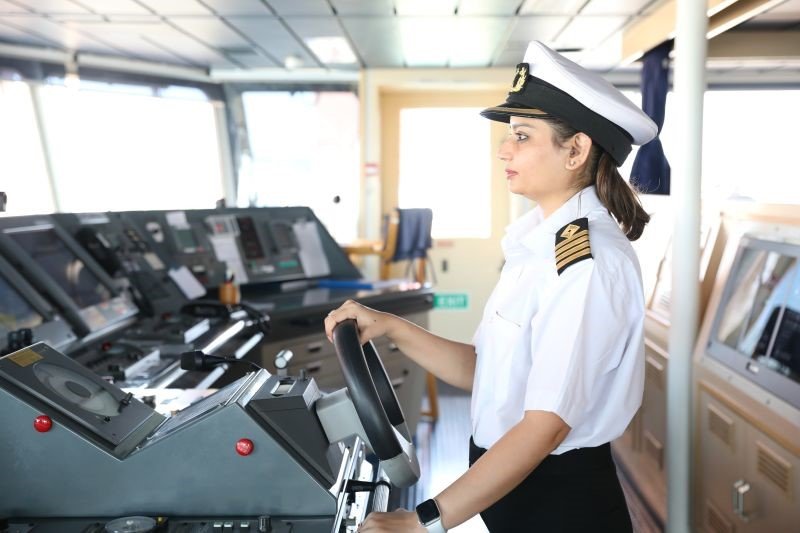
On the occasion of International Women’s Day in Mumbai, the Union Minister of Ports, Shipping and Waterways (MoPSW), Sarbananda Sonowal, launched the ‘Sagar Mein Samman’ (SMS) initiative, a policy framework introduced by the government to build a gender-inclusive and future-ready maritime workforce. The initiative aims to enhance women’s representation at all levels of the maritime domain, from on-ground port operations to leadership and decision-making roles. The SMS policy presents a strategic roadmap to reduce the gender disparity across seafaring and shore-based segments, emphasising women’s safety, leadership development, and long-term career retention within the Indian maritime sector. It envisions a future where women’s participation forms an integral part of every sphere of maritime activity and governance. The Directorate General of Shipping has developed ‘Sagar Mein Samman (SMS)’ as a progressive and inclusive initiative, aligning it with the Government’s broader goals of Diversity, Equity, and Inclusion (DEI).
Key Objectives of ‘Sagar Main Samman’ Policy
- Strengthen women’s capabilities and confidence to assume leadership and decision-making roles across the maritime domain.
- Ensure fair and transparent practices in recruitment, promotion, training, and remuneration to achieve balanced representation at all levels.
- Foster a safe, respectful, and harassment-free work environment that supports women’s overall well-being.
- Offer specialised training, certifications, and industry exposure to enhance the technical and managerial skills of women professionals.
- Uphold workplace dignity by maintaining strict zero-tolerance toward harassment, discrimination, and unsafe practices.
- Promote active involvement of women in policy formulation, committees, and leadership structures within the maritime sector.
- Encourage continuous professional development through regular training, mentoring, and upskilling initiatives.
Furthering the government’s commitment to inclusivity and gender equality in the maritime sector, the ‘Sagar Mein Yog – Complete Wellness Programme’ has been launched to integrate yoga and holistic well-being practices into every stage of maritime training and operations: Pre-Sea, At-Sea, and Post-Sea. The initiative aims to ensure that seafarers remain resilient, balanced, and prepared for every voyage.
The number of women seafarers in India’s marine industry has increased from 341 in 2014 to 2,557 in 2024, and 2,989 women sailors have benefited financially since 2014. The number of women requesting financial aid has risen from 45 in 2014–15 to 732 in 2024–25, reflecting the government’s ongoing efforts to encourage women to pursue careers in the marine industry
By monitoring health outcomes, Sagar Mein Yog seeks to continuously refine and expand its offerings to address the evolving needs of seafarers. The programme is expected to reduce medical emergencies, lower healthcare costs, and minimise attrition, thereby fostering a healthier and more supportive maritime work environment.
Way Forward
The number of female seafarers in India’s marine industry increased from 341 in 2014 to 2557 in 2024, an incredible 649% increase. Approximately 2,989 female sailors have benefited financially since 2014. The number of women requesting financial aid has risen from 45 in 2014–15 to 732 in 2024–25, reflecting the government’s ongoing efforts to encourage women to pursue careers in the marine industry. Indian women are increasingly working as sailors on both Indian and foreign-flag ships.
Empowering women in the marine industry is a strategic requirement. Their leadership offers the maritime industry power, creativity, and a more sustainable future. Due to their exceptional commitment to the cause of nation-building, our Nari Shakti is a pillar of the new Bharat – A continuum.

The writer is Manager at the School of Internal Security, Defence and Strategic Studies, Rashtriya Raksha University. She holds a Master’s in Law degree with specialisation in International Maritime Security Law & Governance. She is an active researcher and her focus areas include Coastal and Maritime Security, Antarctica Law and Polar Studies.





