

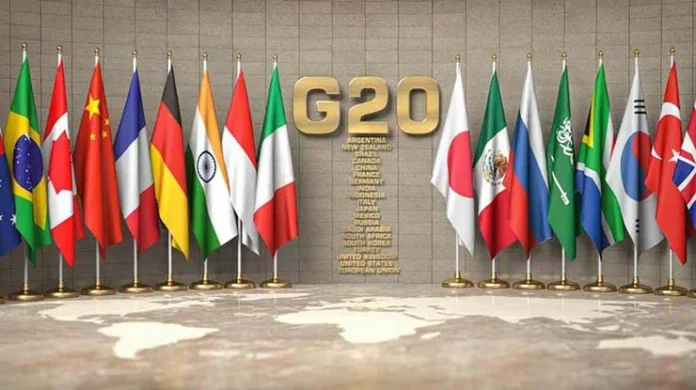
India – the world’s largest democracy and a civilisational state in the current capacity as the G20 president – is playing a monumental role in not only putting in order a fragmented global order but also trying to emerge as the hub of consensus on various issues ranging from climate change to the Russia-Ukraine war. While the dynamics of great power politics are being actively played out in the most powerful grouping in world politics, it is also necessary to understand the geopolitical and defence-related developments especially the prospects for India, the challenges and how India can navigate the maze of this great power competition.

To begin with, G20 is being held at a time when world politics is in a turbulent state – on one hand, there is the Russia-China-Iran troika against the West led by the USA, which is actively involved in the proxy war surrounding Ukraine, and then there is the issue of US-China tussle. India seems to have found itself in a tight diplomatic position.
But the one thing that New Delhi seems to have learnt from the Russia-Ukraine war is that overwhelming dependence on defence imports of a country can put one in a perilous position when it comes to an actual war scenario. In this case, Indian defence platforms are largely of Russian origin, approximately 70 per cent of Indian defence assets are of Russian import. India seems to have learnt this lesson immediately with New Delhi aggressively embracing the idea of autarky or ‘aatmanirbharta’ in the defence sector.
The new national defence policy is aimed at achieving defence exports to the tune of $5 billion in the next five years. The government’s autarky push was seen in the largest ever Aero India show, which concluded in Bengaluru recently. India is trying to slowly shed its defence imports and has found itself attracting new clients – Egypt has evinced interest in buying Tejas fighter jets. Also, New Delhi has successfully signed a $375 million deal with the Philippines to export the BRAHMOS supersonic cruise missiles.
Technology is a critical part of today’s defence sector and India has been aggressively pitching to make the armed forces leaner and more tech-savvy – the launch of new swarm drones by the Indian army and the talks with the United States for the acquisition of 30 armed MQ-9B reaper drones are currently in advanced stages.

However, much needs to be done, India can easily enter negotiations with other partner countries such as France and the UK for the manufacturing of advanced weapons. But this should be done based on the principle of technology transfer. One such excellent prospect is by using Western expertise in the manufacturing of new aircraft carriers. India has already commissioned its first ever indigenously built aircraft carrier Vikrant with over 76 per cent indigenous content. Aircraft carriers are a critical asset for India and will prove to be a game-changer in the Indo-Pacific region where Beijing is the main rival in general as well as in the Indian Ocean.
From the geostrategic perspective, the G20 forum is currently in a polarising position – the inability to issue a joint communique after the conclusion of the G20 foreign ministers meeting due to Russian and Chinese opposition is a testimony to the nature of the tense atmosphere. However, the fact that India could generate consensus on “95% of the issues” in the words of the foreign minister Dr S Jaishankar shows how India can straddle through this complex maze.

The Indian foreign policy, however, does not have an idealist position at this time. The current dispensation’s pursuit of a hard-core pragmatist-realist policy is – what is the right policy? that is being followed. The diplomatic balancing game that India is playing by managing a tightrope walk between the West and Russia-China duo is correct.
However, the scope for manoeuvring in this diplomatic tightrope game is narrowing day by day. Moscow and other Western capitals found themselves in a catch-22 situation. For Russia, withdrawing from Ukraine will be a catastrophic loss of face, the relenting by the West would result in the death of Ukrainian sovereignty as well as mortal threats to the Western military alliance of NATO in general and the Western countries bordering Russia. As a policy prescription, India must try and play a more proactive role in defusing this crisis because a diplomatic breakthrough at an Indian initiative will also put pressure on Beijing to renounce its irredentist claims on Arunachal Pradesh and Taiwan.
India must as the present president of G20 try and amass global support against Beijing especially emphasising the need to put the dragon on the back foot when it comes to the protection of Indian sovereignty and security.
Conclusion
With the government of India playing a proactive role in promoting an India-centric inclusive world order, it is imperative that the rest of the world actively heed India’s advice for that is perhaps the only way to tackle a broken world at the cusp of historic and existential problems which threatens to undermine the organic unity of the comity of nations. Only India can solve this conundrum.
References
https://www.reuters.com/world/india/india-wants-lift-defence-exports-5-bln-by-202425-says-modi-2023-02-13/
https://timesofindia.indiatimes.com/city/bengaluru/argentina-egypt-keen-on-buying-tejas/articleshow/97932706.cms?from=mdr
https://indianexpress.com/article/india/consensus-eludes-g20-communique-over-ukraine-but-washington-echoes-new-delhi-8476381/
–The writer is currently working as a Research Associate at Defence Research and Studies (dras.in) and is a columnist. The views expressed are personal and do not necessarily reflect the views of Raksha Anirveda

The writer is a doctoral candidate in Political Science at Mahatma Gandhi Central University. The views expressed are personal and do not necessarily reflect the views of Raksha Anirveda