


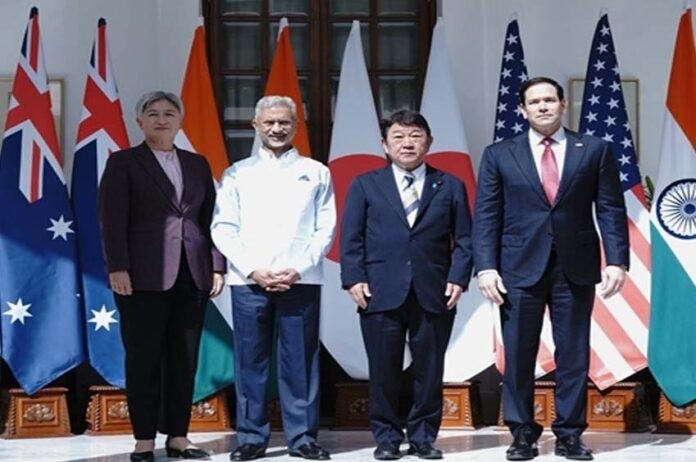
India’s strategic positioning on the eve of August 15, 2026 is best understood not as a choice between old partnerships and new alignments, but as an attempt to operationalise strategic autonomy in a world marked by institutional rivalry, sharpened Sino-American competition and the growing fusion of geopolitics, geoeconomics and geotechnology. In this setting, New Delhi is neither abandoning its historic Russia relationship nor subsuming itself into the QUAD, nor getting bogged down due to its relationship with its Northern competitor. Rather, it is pursuing a calibrated strategy that seeks to preserve room for manoeuvre while advancing the long-term developmental and technological ambitions embedded in the Viksit Bharat 2047 vision.
The challenge is that the external environment is becoming less accommodating. China’s rise, the hardening of supply-chain blocs, the weaponisation of financial instruments, sanctions and the strategic centrality of critical and emerging technologies are compressing the diplomatic space traditionally available to middle and rising powers. For India, this means that foreign policy can no longer be conducted through the older grammar of political balancing alone. It must increasingly integrate defence diplomacy, trade diversification, technology partnerships and industrial strategy into a single framework of statecraft. In fact, India’s diplomacy in 2026 will be tested on its ability to convert multi-alignment into strategic leverage rather than strategic overreach.

The Multipolar Order and India’s Expanding Footprint
The contemporary global order, rather than being described as multipolar, could effectively be described as a fragmented order with competing centres of power, weak consensus and overlapping institutional rings. In such an environment, where the world is standing at the cusp of transition, states that are not formal treaty allies of any one bloc acquire disproportionate diplomatic prominence.
A 2026 study on India’s role in a “fragmented global order” argues that rising powers have emerged as “crucial swing states” with “growing economic clout and diplomatic influence,” and that “multi-alignment” has become a “preferred modus operandi” for navigating great-power rivalries and geopolitical contests while preserving autonomy. The description captures India’s position well.
India, with its size, demography and exponential growth potential, is being viewed by multiple power centres as a consequential actor, whose choices can shape outcomes across trade, connectivity, security and technology governance. As per M Singh (Swinging for Self-Help: India’s Quest for Resilience in a Fragmented Global Order, 2026), “swing state(s)” “refuse to be arm-twisted by great-power competition,” and use transactional and coalition-building diplomatic means to maximise benefits while retaining policy independence. In practical terms, India is leveraging that position across multiple platforms, like the G20, BRICS, QUAD, SCO and issue-based coalitions in various domains.
India’s emergence as a “crucial swing state” has made it a coveted partner for the US, China, Russia and Europe, each seeking to gain an edge in the new great game
Yet there are limits to India’s arc of action. China’s “growing economic footprint is unmatched,” while India’s “supply-chain dependence on China in areas of critical and emerging technology” limits its developmental ambitions and material influence. India remains exposed in the upstream layers of modern technology production, even in those areas where the downstream layers are increasingly being localised. Multipolarity gives India room to shape coalitions and hedge across rival power centres, but it also raises the costs of indecision during periods of intensified geopolitical pressure.

Russia, QUAD and Strategic Autonomy
In 2026, the foremost strategic concern for India is not whether it prefers Russia or the West; it is how to preserve the utility of both relationships without allowing either to have a proscribed view over Indian interests. This is the essence of strategic autonomy. India’s foreign policy is increasingly explained by “hedging,” comprising diversified engagement, selective alignment and limited resistance. India, over the years, has been able to build soft-balancing coalitions and limited hard-balancing relationships with the United States, all the while avoiding commitments that would alienate China and Russia through continued engagement within institutions such as BRICS, SCO and G20.
This formulation helps clarify the apparent contradiction in India’s policy. On one hand, QUAD serves important functions for India: maritime coordination, Indo-Pacific signalling, technology partnerships and a framework for balancing the strategic consequences of China’s rise — all of this without the inconvenience of the transformation of the QUAD into a formal alliance. India has been resistant to seeing the QUAD evolve into a “security community,” preferring instead to negotiate the character of regional order rather than subordinate itself to rigid bloc politics. This is essential, as alliances reduce autonomy, and at the current juncture, India needs strategic flexibility.

On the other hand, historic ties with Russia remain central to India’s flexibility. Russia not only matters to India due to defence systems, energy transactions and diplomatic continuity but also because Moscow continues to occupy a pivotal place in Eurasian geopolitics. India’s Russia relationship also serves as a hedge against overdependence on Western security and technology ecosystems. It is a reality that India–Russia ties have remained “resilient in the backdrop of the prevailing complex, challenging and uncertain geopolitical situation.” This underlines the fact that the relationship is still seen in New Delhi as part of a wider autonomy architecture rather than a merely sentimental inheritance.
India as a Critical Swing State in the Shadow of China’s Rise
China’s rise has changed how India is perceived externally and how it must think about itself strategically. Beijing’s economic scale and military assertiveness have not only altered the balance of power in Asia, but have also made India more valuable to others. In an era of intense US-China rivalry, India is increasingly viewed as a pivotal actor whose alignment choices, market size, industrial base and geographic position, can shape the wider Indo-Pacific and Eurasian balance.
India is neither abandoning its historic Russia ties nor fully subsuming itself into the QUAD—instead, it is pursuing strategic autonomy through multi-aligned partnerships
- Raja Mohan’s earlier formulation of India as a “swing state” has acquired greater importance in the present context, because the stakes of India’s choices are now wider and materially more consequential. Today, India is being “courted by the US, China and Europe to gain an edge in the new great game,” and has “managed to consolidate” its position using “diplomatic and economic heft”. The significance of this lies in the fact that India is no longer treated simply as a regional power managing South Asian contingencies; it is now perceived as a relevant actor in the emerging order.
Viksit Bharat 2047 and the Imperative of Technological Sovereignty
If Viksit Bharat 2047 is to be more than a developmental slogan, it must rest on technological depth, industrial resilience and control over critical supply chains, apart from a stable internal and external environment. In this respect, the most important strategic question for India is no longer whether it has diplomatic partners, but whether it can convert partnerships into domestic capability. An Economic and Political Weekly analysis states the issue with unusual clarity: “Technological sovereignty is an imperative for strategic autonomy and … it has been India’s Achilles heel since independence”. That is perhaps the most concise formulation of the link between foreign policy and development in contemporary Indian strategy.
The same analysis warns that technological sovereignty will remain elusive unless both public and private research and development expenditure increase substantially, and unless technology policy is pursued with full awareness of “geopolitical supply chain realities”. This is a critical point for strategic planning. India cannot secure semiconductor resilience, AI capability, cyber autonomy or defence-technology depth through slogans of self-reliance alone. It must build ecosystems that include: capital, skills, standards, partnerships, and industrial policies, which reduce external chokepoints.
Emerging scholarship on India’s digital diplomacy suggests that New Delhi is attempting precisely such a middle path.
A 2025 article on “digital neo-nonalignment” describes India’s strategy as one aimed at preserving “infrastructural sovereignty, regulatory autonomy and normative influence” in the global AI and digital-governance domain. That framing aligns closely with India’s current policy direction: engage the United States, Japan, Europe, and like-minded partners on advanced technologies; maintain selective technological channels where possible with Russia and Eurasian actors; and simultaneously invest in domestic digital public infrastructure and industrial capability.
The real test lies in converting diplomatic flexibility into domestic technological sovereignty, a prerequisite for realising the Viksit Bharat 2047 vision
Technological sovereignty for India, therefore, means: securing access to critical technologies without being dependent on one ecosystem; embedding domestic manufacturing into global value chains on terms that support national capability accumulation; shaping norms and standards rather than merely following them; and ensuring that defence modernisation and civilian technology strategy reinforce one another.
Eurasian Theatre: Strategic Recommendations for Defence Diplomacy and Technology Statecraft
For India, even though the Indo-Pacific receives greater public attention, the Eurasian theatre remains central to its long-term strategic calculus. Eurasia is where India’s home is. Eurasia matters for energy, connectivity, continental security, critical minerals and the future of Russia’s strategic orientation. It also matters because the region sits at the intersection of Western sanctions, Chinese expansion and emerging transport corridors that could redraw trade geography.
India’s defence diplomacy in Eurasia assumes importance and needs to have multiple offshoots.
India’s Russia relationship must be strengthened while shifting from a buyer-seller perspective towards co-development, co-production and technology absorption. This is especially important where legacy Russian-origin platforms remain central to India’s military readiness. India should use Eurasian connectivity diplomacy to reduce strategic vulnerability. The International North–South Transport Corridor and related frameworks retain value because they diversify routes and expand India’s economic presence westward and northward.
India should build a dedicated Eurasian technology agenda. This would include cooperation on critical minerals, energy technologies, cyber resilience, Arctic logistics research and selective dual-use sectors where collaboration remains feasible. Defence diplomacy must become more integrated with industrial policy.
Building semiconductor resilience, AI capability and defence-industrial depth require converting partnerships into domestic capability —not just diplomatic slogans
India should align military modernisation, export promotion and co-production frameworks with the wider objectives of Viksit Bharat 2047. If strategic autonomy is to be materially credible, defence partnerships must generate domestic capability, skilled employment and innovation spillovers. Lastly, India should continue to engage the QUAD, without diluting its Eurasian options, as it benefits India in the form of maritime security, supply-chain resilience and high-technology collaboration without foreclosing strategic flexibility elsewhere.
India’s Strategic Outlook—2026
India’s strategic positioning in 2026 reflects a transitional moment in which older doctrines are being challenged by new realities. The country’s historic Russia ties, expanding QUAD engagement and technological ambitions under Viksit Bharat 2047 are not inherently contradictory; they are components of a larger effort to build a sovereign developmental state in an unstable external environment. But that effort will succeed only if diplomacy is backed by industrial depth, technological investment and sustained strategic clarity.
In the language of contemporary literature, India is a “crucial swing state” because it has stakes in a fragmented order. In the language of technological strategy, sovereignty is “an imperative for strategic autonomy”. Therefore, India must remain flexible without becoming ambiguous, connected without becoming dependent and assertive without becoming captive to bloc politics. That is the real test of Indian statecraft in 2026, and the necessary foundation for Viksit Bharat 2047.

The writer, Kirti Chakra, AVSM, VSM, is an Indian Army veteran. He has also served as the Indian Military Attaché in Moscow. He is the Founding Director and CEO of ThorSec Global. An accomplished scholar, he specialises in Geopolitics with a focus on Russian Studies and is currently pursuing his PhD in the field, further enriching his depth of knowledge and global perspective. He can be reached at deepakmehra67@yahoo.co.uk and deepak.mehra@thorsecglobal.com. The views expressed are of the writer and do not necessarily reflect that of Raksha Anirveda





