


every few months, a big and shiny number floats around in the news. People are being told that the space industry will soon be worth around two and a half trillion dollars ($2.5 trillion). It sounds huge. It makes us imagine hundreds of rockets roaring into the sky, new planets, and shining space stations. But when you look closely, most of this money has nothing to do with rockets at all. That is the interesting twist in this story.
First, an important point. This giant figure does not come from NASA or from any government space agency. It mostly comes from a chart based on estimates made by McKinsey, a famous consulting company, and it was shared by Global X, a company that sells investment products to people. Even Global X, in its own note, admits that the chart is meant to show which sectors could give good returns to those who invest their money. In simple words, the number was made to attract investors, not to describe rockets.

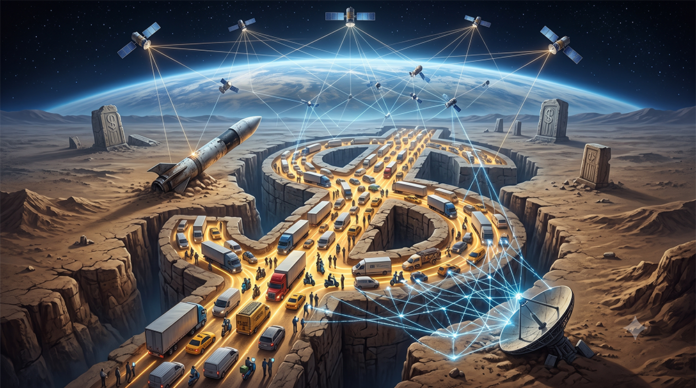
Now let us understand what the chart actually shows. When you break the big number into pieces, the largest part is not space at all. Supply chain and transportation take more than five hundred billion dollars ($500 billion). Food and beverage delivery and tracking take more than four hundred billion ($400 billion). Retail and consumer goods take more than two hundred billion ($200 billion). And the part that is actually called “space” the real rockets, satellites, and launches sits quietly at the bottom, worth less than one hundred billion ($100 billion). So the biggest slices belong to trucks, shops, and food, while rockets get the smallest slice.
The original McKinsey report, prepared along with the World Economic Forum, explains this more carefully. It divides the space economy into two parts. One part is called the “backbone.” This includes the real hardware: satellites, rockets, and launch systems. The other part is called the “reach.” This includes all the ordinary businesses on the ground that simply use signals or pictures coming from satellites.
The original McKinsey report, prepared along with the World Economic Forum, explains this more carefully. It divides the space economy into two parts. One part is called the “backbone.” This includes the real hardware: satellites, rockets, and launch systems. The other part is called the “reach.” This includes all the ordinary businesses on the ground that simply use signals or pictures coming from satellites
The numbers tell the real story. This report says the full space economy was around six hundred and thirty billion dollars ($630 billion) in 2023, and it may grow to about one point eight trillion dollars ($1.8 trillion) by 2035, not two and a half trillion, as many headlines suggest. In 2023, the backbone and the reach were almost equal, each worth around three hundred billion dollars ($300 billion). But by 2035, the reach is expected to shoot ahead and cross one trillion dollars ($1 trillion), while the backbone reaches only around seven hundred and fifty-five billion ($755 billion). This gap is very important to notice.
Why? Because the fastest-growing part of this space economy is not really space. Consider simple examples. A taxi driver using GPS on his phone to find a passenger is counted as “reach.” A grocery shop tracking its delivery van is also “reach.” An insurance company looking at satellite pictures to check flood risk in a village is again “reach.” None of these people are building rockets. None of them are going into space. They are only using satellite services in their normal work.

And this is the honest heart of the matter. These are not brand-new industries. Taxis, grocery shops, and insurance companies already existed for many years. They are simply being given a shiny “space” label because they happen to use satellite-based services. When you add up all such businesses, the total naturally looks enormous.
This is not a new trick. The same method has been used for semiconductors, artificial intelligence, and clean energy. Every time, people count every single industry that uses the technology, and suddenly the market looks giant and exciting. It is a common way to make a market appear bigger and more attractive so that more money flows in.

Every time, people count every single industry that uses the technology, and suddenly the market looks giant and exciting. It is a common way to make a market appear bigger and more attractive so that more money flows in
To be fair, this does not mean space is fake or failing. The space business is truly growing. The cost of launching things into space has fallen by about ten times (10x) over the last twenty years, and far more satellites are being sent up than before. That progress is real and worth celebrating.
But the trillion-dollar headline is used more to grab attention and pull in investors than to show the true picture of rockets and satellites. When the fastest-growing part of an industry never actually leaves the ground, the big market number is not really measuring that industry. It is mostly measuring how strongly people are being encouraged to open their wallets and put money into it.
So the next time you see that huge space figure, pause and smile. Most of that trillion never flies anywhere. It quietly stays right here on Earth, riding in taxis, delivery vans, and grocery trucks, wearing a costume that says “space.”

-The writer is an award-winning science communicator and a Defence, Aerospace & Geopolitical Analyst. He is the Managing Director of ADD Engineering Components India Pvt. Ltd., a subsidiary of ADD Engineering GmbH, Germany. You can reach him at: girishlinganna@gmail.com. The views expressed are personal and do not necessarily carry the views of Raksha Anirveda





