


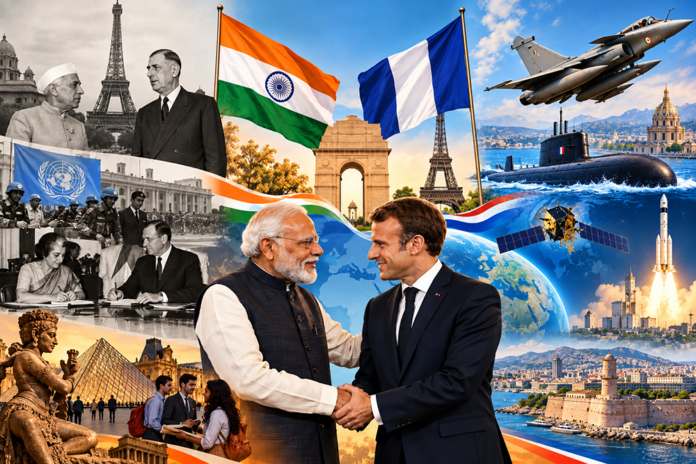
Today, the Franco-Indian relationship is arguably stronger and more comprehensive than at any point since 1947. France has become one of India’s most trusted Western strategic partners, with cooperation extending across defence, nuclear energy, space, maritime security, critical technologies, climate policy and the Indo-Pacific. Major programmes such as the Rafale fighter and Scorpène submarine partnerships have created unusually deep defence-industrial ties, while Paris and New Delhi increasingly seek co-development, technology transfer and joint production, rather than a conventional supplier-buyer relationship. This ambition is formally set out in the Horizon 2047 Roadmap, which commits the two countries to cooperating in the co-development and co-production of advanced defence technologies.
Politically, the partnership is reinforced by a remarkable degree of strategic compatibility: both countries favour a multipolar international order, defend strategic autonomy and resist being forced into an exclusive alignment with either Washington or Beijing. The reciprocal symbolism of Narendra Modi as France’s Bastille Day guest of honour in 2023 and Emmanuel Macron as India’s Republic Day chief guest in 2024 reflected this closeness, while the elevation of relations to a Special Global Strategic Partnership in 2026 confirmed that the relationship now extends well beyond bilateral cooperation. France and India increasingly regard one another as long-term partners in maintaining an Indo-Pacific and international order in which middle and major powers retain genuine strategic freedom.

France and India were, in many respects, naturally predisposed to move closer together. Both emerged after the Second World War as Middle Powers — too large, capable and historically self-conscious to accept permanent subordination to a superpower, but not powerful enough to shape the international system alone.
France’s pursuit of autonomie stratégique and India’s commitment to non-alignment expressed, in different forms, the same underlying ambition: to preserve freedom of action in a world dominated first by the United States and the Soviet Union, and later increasingly by the United States and China. This parallel between the two countries’ traditions of strategic autonomy has been examined by both Frédéric Grare and Jean-Luc Racine in his Oxford Handbook chapter, “India’s Foreign Policy toward France: A Strategic Partnership First”.
France and India were, in many respects, naturally predisposed to move closer together. Both emerged after the Second World War as Middle Powers — too large, capable and historically self-conscious to accept permanent subordination to a superpower, but not powerful enough to shape the international system alone
Yet this underlying convergence was initially obscured by two obstacles:
- The first was the unresolved post-colonial dispute over the French establishments in India, which burdened relations during the first years after 1947.
- The second was the Cold War itself: despite their shared attachment to autonomy, France remained broadly anchored in the Western camp while India developed an increasingly close strategic relationship with the Soviet Union.
These differences delayed and slowed what was otherwise a natural rapprochement. Once the colonial question was settled and the bipolar order began to loosen, the deeper structural affinity between Paris and New Delhi became progressively clearer, setting the two countries on a path of increasingly close strategic cooperation.

1947–1991: From Colonial Dispute to Normal Relations
Between 1947 and the end of the Cold War, Franco-Indian relations developed slowly but steadily, constrained by the colonial legacy and by the two countries’ different strategic alignments.
After negotiations and growing local pressure for integration with India, France transferred Pondicherry, Karikal, Mahé and Yanam de facto on November 1, 1954. The Treaty of Cession was signed in 1956 and entered into force in 1962 after ratification by the French Parliament. This removed the principal post-colonial dispute from the relationship.

During the Cold War, France was aligned with the US and India was closer to the USSR, but there was an important intellectual affinity between Indian non-alignment and the Gaullist conception of national independence. India resisted formal integration into either the American or Soviet bloc; France under Charles de Gaulle sought greater freedom from US leadership by withdrawing from NATO’s integrated military command in 1966 and developing an autonomous nuclear deterrent. Yet, in practice, India developed defence, diplomatic and technological relations with the Soviet Union from the 1960s onward, and France remained a NATO member.
After negotiations and growing local pressure for integration with India, France transferred Pondicherry, Karikal, Mahe and Yanam de facto on November 1, 1954. The Treaty of Cession was signed in 1956 and entered into force in 1962 after ratification by the French Parliament. This removed the principal post-colonial dispute from the relationship
Thus, during the 1960s and 1970s, while the US restricted military sales to India but provided extensive arms supplies to Pakistan, the Soviet Union sold advanced military hardware to India at highly subsidised “friendship prices” and in Indian Rupees, which hugely benefited a cash-strapped India. These commercial terms could not be matched either by the French or the British. Furthermore, Moscow offered extensive technology transfers and licensed domestic production.
These geopolitical realities pushed India into a close strategic alignment with the USSR. This partnership proved crucial during the 1971 Indo-Pakistani War, which resulted in the liberation of Bangladesh; the Soviet Union repeatedly used its UN Security Council veto to block anti-India resolutions introduced by the US and its Western allies. Yet, it is important to note that while India relied heavily on the USSR for military hardware, its broader economic and commercial dependence on the Soviet bloc was relatively minimal.
France’s position was almost the reverse of India’s. Its postwar reconstruction was deeply tied to the United States: between 1948 and 1952, France received about $2.7 billion under the Marshall Plan, roughly a fifth of all aid distributed through it. That economic connection, followed by France’s place in the Western alliance, did not prevent de Gaulle from pursuing an independent foreign policy. It did, however, mean that French strategic autonomy developed within the Western camp, whereas India’s growing military dependence drew it closer to Moscow.
Charles de Gaulle visited India in 1960, and successive French and Indian governments-maintained dialogue despite disagreements over broader Cold War issues. France treated India as an important sovereign actor, while India valued France as a Western country willing to pursue policies that were not always identical to those of the US or the UK
The distinction was visible during the 1971 Indo-Pakistani War. France abstained from the US-backed Security Council drafts calling for an immediate ceasefire and troop withdrawal, and also abstained when the General Assembly adopted a resolution opposed by India. It therefore did not vote for those measures against India, but neither did it offer the diplomatic protection supplied by Soviet vetoes. France voted for a subsequent Security Council ceasefire resolution on December 21, after the decisive fighting had ended.
In short, while the Cold War created a real intellectual affinity around sovereignty, freedom of action and resistance to excessive dependence on a superpower, that affinity — because of the constraints palmed by the superpowers upon the two countries — was unable to translate into meaningful defence cooperation.
An important exception to this convergence in speech yet not in acts was Space cooperation, which became one of the earliest and most durable pillars of the relationship. French assistance contributed to the development of India’s early space capabilities, and cooperation between CNES and ISRO later expanded into satellite launches, Earth observation, climate monitoring and scientific missions. Defence ties also grew, although they remained far less important than India’s relationship with the Soviet Union, as India acquired French military equipment including Ouragan and Mystère combat aircraft in the 1950s and 1960s.
Political relations also improved incrementally through high-level visits and diplomatic exchanges. Charles de Gaulle visited India in 1960, and successive French and Indian governments maintained dialogue despite disagreements over broader Cold War issues. France generally treated India as an important sovereign actor rather than simply as part of a bloc, while India valued France as a Western country willing to pursue policies that were not always identical to those of the United States or the United Kingdom.
France’s reliability became a matter of proven fact when, after India’s nuclear tests at Pokhran in May 1998, France opposed international sanctions against India. A 2023 report of the French National Assembly identifies this episode as a major source of Indian confidence in France
Nevertheless, the relationship remained secondary for both sides until the 1990s. India’s core strategic and defence relationship was with the Soviet Union, which became by far its largest arms supplier and a major diplomatic partner. France, for its part, concentrated primarily on Europe, NATO, its relationship with the United States and its former African sphere of influence. Economic ties with India remained modest, and there was no overarching institutional framework for strategic cooperation.
1991-2026: An Irresistible Rapprochement
By the end of the Cold War, the foundations of a rapprochement were already visible — especially in defence, space and shared ideas of strategic autonomy — but the relationship had not yet become a central pillar of either country’s foreign policy.
Four factors have played an essential part in the exceptional rapprochement of the subsequent three and a half decades:
- The collapse of the Soviet Union in 1991, which removed constraints upon India to chart its own course;
- The liberalisation of the Indian economy in the early 1990s, which led to an enduring spike in French-Indian trade;
- The rise of China to great power status in the 2000s and 2010s, which led India to grow closer to the West;
- And since the mid 2010s, the rise of an increasingly transactionalist foreign policy establishment in the US.
Together, these developments have made a policy of alignment with their Cold War era blocs untenable, and the search for rapprochement between Middle Powers indispensable.
1991–1998: The End of the Soviet Constraint and the Opening of India
The collapse of the Soviet Union was the first decisive change:
- India lost the partner on which much of its defence equipment, diplomatic support and strategic positioning had come to depend. The disappearance of the USSR therefore forced New Delhi to diversify its external relationships.
- At almost exactly the same moment, the 1991 balance-of-payments crisis — prompted by decades of flawed inward-looking economic policies, compounded by severe internal socio-political upheaval and rising oil prices due to the Gulf War of 1991 — led India to dismantle important elements of the Permit Raj, liberalise trade and investment and open much more of its economy to foreign capital and technology.
France was well placed to benefit from both developments. It was Western, technologically advanced, and liberalisation gave French industrial groups access to an Indian market that had previously been considerably more restricted. Furthermore, France was a major defence and nuclear power, but was perceived in New Delhi as less politically intrusive than the United States. It could therefore help India diversify away from excessive dependence on Russia without requiring it to enter an American-led alliance system.
In 2005, India selected the French-designed Scorpène submarine for Project 75, with six submarines to be constructed in Mumbai with substantial technology transfer. The programme mattered because it fit India’s objective of building domestic industrial capabilities rather than remaining permanently dependent on imports
France’s reliability became a matter of proven fact when, after India’s nuclear tests at Pokhran in May 1998, France opposed international sanctions against New Delhi. A 2023 report of the French National Assembly identifies this episode as a major source of Indian confidence in France. France had shown that it could maintain strategic relations with India even when New Delhi diverged sharply from the preferences of much of the Western bloc.
The same year, the two countries created the Franco-Indian Strategic Partnership — India’s first ever strategic partnership and France’s first with a non-Western one. The French Foreign Ministry describes its original purpose explicitly as enabling both countries to strengthen their respective strategic independence through bilateral cooperation. The upper-middle power rapprochement logic had acquired institutional status.
2005–2017: The Rise of China Gives the Partnership a Geopolitical Purpose
A third factor gradually became dominant: China’s rise from a major Asian power into a global power.
For India, China increasingly became the principal long-term strategic challenge, owing to their disputed border, widening economic and military asymmetry and Beijing’s growing presence in the Indian Ocean. A French parliamentary assessment in 2023 went as far as describing China as having become the principal determinant of Indian foreign policy, ahead even of Pakistan.
This pushed India closer to the Western countries, but without abandoning strategic autonomy. France was particularly attractive in this respect. Unlike a formal US-led alliance, cooperation with France allowed India to strengthen its military capabilities while maintaining its freedom to work simultaneously with Russia, the United States and other partners.
In 2005, India selected the French-designed Scorpène submarine for Project 75, with six submarines to be constructed in Mumbai with substantial technology transfer. The programme mattered not simply as an arms sale, but because it fit India’s objective of building domestic industrial capabilities rather than remaining permanently dependent on imports. The same philosophy would later underpin much of Franco-Indian defence cooperation.
After the international framework governing civil nuclear trade with India changed in 2008, France and India signed an agreement on the peaceful uses of nuclear energy. France thus became one of the states helping to reintegrate India into international civilian nuclear commerce despite its remaining outside the NPT as a recognised nuclear-weapon state
Nuclear cooperation followed a similar trajectory. After the international framework governing civil nuclear trade with India changed in 2008, France and India signed an agreement on the peaceful uses of nuclear energy on September 30, 2008. France thus became one of the states helping to reintegrate India into international civilian nuclear commerce despite its remaining outside the Nuclear Non-Proliferation Treaty as a recognised nuclear-weapon state.
In 2016, India signed the agreement to acquire 36 Rafale fighter aircraft from France. Together with the Scorpène programme, the Rafale purchase established France as one of India’s principal suppliers of high-end military technology. At the same time, French companies expanded their presence across aerospace, energy, transport, engineering, information technology and consumer markets as India’s economy continued to internationalise.
Economic relations thus increasingly reinforced strategic relations. By 2024, bilateral trade in goods and services had reached approximately €17 billion, while more than 600 French companies and subsidiaries were established in India. The relationship was no longer merely government-to-government: a substantial network of companies, industrial projects and technology partnerships now gave it economic depth.
2017-2026: The Rise of America’s Transactionalist Foreign Policy Establishment
A fourth force became increasingly important from 2017 onward: uncertainty surrounding the nature of American leadership.
For France, the AUKUS crisis of 2021, in which Australia cancelled its French submarine programme in favour of a partnership with the United States and United Kingdom, reinforced this concern. Macron subsequently argued that France should remain allied with Washington without becoming dependent upon it and explicitly linked this principle to cooperation with India in the Indo-Pacific.
In 2016, India signed the agreement to acquire 36 Rafale fighter aircraft from France. At the same time, French companies expanded their presence across aerospace, energy, transport, engineering, information technology and consumer markets as India’s economy continued to internationalise
For India, the 2025 US tariff shock reinforced similar concerns about the risks of excessive dependence on Washington. In August 2025, the Trump administration imposed an additional 25% tariff on Indian goods because of India’s continued purchases of Russian oil, on top of the reciprocal tariff already applied to India, bringing the effective additional tariff on many Indian exports to as much as 50%. Washington explicitly linked trade access to India’s foreign-policy choices. The episode strengthened the rationale for diversifying India’s Western partnerships.
Taken together, the AUKUS crisis of 2021 under the Biden administration and the tariff confrontation with India in 2025 under the Trump administration suggest that this greater transactionalism in American foreign policy transcends Republican or Democratic administrations. The instruments differed — strategic exclusion and alliance management in the French case, economic coercion in the Indian one — but both episodes showed Washington willing to impose substantial costs on close partners when immediate US interests diverged from theirs.
For Paris and New Delhi alike, the implication is structural rather than partisan: even close relations with the United States cannot eliminate the need to preserve independent capabilities, diversify strategic partnerships and avoid excessive reliance on any single superpower.
What the Future May Bring
The rapprochement since 1991 can therefore be understood less as a succession of individual diplomatic initiatives than as the consequence of an international structure that allowed them to grow closer. The disappearance of the Soviet Union freed India to diversify; economic liberalisation gave the relationship material depth; the rise of China created a common Indo-Pacific strategic interest; and growing distrust of the United States made the rapprochement a matter of absolute necessity.
But above all, the rapprochement is powered by the structural interest of middle and upper-middle powers to move towards forms of multi-alignment: cultivating close relations with several major powers simultaneously while refusing exclusive dependence on any of them.
Defence cooperation is also moving from procurement towards joint capability-building. The sixth Indian-built Scorpène submarine was delivered in January 2025; India subsequently contracted for 26 Rafale Marine fighters, and by 2026 both governments were explicitly prioritising joint research, co-design, co-development and co-production
This shared approach is increasingly shaping the future of the relationship.
The Horizon 2047 Roadmap, adopted during Narendra Modi’s Bastille Day visit in July 2023, set out a long-term agenda extending well beyond arms purchases to defence co-development, space, nuclear energy, critical technologies, artificial intelligence, cyber security, maritime cooperation and resilient supply chains.
Defence cooperation is also moving from procurement towards joint capability-building. The sixth Indian-built Scorpène submarine was delivered in January 2025; India subsequently contracted for 26 Rafale Marine fighters, and by 2026 both governments were explicitly prioritising joint research, co-design, co-development and co-production. The relationship is therefore increasingly designed not simply to exchange equipment, but to strengthen the sovereign technological and industrial bases of both countries.
The elevation of relations in February 2026 to a “Special Global Strategic Partnership” gave this logic an explicit political formulation. The joint declaration defined the objective not merely as closer bilateral cooperation, but as strengthening the two countries’ “sovereignty and decision-making autonomy.”
Looking forward, the Franco-Indian partnership is thus set to deepen precisely because it does not require either side to choose a bloc. Its strategic value lies in helping both countries preserve room for manoeuvre in an increasingly competitive international system.

Basile Marin
The writer is CEO and co-founder of Expansion Partners, an institutional investor in technology companies and bioenergy project development firms. Since 2021, he has been a regular contributor to Forbes France, Conflits, L’AGEFI and the Revue Politique et Parlementaire. In India, he publishes in The Diplomatist.

Léo Marin
The writer is Chief Investment Officer at Expansion Partners, a Paris-based institutional investor in renewable fuel technologies. Among other things, he successfully led Expansion Partners’ acquisition of the AI-specialist start-up Biomass Centrale, of which he is now the CEO. In addition to his work in finance, he is a writer and has published several books with Éditions Albin Michel. His latest novel is entitled L'Enfant du volcan. He is also a reservist with the Paris Fire Brigade. Since 2021, he has been a regular contributor to l’AGEFI. In India, he publishes in The Diplomatist.

Lt Col Anjan Mukhopadhyay
The writer is an Indian Army veteran and the Al & Automation Digital Transformation Manager of Global Satellite NOCs at Ericsson. He has been the chairman of the Board of Expansion Partners since February 2026.





