


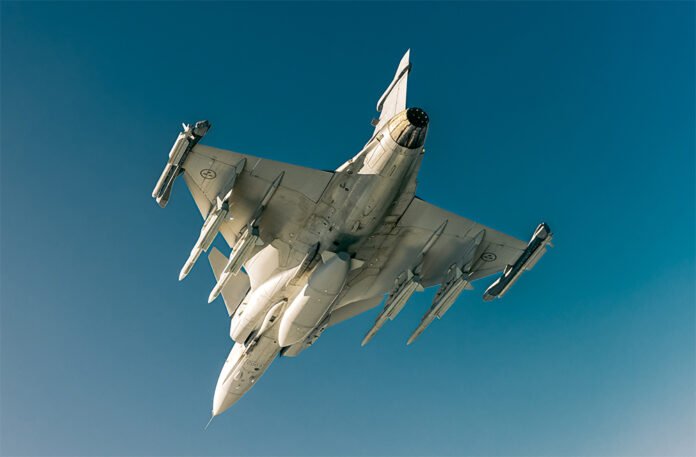
Saab and GKN Aerospace have agreed to deepen their work on the propulsion system for Sweden’s Gripen E/F fighter, positioning GKN as Saab’s preferred provider of engine services for the aircraft.
Announced on October 8, the long-term agreement covers propulsion support, capability development and contributions to Saab’s international Gripen campaigns. The companies said it provides a framework for closer cooperation and is intended to strengthen the fighter’s proposition for Swedish and overseas customers. They did not disclose the agreement’s financial value or a timetable for expanding specific technical activities.

The move follows a Swedish government decision to strengthen national capability and expertise related to the engine. Saab said the government tasked it and GKN with jointly creating the conditions to meet that objective. Under the agreement, GKN is expected to assume a progressively larger role, supplying expertise, capacity and technical support to the Gripen E/F programme.
The agreement expands an established partnership rather than introducing a new engine or replacing its manufacturer. The Gripen E/F is powered by the General Electric F414G, known in Sweden as the RM16. GKN has already developed RM16 support capabilities in Sweden; in 2022, it reported the first RM16 engine run at its test facility in Trollhättan. The new deal broadens the companies’ collaboration into longer-term capability development and wider support for Gripen operators.
GKN’s history with the Gripen’s earlier C/D variant offers a precedent for domestic engine expertise. The company holds the type certificate for the RM12, a Swedish-developed engine based on the GE F404, and provides maintenance and technical support for it. Saab and GKN have collaborated on that engine; the new arrangement extends their work to the E/F propulsion system.
For Sweden, a larger domestic support role could help build know-how and sustainment capacity around a key aircraft system. It could also strengthen the industrial network supporting the Gripen in service. Saab says GKN’s role will include contributions to international campaigns, while the companies say they will continue exploring ways to build long-term Swedish capability. The agreement, however, does not announce a transfer of complete-engine production or specify which additional technical responsibilities GKN will take on.

That distinction matters: deeper Swedish involvement in support is not the same as changing the engine’s origin. General Electric remains the F414G’s manufacturer, and Saab’s agreement with GKN concerns cooperation, support and capability development. The public announcement leaves open how far those activities will ultimately extend, and how the work will be divided between the companies.
The partnership also comes amid continued international activity around the Gripen programme. Saab’s recent announcements include the first Brazilian-produced Gripen E’s maiden flight, while the new agreement explicitly includes support for the company’s international campaigns. Expanding domestic engine expertise could therefore serve both Sweden’s own fleet and efforts to support current and prospective operators abroad, although the companies have not provided details of specific export-related tasks.

For now, the agreement establishes a framework rather than a detailed public work plan. Its significance will depend on the responsibilities, technical capabilities and support capacity that Saab and GKN develop under it. The immediate direction is clear: Sweden wants stronger national expertise around the Gripen E/F engine, and the two companies are being tasked with helping build it.






