


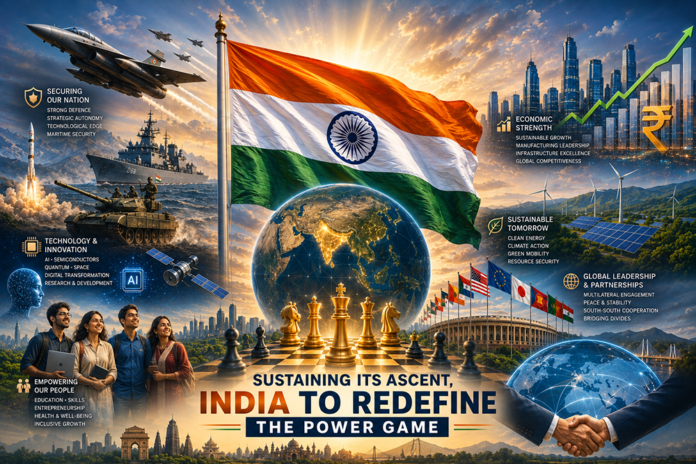
Every Independence Day invites a national accounting. We measure the distance travelled since 1947 in the familiar currencies of nationhood, output, arms, borders held, poverty pushed back. Honestly, the most consequential shift of the past decade can’t really be captured by any of these numbers because the measurements themselves feel obsolete, like an outdated yardstick. India’s move from an emerging power to a true global power is stunning, not just because of how far the country has come, but because of what it quietly reveals. That whole idea of power is being rewritten in the twenty-first century, and India is probably the clearest case study of that whole rewriting, too.
For most of modern history, power was accumulative. A nation grew strong by amassing things, territory, population, factories, gold, warships, colonies. Strength was a stockpile. The great theorists of international relations, from Morgenthau to Waltz, read the world through this lens: count a state’s resources and you could estimate its weight. By that arithmetic, India’s rise is impressive but unexceptional, one more large economy climbing the tables.

The arithmetic misses the point. What India has built over the past decade is not a larger stockpile but a different power altogether, systemic power, the capacity to organise complex systems rather than simply to possess resources. This is the deeper story of the decade of transition, and its implications reach far beyond India’s borders.
Consider the conventional wisdom about globalisation, which held for a generation that global markets shrink the state. Governments, we were told, become facilitators, referees, at best custodians of a game whose rules are set elsewhere. India inverted this logic
Consider the conventional wisdom about globalisation, which held for a generation that global markets shrink the state. Governments, we were told, become facilitators, referees, at best custodians of a game whose rules are set elsewhere. India inverted this logic. It built domestic platforms, plus a unified payments setup, a digital identity backbone, one goods and services tax, and then production incentives for strategic sectors, and after that it basically used those same platforms to pull in global capital, technology, and collaborative partnerships. The integration that followed didn’t just drain the state; it kept it fed and even stronger. More revenue, better data, deeper industrial capacity flowed back and strengthened the very institutions that had launched the platforms. Here globalisation is not a constraint but an instrument, a tool the state wields for its own construction.
This describes a state that has stopped trying to control everything and learned instead to orchestrate. It sets standards, builds infrastructure, and lets others compete within frameworks it designs. Its influence no longer rests on ownership but on integration, on being the operating system upon which many actors run.
Classical geopolitics always prized reach, bases, sea lanes, the projection of force outwards, the whole loud business. India has gone a different way though: depth, the almost boring work of becoming harder to pressure, coax, or straight up coerce. Energy flows from Russia, the Gulf, the United States, so a single supplier can’t hold a veto over the whole thing
The strategic posture that follows is equally novel. Classical geopolitics always prized reach, bases, sea lanes, the projection of force outwards, the whole loud business. India has gone a different way though: depth, the almost boring work of becoming harder to pressure, coax, or straight up coerce. Energy flows from Russia, the Gulf, the United States, and renewables, so one supplier can’t really hold a veto over the whole thing. Technology partnerships keep stretching across Washington, Tokyo, Paris, Tel Aviv, and Taipei, which suggests that no single ecosystem gets to turn off the lights. And trade corridors keep multiplying, so even if one path is constrained, there’s usually another way around, or through, or alongside. This is a fortress with open gates, deeply enmeshed in the world, yet structurally resistant to pressure from any part of it. Resilience, in this reading, is not defensive timidity. It is a form of power, because it makes coercion prohibitively expensive.

As India’s capabilities are modular – a digital module, an energy module, a defence-export module, a climate module – they can be deployed independently, with different partners, for different ends. India can work with one power on semiconductors, another on energy, a third on trade, a fourth on climate, without any single relationship holding the others hostage. This is not the old search for a bloc to belong to. It is portfolio management: foreign policy run as an exercise in diversification and risk-adjusted return rather than loyalty. The objective is not to pick a side but to remain indispensable to all sides.
As India’s capabilities are modular – a digital module, an energy module, a defence-export module, a climate module – they can be deployed independently, with different partners, for different ends. India can work with one power on semiconductors, another on energy, a third on trade, a fourth on climate, without one tie-up holding the others hostage
Indispensability, in fact, is the through-line. The influence India increasingly exercises is embedded rather than episodic. Traditional diplomacy produces spikes, a summit, a treaty, a crisis, that fade. Embedded influence runs continuously, through the payment rails other countries adopt, the digital-identity architectures they emulate, the supply chains and training contracts that tie their operations to India’s over years. Once a partner builds on your infrastructure, exit becomes costly. This is influence without coercion, the power of being structurally necessary.

Set beside the other great models of statecraft, the distinctiveness sharpens. The United States has long projected power as the hegemon of markets; China as a state capitalist commanding its economy from the centre; the European Union as a regulatory power exporting its rules. India is doing something else, becoming an orchestrating state, deriving strength not from dominating markets, directing firms, or dictating regulations, but from convening, coordinating and connecting. Its sovereignty is being quietly redefined in the process. That Westphalian idea basically treated sovereignty as control over your own territory and, uh, non-interference in other places. But India is now increasingly practising a sovereignty of influence: it’s not just the capacity to say no, or to refuse to play. It’s more like the ability to shape the platforms and the standards that other actors end up choosing to join, or adapt to, over time.
The question of what it means to be a great power in this century must be answered afresh. India’s experience offers one answer: greatness now lies in the ability to organise, coordinate and sustain complex transnational systems while keeping domestic resilience and strategic optionality intact
Underneath all of this lies a single, more fundamental shift. The organising logic of the state is moving from optimisation to adaptation. Twentieth-century states sought the optimal equilibrium, the most efficient factory, the ideal alliance, the perfect plan, under conditions assumed to be stable. But stability is gone. In a world where technological acceleration never really slows, where supply-chain shocks, cyber conflict, and compressed decision cycles stack up like layers, the decisive advantage doesn’t go to the state with the neatest plan. It goes to the one that can learn, reconfigure, and basically evolve faster. Redundancy, diversification, modularity, and institutional flexibility, once treated like inefficiencies, start looking like adaptive investments, like a living system that keeps retooling itself. The point is no longer to predict the future but to build systems that function across many possible futures.
This is why India’s decade matters to the world, and not only to Indians. If power is no longer chiefly about territory, resources or military mass, but about orchestration, network centrality, credibility and the capacity to adapt, then the question of what it means to be a great power in this century must be answered afresh. India’s experience offers one answer: greatness now lies in the ability to organise, coordinate and sustain complex transnational systems while holding domestic resilience and strategic optionality intact.
Nearly eight decades after independence, then, India is doing more than joining the ranks of great powers. It is quietly helping to redefine what that rank means, a prototype of a new category of statecraft that other middle powers may emulate and that every great power will have to reckon with. The stockpile era is ending. The age of the orchestrating state has begun.

The writer is an expert on geopolitics, national security, and counter-terrorism; and he regularly contributes his subject thought-leadership and academic commentary with several publications in newspapers, journals, and periodicals. He works with investigative agencies, regulatory bodies, financial institutions and enterprises, providing strategic and regulatory advisory. The views expressed are personal and do not necessarily carry the views of Raksha Anirveda





