


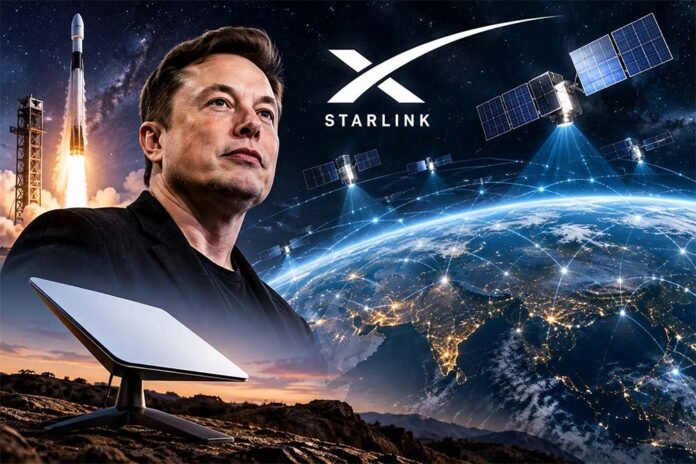
Starlink has held a satellite communications licence since 2025, along with an IN-SPACe authorisation. It still lacks spectrum and final security clearance, and those two factors determine whether a single terminal can legally connect a customer.
In June, Bloomberg reported that security agencies under the Home Ministry had withheld final clearances after reports that Starlink terminals were used in the Iran conflict in a country where the company held no licence. Starlink called the report misleading and said talks were ongoing. On October 8, Elon Musk called the delay in spectrum and security clearances a crime against India’s people. The Ministry of Communications replied that the framework is fair and the charge baseless.

On October 8, Elon Musk called the delay in spectrum and security clearances a crime against India’s people. The Ministry of Communications replied that the framework is fair and the charge baseless
The Real Objection is Control
Nobody doubts that Starlink works, and that is exactly why planners worry. Thousands of low-orbit satellites serve terminals the size of a laptop, owned by a private American company whose founder often announces decisions on X. India’s question is plain. When a crisis pulls the interests of that company, the United States and India in different directions, who decides whether the signal stays on?
Recent history gives the question teeth. Accounts from 2022, when Starlink coverage near Crimea was reportedly restricted during a Ukrainian operation, showed a commercial operator deciding the timing of a military action. Musk has disputed parts of that account, but the structural point holds. The Iran reports point the other way: terminals reportedly worked where the company said it had no licence. A network its owner can switch off is also one its owner can leave on. Both are a loss of control.
Three Technical Worries
First, terminals the state cannot see: Industry sources have told reporters that India has no reliable way to detect Starlink terminals operating inside the country. A mobile network can be located and intercepted. A dish talking straight to a satellite leaves little ground infrastructure. In December 2024, the Army recovered a purported Starlink device in Manipur, and a terminal turned up in a drug seizure in the Andamans. Musk said the service was never active in India. The episode still shows how a terminal bought elsewhere can surface where the state has no visibility.
Bharti-backed OneWeb and the Jio-SES venture received approvals earlier, and both rely on foreign satellite operators. If security is the reason for caution, the same questions apply to them, and they must be asked openly. Otherwise, a security decision starts to look like a commercial one wearing a uniform, and that costs India more with investors than any delay
Second, laser links: Newer satellites can relay traffic between themselves without touching a ground station. That is my reading of the technology, and engineers should test it. But it suggests that gateways on Indian soil offer less assurance than they sound.

Third, the company’s ties to Washington: SpaceX reportedly does classified work for US intelligence agencies and sells a military variant, Starshield. Minister Jyotiraditya Scindia said in November 2024 that no licence would be granted until Starlink met every security norm. That was the right standard then, and it is the right one now.
Why War Changes the Arithmetic
Ukraine has shown what a low-latency link that is hard to jam can do on a battlefield. Drone video, artillery corrections and command traffic ride on a commercial service. A planner reads that and sees a force multiplier for whoever has access and an exposure for whoever depends on it. Unauthorised use by Russian units has also been reported, a reminder that the hardware serves whoever gets hold of it.

Now set that against India’s geography: a long land border with two adversaries, a restive northeast, and island territories far from the mainland. A terminal that connects a village in Ladakh can as easily carry an insurgent’s video feed from a forward ridge. In those places, unmonitored connectivity is a security matter before it is a consumer service.
What a Sovereign Rule Set Looks Like
India’s conditions reportedly include local data storage, Indian gateways, lawful interception, and the power to restrict service in sensitive areas. Starlink says it has built 20 gateway sites in India and will keep user data within the country. The most important item is missing from that list: the override.
As far as I can tell, India still has no home-built low-orbit broadband constellation at meaningful scale, and today’s partnerships rely on foreign capacity. Until that changes, India negotiates as a customer
Hardware on Indian soil does not settle who holds final authority over a constellation under foreign jurisdiction. India should ask for three things in writing, with penalties. Terminals that refuse to work outside authorised zones. An Indian-controlled way to deactivate any terminal on Indian territory. And a live test of both before commercial launch, not after.
The Other Side of the Argument
Delay is not free. Millions of Indians in villages, hill districts and border areas still face poor connectivity, and Starlink’s pitch is that it can close that gap quickly. Musk’s monopoly complaint deserves a hearing too. Yet New Delhi eventually backed administrative spectrum allocation, the route Starlink lobbied for, over the auction that Airtel and Jio wanted. That runs counter to the idea that incumbents simply won.
There is also a consistency test. Bharti-backed OneWeb and the Jio-SES venture received approvals earlier, and both rely on foreign satellite operators. If security is the reason for caution, the same questions apply to them, and they must be asked openly. Otherwise, a security decision starts to look like a commercial one wearing a uniform, and that costs India more with investors than any delay.
What India Should do
Publish the conditions with a date. Apply them equally to an American firm, a European firm, and an Indian joint venture. And use the wait to build. As far as I can tell, India still has no home-built low-orbit broadband constellation at meaningful scale, and today’s partnerships rely on foreign capacity. Until that changes, India negotiates as a customer.
Controlling the signal matters in modern war. But control means little unless India holds the switch. That should be proven before the first terminal goes live, not promised afterwards.

The writer, a PVSM, AVSM, VSM has had an illustrious career spanning nearly four decades. A distinguished Armoured Corps officer, he has served in various prestigious staff and command appointments including Commander Independent Armoured Brigade, ADG PP, GOC Armoured Division and GOC Strike 1. The officer retired as DG Mechanised Forces in December 2017 during which he was the architect to initiate process for reintroduction of Light Tank and Chairman on the study on C5ISR for Indian Army. Subsequently he was Consultant MoD/OFB from 2018 to 2020. He is also a reputed defence analyst, a motivational speaker and prolific writer on matters of military, defence technology and national security. The views expressed are personal and do not necessarily carry the views of Raksha Anirveda





