


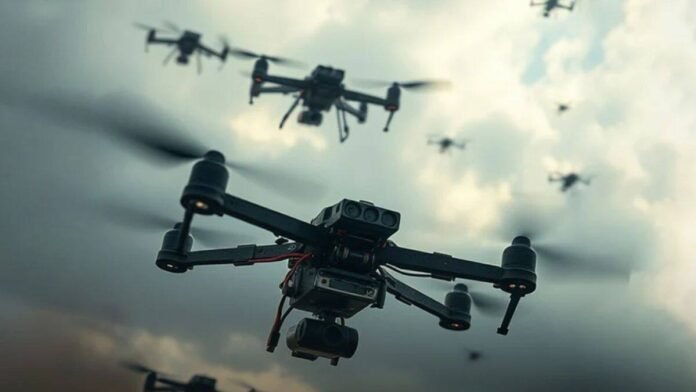
The modern battlefield has undergone a profound structural shift, proving that the side controlling low-altitude airspace with nimble, massed aerial networks can systematically outmanoeuvre conventional military capabilities.
Recognising this operational reality, India is finalising its largest-ever domestic procurement programme for unmanned aerial systems (UAS), planning to issue contracts worth over $2 billion (exceeding 200 billion Indian rupees) to domestic manufacturers.

According to Smit Shah, president of the Drone Federation of India – an industry body representing more than 550 aerospace companies – the massive acquisition initiative is in its advanced stages of planning.
This monumental wave of procurement represents an extraordinary jump from recent defence transactions, significantly outpacing the government’s recent emergency tactical drone orders, which totaled approximately 30 billion rupees ($313 million).
To match the breakneck speed of global technological change, the armed forces will bypass standard bureaucratic delays by routing these contracts through fast-track and emergency procurement mechanisms, demanding complete manufacturing deliveries within a compressed timeline of 18 to 24 months.
Lessons from Global and Regional Flashpoints
This aggressive shift in defence spending is directly informed by immediate geopolitical friction. Indian military planners carefully analysed large-scale border skirmishes with arch-rival Pakistan in May of last year, a conflict that marked the first time both nations deployed unmanned aerial networks at a massive, coordinated scale.

The operational lessons from that theater, combined with the devastating effectiveness of low-cost first-person view (FPV) kamikaze systems and loitering munitions in the Ukraine and West Asia conflicts, have permanently transformed New Delhi’s tactical doctrine.
The realisation that a commercially built drone costing a fraction of a precision-guided missile can reliably destroy multi-million-dollar armour and radar installations prompted the Ministry of Defence to act.

In March, the Defence Acquisition Council granted Acceptance of Necessity for a massive capital acquisition envelope worth 2.38 trillion rupees ($24.85 billion) focused on transport aircraft, advanced missile systems, and a dedicated segment for armed “remotely piloted strike aircraft.”
From Assembly to Industrial Sovereignty
The impending multi-billion-dollar injection is poised to fundamentally restructure India’s rapidly growing drone industry, which has expanded to include over 600 companies and component manufacturers, with more than 100 private enterprises entirely dedicated to engineering defence applications.
The market spans established industrial giants like the Tata Advanced Systems, Adani Group, and Larsen and Toubro, alongside specialised, high-growth defence tech firms and startups including ideaForge, Newspace Research, and Asteria Aerospace.
However, defence experts warn that true sovereignty cannot be achieved through simple assembly. The massive scale of the upcoming $2 billion order provides the industry with the necessary financial runway to invest deeply in the domestic creation of sensitive components.
By moving beyond imported parts, local manufacturers are using this pipeline to build indigenous flight controllers, advanced electric propulsion systems, thermal imaging sensors, and encrypted satellite communication links.
To sustain this momentum, the government has re-engineered its previously slow procurement process, utilising swift acquisition pipelines under the updated Defence Acquisition Procedure to compress multi-year cycles into mere months.
Simultaneously, the Ministry of Defence has expanded funding initiatives like the Innovations for Defence Excellence (iDEX) scheme. By directly financing early prototypes, relaxing rigid testing frameworks, and encouraging the services to issue repeat and interim orders, the defence establishment is allowing startups to rapidly refine their products in real-time.
This structural predictability has finally unlocked a surge of venture capital funding and prime-to-startup partnerships, transforming India’s uncrewed aviation sector into a highly resilient defence technology ecosystem.






