


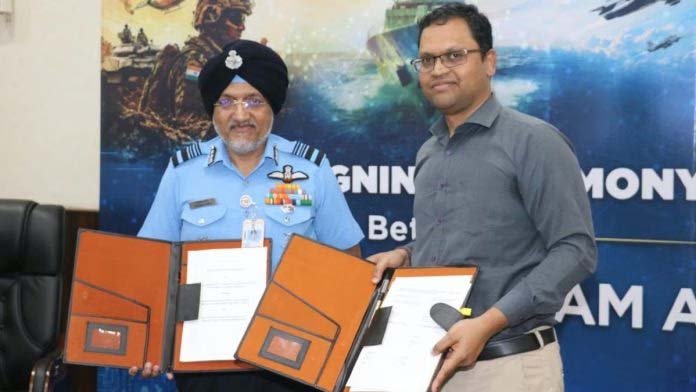
New Delhi: The memorandum of understanding creates an umbrella for multiple projects across the three services and joint, tri-service and integrated organisations under HQ IDS. Sarvam will design, develop and deploy applications for operational, training and decision-support needs, and provide follow-on technical support. HQ IDS will facilitate work with the services. The agreement does not announce a single system or disclose project budgets, deployment dates or locations.
Sarvam said the services and joint organisations will have access to shared foundation models, agentic infrastructure and geospatial and perception systems. The stated areas of work include decision support, target acquisition and data fusion across the “sensor-to-shooter loop” – the process connecting information from sensors to operational response. The company says human oversight will be retained over operational decisions, and that the AI systems are intended to run on sovereign infrastructure.

The work will be handled by Chanakya, Sarvam’s division focused on national security and defence. Its AI stack includes Sarvam 105B, the company’s large language model. Sarvam co-founder Pratyush Kumar described the partnership as an opportunity to develop Indian-built AI for national defence. The company says the projects could include an “AI fabric” connecting elements of defence capabilities, though it has not detailed what systems or data that fabric would connect.
The wording of the agreement matters: it establishes a framework for collaboration, not evidence that new AI tools have already been deployed across all three services. Individual projects and their technical specifications remain undisclosed. Nor has Sarvam published financial terms. The announcement therefore signals a pathway for development, while leaving open the questions of what will be built first, how performance will be assessed, and when service personnel might use the resulting applications.
There is a recent example of Sarvam technology in a military education setting. The Defence Services Staff College in Wellington launched DRONA 2.0 in August, integrating Sarvam 105B with open-source models for research and training. Reports said the system supports document analysis, speech functions, translation and data analytics, and was trained on the college’s academic material. DSSC and Sarvam also signed a separate agreement for further collaboration. That earlier project is distinct from the new HQ IDS framework; the public announcement does not say DRONA 2.0 is being extended to the three services under this MoU.
The new framework also fits the government’s wider push to develop domestic AI capacity. The IndiaAI Mission has supported work on Indian foundation models, including Sarvam’s, according to public reporting. That programme is separate from the defence agreement: no public details establish that IndiaAI Mission support will fund the military projects. Sarvam’s stated emphasis on Indian models and sovereign infrastructure echoes the government’s broader aim of reducing reliance on external technology in strategically important areas.

Putting AI into military settings brings practical questions beyond model capability. Systems used to combine data or inform decisions need to perform reliably with relevant information, and users need ways to assess outputs and maintain human control. The company’s stated commitment to oversight addresses one aspect of that challenge, but the announcement provides no details about testing, safeguards, access controls or the handling of errors. Those implementation details will be important as projects move from an umbrella agreement to specific applications.
For now, the agreement gives Sarvam a formal route to work with HQ IDS across India’s three armed services. Its significance will depend on the projects that follow: their scope, security arrangements, validation and eventual use in training or operations.








