


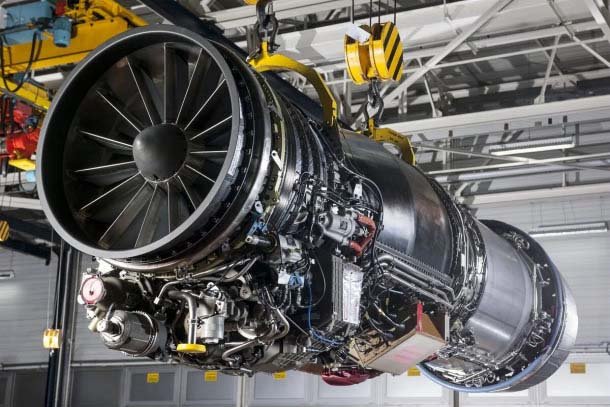
Safran India chief executive Jetendra (JS) Gavankar has said the company is in active discussions with the Indian government over a proposed advanced fighter-jet engine, underlining the strategic importance of propulsion to New Delhi’s fifth-generation combat-aircraft ambitions.
Speaking at News18’s DEFCON 2026, Gavankar said Safran viewed India as a long-term strategic partner rather than simply a market for selling aircraft equipment. The company, he said, employs roughly 3,500 people in India and expects its workforce to grow by about 30 per cent next year.

The proposed fighter engine is intended to support India’s Advanced Medium Combat Aircraft, or AMCA, a twin-engine stealth fighter being developed for the Indian Air Force. India wants a high-thrust powerplant for later AMCA variants, known as the Mk2, after relying initially on imported engines for early aircraft.
Under the model being discussed, Safran and India’s Defence Research and Development Organisation would jointly design and develop a new engine in India. The programme would go beyond licensed production or final assembly by giving Indian engineers access to advanced design, testing, manufacturing and maintenance capabilities.
Gavankar said Safran had already signed a contract with Hindustan Aeronautics Limited for a turboshaft engine to power the Indian Multi-Role Helicopter programme. The arrangement is structured around roughly equal design and development responsibilities, after which the engine is expected to be built and certified in India.
The helicopter project is significant because it offers a practical test of the co-development approach. HAL and Safran would integrate the engine, establish local production and potentially create export opportunities for a powerplant in a market category with limited alternatives, Gavankar said.

The fighter-engine proposal is more technically demanding. Modern turbofans require expertise in hot-section design, high-temperature materials, turbine blades, cooling systems, compressors, control software and precision manufacturing. These technologies determine not only thrust, but also fuel efficiency, reliability, range, heat management and the aircraft’s ability to sustain high performance.
India’s need for outside expertise reflects the difficulties faced by its indigenous Kaveri engine programme. Although the project helped develop national capability in gas-turbine design and testing, it did not achieve the thrust required for a frontline fighter. Indian combat aircraft consequently continue to rely on foreign engines, including Russian, American and French designs.

Safran has offered what it describes as complete technology transfer for a new engine, including sensitive hot-section and turbine technologies. Reports indicate the proposed powerplant would belong to the 120-kilonewton class, with India retaining ownership of the resulting intellectual property.
That offer is strategically important because access to core engine technology has historically been more restricted than access to airframes or weapons. India has frequently manufactured foreign-designed systems locally, but without full control over source technologies, upgrades or critical components. A jointly owned engine could reduce that dependence across the aircraft’s lifecycle.
Safran is not the only contender. Britain’s Rolls-Royce has also offered to co-develop an Indian fighter engine with full intellectual-property rights. Its proposal includes domestic design, engineering, testing, certification and future upgrades, with ground testing targeted for 2032 and a first flight planned for 2034.
The competition gives India greater leverage, but it also creates a demanding decision. The government must weigh development schedules, cost, technology depth, industrial participation and the credibility of promised knowledge transfer. Engine programmes routinely take more than a decade and require extensive prototype testing before certification.
For the AMCA, the immediate requirement is operational progress. Early variants are expected to use GE F414 engines, while the indigenous or jointly developed powerplant would serve later versions. Analysts say the choice could shape India’s aerospace industry well beyond one fighter, influencing naval aircraft, unmanned systems and future sixth-generation programmes.
Safran’s latest statement therefore signals more than a commercial negotiation. It points to a possible shift from assembling imported propulsion systems to building an Indian-owned fighter-engine ecosystem – if discussions can be converted into a formal agreement and delivered on schedule.






