


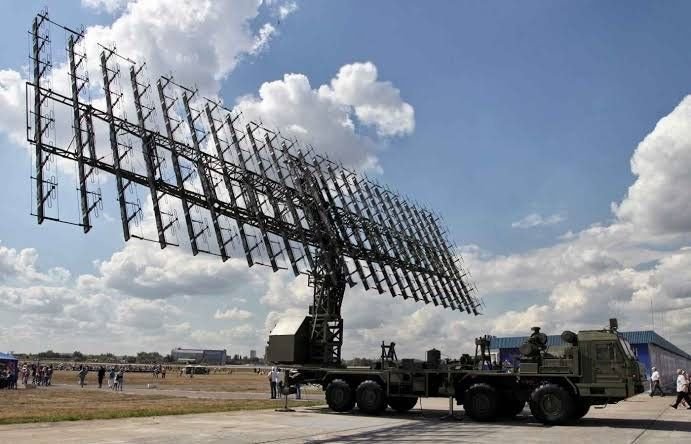
New Delhi: India has quietly inducted the Russian-made Nebo-UM VHF-band radar into its air defence network, a system capable of detecting stealth aircraft and missiles at ranges up to 600 kilometres. Despite no official announcement of contracts or costs, its presence in Indian Air Force exercises confirms operational deployment, significantly strengthening India’s early warning capability against advanced aerial threats.
The Russian-origin Nebo-UM (55Zh6ME) is an advanced mobile 3D Very High Frequency (VHF) early-warning radar. Designed to detect low-observable stealth aircraft, ballistic missiles, and hypersonic targets at long ranges , it serves as a critical first layer in integrated air defence networks. The Nebo-UM radar is a Russian-origin system developed by the Nizhny Novgorod Research Institute of Radio Engineering, part of Almaz-Antey. It is a mobile three-dimensional phased-array radar operating in the Very High Frequency band, specifically between 133–144 MHz and 216–225 MHz.

Unlike conventional higher-frequency radars, its longer wavelengths interact differently with stealth aircraft, reducing the effectiveness of radar-absorbent materials and stealth shaping. This makes it particularly effective against fifth-generation fighters. The radar has an instrumented detection range of up to 600 kilometres, with the ability to track stealth aircraft at distances exceeding 250 kilometres under favourable conditions. It can also detect cruise missiles and ballistic missiles, providing valuable early warning for India’s layered air defence network. The system is capable of tracking targets flying at speeds up to Mach 6.4 and altitudes exceeding 80 kilometres, covering a wide spectrum of aerial and missile threats.
Mounted on heavy 8×8 wheeled vehicles, the Nebo-UM is designed for rapid deployment and mobility. This allows it to be repositioned quickly across operational sectors, enhancing survivability against anti-radiation missile attacks. Its mobility also supports flexible deployment along contested border corridors, particularly in regions facing advanced stealth threats.
Once deployed, the radar automatically detects and tracks targets, calculates flight parameters, performs Identification Friend or Foe procedures, and transmits real-time data to India’s Integrated Air Command and Control System.
The radar functions primarily as an early warning sensor rather than a fire-control system. It cannot directly guide missiles but provides precise target cueing to other sensors and long-range surface-to-air missile systems such as the S-400 and MRSAM networks. This layered integration ensures that once stealth aircraft are detected, higher-frequency radars and interceptor aircraft can be vectored to engage them effectively.

India’s induction of the Nebo-UM reflects a deliberate strategy to strengthen its surveillance grid against stealth threats. While indigenous projects such as the Surya radar are under development, the Nebo-UM provides an immediate capability boost. Its quiet introduction, without publicised contracts or declared numbers, underscores the sensitive nature of such acquisitions and the strategic importance of maintaining secrecy around deployment details.
The radar’s appearance during the Indian Air Force’s Vayu Shakti 2026 exercise confirmed its operational presence. Defence analysts noted its distinctive antenna design, which matched the Nebo-UM configuration. This revelation has sparked considerable interest among global observers, highlighting India’s growing emphasis on counter-stealth technologies.

By integrating the Nebo-UM into its air defence network, India has added a powerful tool to its arsenal. It complements indigenous systems like Arudhra, Ashwini, and Rohini, creating a multi-layered radar grid capable of detecting diverse aerial threats. The Nebo-UM’s ability to counter stealth aircraft ensures that India remains prepared against evolving challenges in the region, particularly from adversaries deploying fifth-generation fighters and advanced missile systems.






