


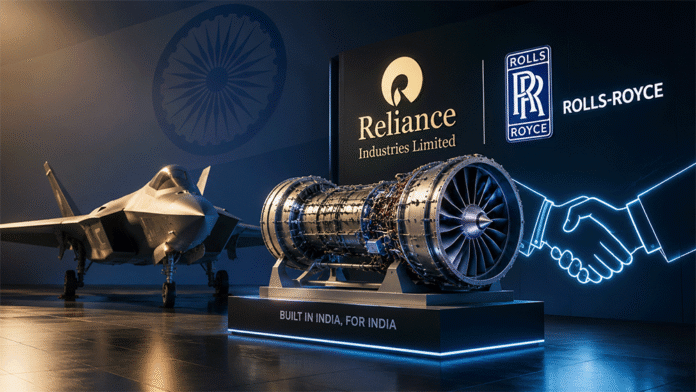
Rolls-Royce’s board has held its first meeting in India, a high-profile signal of the British engineering group’s growing focus on the country as it pursues a role in the Advanced Medium Combat Aircraft (AMCA) programme.
The visit comes as Rolls-Royce and Reliance Industries seek to develop an indigenous combat engine for the future stealth fighter. The companies announced their strategic intent to collaborate in August, proposing joint design, development and manufacturing, alongside exploration of a dedicated Aerospace Gas Turbine Complex in India. Their announcement describes an industrial proposal, not a signed engine-production contract or confirmation that they have been selected to power the aircraft.

Rolls-Royce chief executive Tufan Erginbilgiç met Prime Minister Narendra Modi during the board’s India visit. Discussions included the company’s plans and potential contributions to Indian energy and defence priorities. The board meeting, held in India for the first time, puts the company’s ambitions in the spotlight as New Delhi seeks greater domestic capacity in strategically important technologies.
The proposed partnership brings together Rolls-Royce’s engine-development experience and Reliance’s manufacturing and industrial execution capabilities. The companies say the proposed complex could support design, development, manufacturing, testing, production and through-life support. Reliance executive director Anant Ambani has framed the effort as a contribution to India’s strategic autonomy and a wider domestic aero-engine ecosystem.
Whether that proposition advances, will depend on the Indian government’s choices and the technical challenge of developing a high-performance combat engine. India’s AMCA programme is still being developed, and the engine contest is not settled. Reportedly, Rolls-Royce has submitted a proposal, while a separate Safran-Defence Research and Development Organisation (DRDO) effort is also being considered. The emergence of Reliance as an industrial partner strengthens Rolls-Royce’s offer, but does not establish that it has won the programme.
The question of technology ownership is central to India’s search for a sovereign engine. Rolls-Royce has previously said its offer would include technology transfer and Indian ownership of intellectual property developed under the project, according to coverage of its proposal. That distinction matters: local assembly alone would not give India the same ability to modify, manufacture and sustain an engine independently. The precise terms, however, would depend on a final agreement and government decision.

The proposed engine is aimed at a later stage of the AMCA programme, not its earliest aircraft. The first AMCA aircraft are expected to use the GE F414-INS6, following GE Aerospace’s selection for prototype development, testing and certification. A 2023 memorandum with Hindustan Aeronautics Limited covered potential local production of the F414. That pathway is separate from the longer-term competition to develop an indigenous engine.
Rolls-Royce’s India push also extends beyond combat aviation. The proposed gas-turbine complex is presented as a centre for broader propulsion capabilities, while the company has existing operations in the country. Building an enduring aerospace industry would require more than a headline partnership: it would depend on sustained investment, technical skills, facilities and a clear allocation of responsibilities between partners and the state.

The board visit therefore signals strategic intent, not a completed industrial transformation. For Rolls-Royce, India offers a possible role in a major future fighter programme and a deeper local footprint. For Reliance, the tie-up opens a route into advanced aerospace propulsion. For India, the stakes are higher still: turning competing proposals into a dependable engine capability under national control.






