


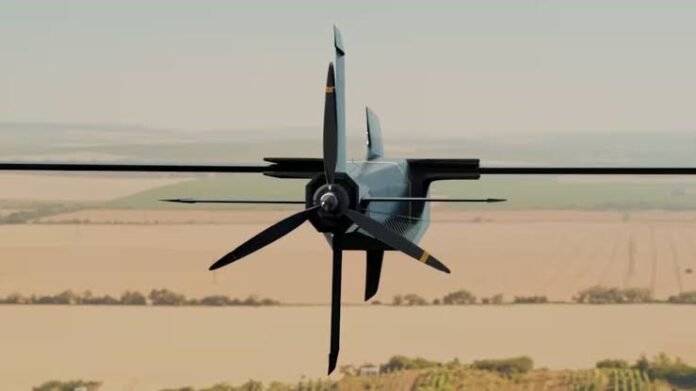
Paris. German defence giant Rheinmetall has introduced a revolutionary shipping container multi-launcher capable of deploying lethal swarms of its newly developed FV-014 attack drones onto highly dynamic modern battlefields.
The face of modern attrition warfare is shifting decisively towards massed, autonomous strike platforms. At the Eurosatory defence exhibition outside Paris, Düsseldorf, Germany-based systems provider Rheinmetall capitalised on this tactical shift by staging the world premiere of its Containerised Missile Launcher, abbreviated as the CML.

Built inside a standard twenty-foot commercial shipping container format, the modular weapon system is engineered to transport, conceal, and rapidly launch up to eighteen FV-014 loitering munitions, colloquially known as kamikaze drones. This design approach highlights a broader European push to achieve asymmetric superiority through distributed, high-volume precision fires.
Logistical flexibility and survivability form the conceptual core of the new containerised architecture. By utilising a standardised shipping container framework, the CML is entirely compatible with civilian and military transport networks, including logistics trucks, freight trains, and naval vessels.
This compatibility facilitates covert strategic movement and enables front-line units to deploy heavy fire support without establishing highly visible, stationary artillery positions. The mobile launcher is completely self-contained, equipped with its own internal battery storage and an intelligent sleep mode that allows it to sit dormant for extended periods as a standalone solution along fortified borders.
Upon receiving an encrypted digital instruction, the platform automatically awakens, transitions into active firing mode, and utilises rocket-assisted starts to eject its munitions safely into the air.

The primary payload of the system is the advanced FV-014 loitering munition system, which effectively bridges the capability gap between front-line aerial reconnaissance and conventional deep-strike artillery.
Weighing approximately twenty kilogrames, each electric-powered drone is optimised for high-volume industrial mass production and low acoustic signatures.

Once ejected from the container, the munition completes a momentary post-launch tumbling phase before extending its aerodynamic stabiliser fins to accelerate towards designated combat coordinates.
With an overall range of up to one hundred kilometres and a maximum flight endurance of 70 minutes, the platform can loiter over a general target area, maintaining constant 360-degree situational awareness via a nose-mounted gyrostabilised gimbal camera.
For target engagement, the drone deploys a four-kilogrames high-explosive dual-purpose warhead capable of penetrating over six hundred millimetres of rolled homogeneous steel armour, rendering it highly lethal against main battle tanks, heavy infrastructure, and hidden artillery emplacements.
A major technical breakthrough driving the CML platform is its advanced swarm intelligence and open software architecture. Guided digitally by the proprietary Rheinmetall Battlesuite, a single human operator can seamlessly coordinate and command multiple airborne munitions in real time.
Automated artificial intelligence routines handle the intense workloads of navigation, obstacle avoidance, and target classification, though a human commander remains strictly in the loop to authorise the final strike or abort an attack if battlefield variables shift.
Crucially, the drone operates reliably in heavily contested electronic environments with degraded satellite navigation. To foster a broader industrial ecosystem, Rheinmetall plans to disclose the physical and electronic connector interfaces inside the shipping container, theoretically allowing third-party manufacturers to design alternative, complementary munitions for the multi-launcher.
This unveiling closely follows significant procurement milestones for the system within NATO. Following successful operational demonstrations in early 2026, the German Armed Forces signed a framework agreement worth billions of euros for the FV-014, placing an initial delivery order valued at approximately three hundred million euros.
Production has already commenced at Rheinmetall’s specialised facility in Neuss, with the first major batch of mass-produced munitions scheduled to enter active service by the first half of 2027.






