


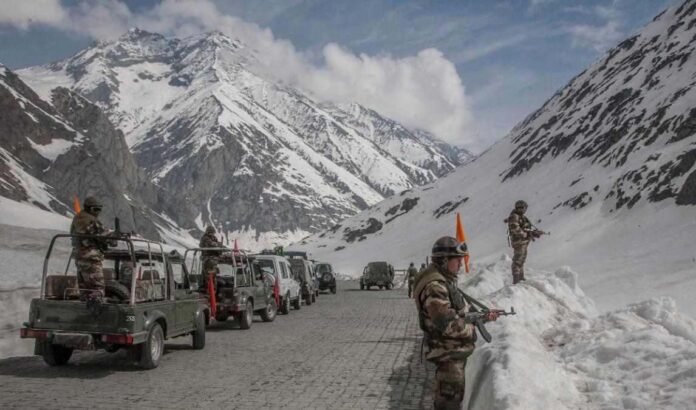
On the morning of August 1, 2026, a column of traders led their horses through the thin, cold air of the Shipki La pass in Himachal Pradesh’s Kinnaur district, watched over by soldiers of the Indo-Tibetan Border Police and sent off with ceremonial khataks by the state’s revenue minister. They had 72 hours to trade and return, carrying on a barter tradition that predates the modern idea of a border. Two thousand kilometres away, at Nathu La in Sikkim, a parallel ceremony marked the reopening of one of the last living arteries of the old Silk Route. Both crossings had been shut for six years — first by the pandemic, then by the freeze in India-China relations that followed the 2020 military standoff in eastern Ladakh. Their reopening is a modest commercial event by any statistical measure. It is also one of the more telling signals of where the relationship between the two Asian giants now stands.
A Trade too Small to Matter, yet too Symbolic to Ignore
Start with the numbers, because they are genuinely small. The last full year of border trade through these passes, 2019, generated roughly ₹49 crore worth of exchange — a rounding error against the roughly $100 billion in annual India-China trade, which flows overwhelmingly through container ships, not caravans, and is heavily tilted towards Chinese exports of electronics, machinery and chemicals. Nathu La will handle a defined list of goods; Shipki La’s exchange, unusually for the modern era, still runs on barter, with traders permitted roughly 72 items on the Indian side and 30 on the Tibetan side. No economist would call this a meaningful contribution to either country’s GDP.

The last full year of border trade through the Himalayan passes, 2019, generated roughly Rs 49 crore worth of exchange — compared to roughly $100 billion in annual India-China trade, which flows overwhelmingly through container ships, not caravans, and is heavily tilted towards Chinese exports of electronics, machinery and chemicals
But treating these passes as a trade story alone misses the point. Himalayan border trade has never been about volume. It has always been about presence — about which flags fly over which passes, which communities are allowed to earn a living across a frontier, and what a closed or open gate signals to the other side. That is precisely why the reopening, six years in the making, is being read in Delhi, Beijing, Gangtok and Shimla as more a diplomatic barometer than a commercial one.
Why Now
The timing is not accidental. The decision traces back to the 24th round of the India-China Special Representatives’ talks held in August 2025, co-chaired by National Security Advisor Ajit Doval and China’s foreign minister Wang Yi, where both sides agreed to restart trade through three passes — Nathu La, Shipki La and Lipulekh in Uttarakhand — as part of a broader, cautious thaw. That thaw has been visible elsewhere too: direct flights have been discussed, and earlier this year the Kailash Mansarovar Yatra, the annual Hindu and Buddhist pilgrimage to Mount Kailash and Lake Mansarovar in Tibet, resumed through Nathu La after its own five-year suspension. The pass reopening for trade and the pass reopening for pilgrims are, in effect, the same story told twice — evidence that the two governments are willing to let people and goods move again even while the underlying territorial dispute remains exactly where it was.
That juxtaposition is worth sitting with. Nothing about the Line of Actual Control has been resolved. Troops remain deployed in forward positions across eastern Ladakh in numbers well above pre-2020 levels, and the boundary talks that produced this trade agreement have made no public claim of a breakthrough on the core dispute. What has changed is a judgment, on both sides, that keeping the passes shut no longer served either country’s interests — and that low-stakes, high-visibility gestures like border trade can be resumed without prejudging harder questions. It is the diplomacy of the reversible step: easy to take, and just as easy to undo if the relationship sours again.
Himalayan border trade has never been about volume. It has always been about presence, about which flags fly over which passes, which communities are allowed to earn a living across a frontier, and what a closed or open gate signals to the other side. That is why the reopening is read in Delhi, Beijing, Gangtok and Shimla as more of a diplomatic barometer than a commercial one
What it Means on the Ground
For the people who actually live along these passes, the calculus is far less abstract. Sikkim’s border traders, transporters, warehouse operators, porters and small hoteliers have waited six years for a livelihood that vanished almost overnight in 2020. The state government has framed the reopening as a direct boost to employment and local investment, and a new highway linking Rongli and Menla is under construction to improve access to the pass — infrastructure spending that will outlast any single trading season. In Kinnaur, the reopening of Shipki La came with the inauguration of a new facility, the Chhuppan Trade Mart at Namgya, built at a cost of ₹1.70 crore, a small but telling sign that New Delhi is treating this as durable policy rather than a one-off gesture.

These are remote, high-altitude communities for whom cross-border exchange was, for generations, simply the local economy — wool, salt, textiles and household goods moving in both directions long before either Delhi or Beijing existed as we know them today. Six years of closure did not just cost money; it severed a rhythm of life. Its restoration, however constrained by licensing lists and 72-hour barter windows, restores something communities had been asking for since the passes shut.
A Confidence-building Measure, not a Breakthrough
It is tempting, especially in headlines, to overstate what this means for the broader relationship. It shouldn’t. Trade economists are right to note that the volume moving through Nathu La is a negligible fraction of overall bilateral trade, and no one seriously expects yak-wool and handicraft exchanges to move the needle on a $100 billion trading relationship dominated by ports, not passes. The value here is not economic but confidence-building: a low-risk way for two nuclear-armed neighbours with an unresolved border to demonstrate, in a controlled and reversible setting, that cooperation is still possible.

The Himalayan passes function as an early-warning system. When India-China relations deteriorate, the passes are among the first things to close. When the ties improve, they are among the first to reopen. They are a reliable way to read the temperature of a relationship that shaped Asian geopolitics for decades, long before it shows up in a formal joint statement or a resolved map
That is not a small thing, but it is also not a substitute for the harder work still ahead — disengagement and de-escalation along the LAC, agreement on patrolling norms, and eventually some resolution of the boundary question itself. Border trade through Himalayan passes has been suspended before, in 1962, and not restored for decades afterward. Its revival in 2026 is worth welcoming without being naive about how quickly it could be reversed if the broader relationship deteriorates again.
The Case for Paying Attention
So why should anyone outside Sikkim, Kinnaur or the foreign ministries in Delhi and Beijing care about a barter trade measured in crores rather than billions? Because these passes function as an early-warning system in reverse. When India-China relations deteriorate, the passes are among the first things to close. When they improve, even cautiously, they are among the first to reopen. Watching Nathu La and Shipki La, in other words, is a cheap and remarkably reliable way of reading the temperature of a relationship that shaped Asian geopolitics for decades — long before that temperature shows up in a formal joint statement or a resolved map.
For now, the traders have crossed, the khataks have been offered, and the horses have returned across the highest trade routes on earth carrying goods that will barely register in any national ledger. That is precisely why it is worth noticing. Some of the most important signals in international relations are the quiet ones.

The writer is an independent researcher. The views expressed are of the writer and do not necessarily reflect the views of Raksha Anirveda





