


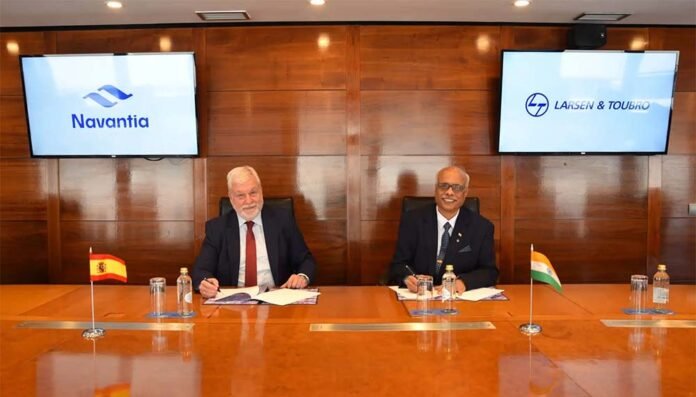
Spanish shipbuilder Navantia and Indian engineering major Larsen & Toubro (L&T) have agreed to collaborate on a proposal for the Indian Navy’s planned four landing platform docks (LPDs), adding a new partnership to a high-value competition that has yet to reach contract award.
The memorandum of understanding was signed in Madrid on October 9. The companies said the arrangement would combine Navantia’s experience designing and building naval vessels with L&T’s engineering and shipbuilding capabilities, while supporting local capacity to construct large warships. It establishes a framework for collaboration; it is not a shipbuilding contract or confirmation that the companies have won the programme.

The proposed design would draw on Navantia’s landing helicopter dock (LHD) family, which includes Spain’s Juan Carlos I and Australia’s Canberra and Adelaide. Navantia said the proven designs would provide the basis for its offering. The companies have not publicly disclosed a final configuration, price or construction schedule for an Indian version.
The difference in terminology reflects the programme’s evolution. India calls the planned vessels LPDs, or landing platform docks, while the through-deck, helicopter-operating design described in the Navy’s earlier requirements resembles an LHD. Such ships are intended to carry troops and equipment, operate helicopters and landing craft, and support amphibious operations from offshore.
Indian Navy issued a request for information in 2021 seeking proposals from domestic shipyards for four vessels. The requirement allowed Indian builders to work with overseas design or technology partners, but stipulated construction in India and a share of indigenous content. The initial information request described ships about 200 metres long, with a through flight deck and capacity for roughly 900 troops.
The government advanced the acquisition in October 2025, when the Defence Acquisition Council granted Acceptance of Necessity for LPD procurement. The council’s announcement said the vessels would help the Navy conduct amphibious operations alongside the Army and Air Force, as well as peacekeeping and humanitarian assistance and disaster relief missions. That approval is a key acquisition step, but it does not itself select a design or place a construction order.

The Indian Navy’s existing amphibious fleet underscores the operational need. It operates INS Jalashwa, a former US Navy landing platform dock, alongside landing ships and smaller landing craft. New ships would give the service greater capacity to move personnel and equipment, support operations ashore and provide a platform for helicopters and other capabilities.
Navantia and L&T are not alone in pursuing partnerships. Mazagon Dock Shipbuilders signed a teaming agreement with Swan Defence and Heavy Industries in October 2025 for the programme. Cochin Shipyard subsequently agreed to cooperate with South Korea’s HD Hyundai Heavy Industries, which is to provide support in areas including planning, procurement, productivity and personnel training. The emerging field highlights the government’s model: Indian yards lead construction, while foreign partners can contribute design and industrial expertise.

The latest pact also revives a Navantia-L&T pairing previously associated with the Indian requirement. Their new agreement formalises a collaboration around Navantia’s ship-design experience and L&T’s domestic manufacturing base. L&T executive Arun Ramchandani said the partnership could support maritime capability and greater autonomy in building complex platforms. Navantia executive Gonzalo Mateo-Guerrero said the company intended to support L&T, the Navy and other stakeholders across the ships’ lifecycle.
The contest now moves beyond announcements and partnerships to the requirements, evaluation and procurement process. The Navy will need to assess competing offers against operational needs, cost, delivery schedules and the extent of indigenous participation. Until the government selects a design and signs a contract, the Navantia-L&T proposal remains an offer-not a confirmed fleet order.






