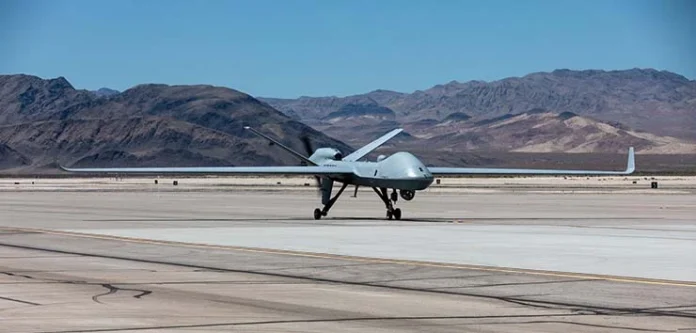
SAN DIEGO. On August 16th, General Atomics Aeronautical Systems, Inc. (GA-ASI) gave a flight demonstration to Royal Air Force (RAF) senior leadership and RAF Reaper operators, as well as guests from the U.S. Marine Corps and Royal Australian Air Force (RAAF). The flight showcased MQ-9B SkyGuardian – GA-ASI’s development RPA that the RAF’s new Protector RG Mk1 is based upon – and several of its revolutionary capabilities, including the new Certifiable Ground Control Station (CGCS), automatic takeoff, landing and taxi over SATCOM, Portable Pre/Post-Flight Equipment (P3E) and the Mission Intelligence Center.

“This demonstration was a complete success and has really built our anticipation and excitement about our new Protector RPA to a whole new level,” said RAF Group Captain Lyndon Jones, Protector RG Mk1 Programme Director. “We witnessed some exciting technologies as part of the demonstration and we’re looking forward to incorporating these innovations into our fleet when we begin taking delivery of Protector in the early 2020s.”
The flight originated from Yuma Army Airfield in Arizona where GA-ASI crews flew SkyGuardian to Nevada and required no forward-deployed aircrew or Ground Control Station (GCS). The flight received FAA clearance to fly without a chase plane, and landed using Automatic Takeoff and Landing Capability (ATLC) via SATCOM data link. It then taxied while still under satellite control from Yuma, before being turned over to GA-ASI’s Portable Pre/Post-Flight Equipment (P3E). P3E is a laptop that allows a forward-deployed maintainer to use automated pre-flight checklists to reduce pre-flight times by up to 50 percent. This capability reduces the airlift requirements by eliminating the need for a forward-deployed GCS.
“This flight demonstrated the full global expeditionary capabilities that the Protector will have when it joins the RAF fleet,” said David R. Alexander, president, GA-ASI. “In addition to RAF’s mission sets, the aircraft’s ability to fly seamlessly in civil airspace will allow it to support domestic emergencies such as fire, flood, and security related missions.”
GA-ASI’s Mission Intelligence Station provides a suite of intelligence products generated by the aircraft, including the System for the Tactical Archival, Retrieval and Exploitation (STARE). Network enabled, the Intel Station allows for the rapid assessment and sharing of imagery by the Intelligence specialist assigned to the mission.