

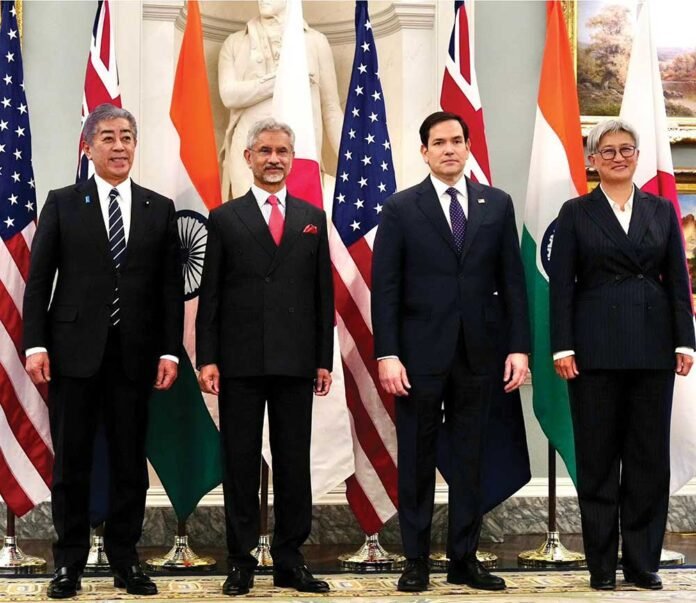
Manila/New Delhi. The four leaders of the Quadrilateral Security Dialogue (Quad) are expected to convene in Manila on the sidelines of the Association of Southeast Asian Nations (ASEAN) summit, US Secretary of State Marco Rubio said, confirming plans for the group’s first leaders’ meeting in more than two years. The date has not been finalised, and Rubio did not name the initiatives that could be announced.
Rubio told Indian broadcaster Network18 that the summit had been agreed in principle and would take place during the ASEAN gathering in the Philippines. He said Washington was enthusiastic about the meeting and expected it to produce “concrete actions” and deliverables, rather than serve only as a diplomatic occasion.

The ASEAN summit is scheduled for November 16 and 17 in Manila. Indian Prime Minister Narendra Modi, US President Donald Trump and the leaders of Japan and Australia are expected to attend the Quad meeting, though the precise timing and format have yet to be announced. Rubio’s confirmation turns earlier speculation about a Manila gathering into an agreed plan, but leaves substantive preparations to be worked out.
The Quad brings together India, the United States, Japan and Australia. It is not a formal military alliance; its agenda has included maritime security, critical and emerging technologies, economic resilience, humanitarian assistance and disaster relief. Japan’s foreign ministry describes the grouping’s work as practical cooperation intended to support a “free and open Indo-Pacific” and deliver benefits to countries across the region.
Rubio’s emphasis on tangible outcomes reflects a central challenge for the forum: turning broad areas of cooperation into initiatives that can be implemented and assessed. The leaders’ 2024 Wilmington declaration listed programmes spanning health, infrastructure, technology, maritime cooperation and regional development. Their next meeting will offer an opportunity to review progress and set priorities, but no new deliverables have yet been publicly confirmed.
The last Quad leaders’ summit was hosted by then-US President Joe Biden in Wilmington, Delaware, in September 2024. India had been expected to host the next gathering in 2025, following the commitment in the Wilmington declaration, but it did not take place. Quad foreign ministers and officials have continued meeting in the interim, keeping the partnership active even without a leaders’ summit.

Japan’s foreign ministry records leaders’ meetings through September 2024 and notes ministerial engagements in 2025 and 2026. The ministers met in New Delhi in May this year, while officials have also held discussions. These lower-level meetings allow cooperation to continue, but a leaders’ summit carries greater political visibility and can set direction across the grouping’s various workstreams.
The Manila meeting is also being watched in the context of the wider regional calendar. One report said the Quad gathering could take place days before Trump is expected to meet Chinese President Xi Jinping in Shenzhen. That timing has prompted attention to how the four governments may discuss regional security and their approach to China, although Rubio’s announcement did not identify China as the purpose of the summit.

The countries have not always approached regional issues in the same way. Analysts have noted that the Quad’s members balance shared interests with distinct national priorities, and that agreement on an agenda does not automatically ensure common positions or implementation. The group’s ability to deliver practical projects-and to sustain them beyond political announcements-will therefore be an important measure of the Manila summit’s success.
The forum’s prior work provides a menu of possible areas for further action. The 2024 declaration highlighted cooperation on maritime domain awareness, resilient infrastructure, undersea cables, critical technologies and humanitarian response. Japan’s 2026 overview also records ongoing initiatives in maritime security, disaster response and counterterrorism. These established projects could provide a basis for new commitments, but no specific package has been announced for November.
Rubio’s comments came during a visit to India, where he also addressed questions about US relations with Pakistan. He said Washington opposed terrorism but needed relationships with countries with which it had disagreements, citing Pakistan’s nuclear status and geography. His remarks touch on a sensitive concern in India, but were separate from the announcement of the Quad summit and did not signal a change in the grouping’s membership or mandate.
For New Delhi, the planned meeting offers a chance to engage directly with Washington, Tokyo and Canberra on shared Indo-Pacific priorities and to demonstrate continuity in the Quad despite the missed 2025 summit. For the other members, it provides a platform to coordinate with India, whose strategic autonomy shapes the group’s approach. Whether the leaders can announce initiatives with clear objectives, timelines and resources remains unknown.
Rubio said the gathering would happen in Manila, but stressed that the specific date was still unsettled. The announcement establishes the destination and broad timeframe, not the final programme. Until the four governments publish a schedule or identify commitments, the promised “concrete actions” remain an expectation rather than a confirmed outcome.