


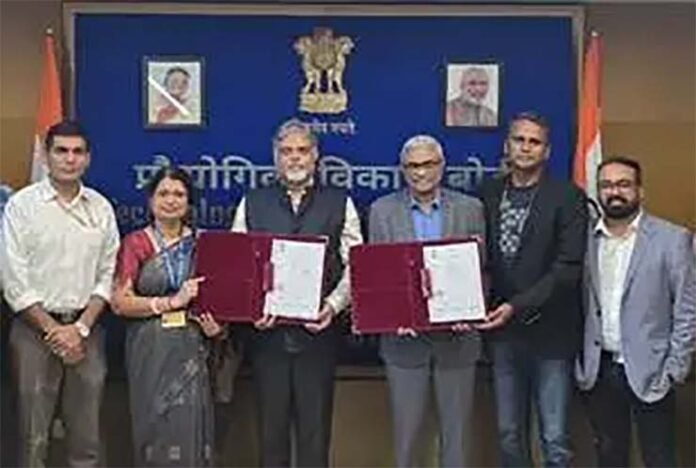
The agreement, signed by the Technology Development Board (TDB) under the Department of Science and Technology (DST), will support QNu Labs’ work on the technology backbone of India’s Quantum Secure and Sensing Networks (IQSN). The funding is approved under the government’s Research, Development and Innovation (RDI) fund, with the project intended to develop infrastructure for secure communications and quantum sensing. QNu Labs says it will contribute part of its recently raised capital to the project.
The ₹150-crore commitment is convertible debt, not an equity investment. QNu Labs’ September funding announcement said the RDI-backed financing would help build the network’s technology backbone, while the company’s ₹200-crore Series A1 equity round would support research and development, product expansion and growth in India and overseas. Together, the two financing streams take the company’s recently reported capital package to ₹350 crore, though the funding instruments and purposes are distinct.

The initiative comes as India seeks to develop domestic capabilities in quantum communication and security. Quantum key distribution (QKD), the technology used in secure quantum communications, enables two parties to establish encryption keys using quantum states of light.
Post-quantum cryptography (PQC), by contrast, uses conventional computing methods and mathematical algorithms designed to resist attacks from future quantum computers. Combining approaches could offer organisations different tools for protecting communications and migrating existing systems, although quantum-safe technologies do not remove the need for sound cybersecurity practices.
QNu Labs develops quantum-security hardware and software, including QKD systems and quantum random number generators. In a September announcement, the company said the new capital would support research and development, expansion into quantum sensing and artificial intelligence, and wider deployment across critical sectors. Its plans include contributing to the RDI-funded IQSN project. The announcement did not provide a detailed spending schedule for the ₹150-crore debt, identify all planned network routes or specify when the proposed infrastructure would become operational.
The project aligns with the broader National Quantum Mission, approved by the Union Cabinet in April 2023 with a budget of ₹6,003.65 crore for 2023-24 to 2030-31. The mission’s objectives include developing quantum computers, secure communications and sensing technologies. Among its communication targets are satellite-based secure links between ground stations over 2,000 kilometres within India, as well as inter-city quantum key distribution over 2,000 kilometres. The mission also supports research and industrial development intended to build an Indian quantum-technology ecosystem.

QNu Labs has also outlined a planned 2,000-kilometre QKD network connecting Bengaluru and Delhi under the National Quantum Mission. The company said the route is intended to secure critical financial systems along the way. That network plan and the wider IQSN backbone are related to India’s quantum communications ambitions, but public information does not establish that the two are identical projects or provide a full engineering blueprint for either.
The financing illustrates how public programmes are beginning to draw private technology companies into infrastructure development, rather than limiting support to laboratory research. It also places pressure on execution: quantum communications networks require reliable hardware, secure interfaces, trained operators and integration with existing fibre and data systems. Converting a funding agreement into operational capability will require technical validation, procurement and coordination among government, industry and potential users.

For QNu Labs, the project adds a national infrastructure component to a business that is also pursuing commercial customers. The company has said it is engaging with banks, telecom operators, government agencies and defence users, while seeking to expand sales in India and overseas. Those ambitions are separate from the government-backed network project, and the agreement itself does not guarantee commercial contracts or revenues.
The next markers will be the release of project details, network deployment milestones and evidence that the technologies can work at scale. The agreement signals government support for quantum-secure infrastructure, but its impact will ultimately depend on whether the network becomes usable, interoperable and sustainable beyond the funding phase.






