


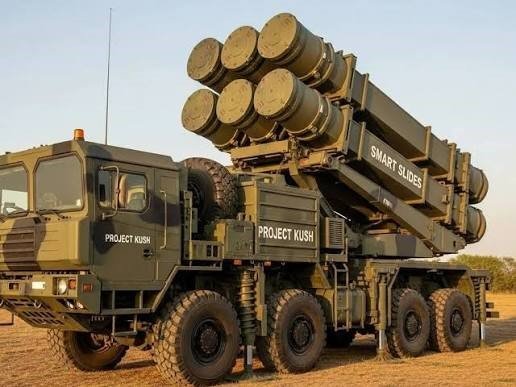
New Delhi: India’s Project Kusha has entered a decisive phase with Solar Industries contributing solid rocket motors and advanced propellants, marking a major milestone in the country’s drive for strategic autonomy in air defence.
The programme, led by DRDO, is progressing rapidly with fabricated interceptors and successful propulsion trials, aiming for induction between 2028 and 2030. India is pressing ahead with its most ambitious indigenous long-range air defence initiative, Project Kusha, also known as the Extended Range Air Defence System (ERADS).

Conceived to rival imported systems such as the Russian S-400, the programme is designed to create a multi-layered shield capable of neutralising fighter aircraft, drones, cruise missiles, and ballistic missiles at ranges of up to 400 kilometres. The system will be mobile, networked, and fully integrated into the Indian Air Force’s Integrated Air Command and Control System (IACCS), ensuring seamless coordination with existing platforms like Akash, Barak-8, and S-400 batteries.
The architecture of Project Kusha is structured around three interceptor variants, each sharing a common kill vehicle but employing different booster configurations to achieve distinct ranges. The M1 interceptor, covering up to 150 kilometres, is optimised for agile targets such as fighter jets and cruise missiles. Reports confirm that the M1 has already been fabricated and is preparing for its first integrated flight trials. The M2 interceptor extends coverage to 250 kilometres, specifically designed to engage stealth aircraft and high-speed threats. The M3 interceptor, the longest-range variant, reaches 350–400 kilometres, targeting high-value airborne assets including aerial refuellers and airborne warning and control systems (AWACS). All interceptors will be guided by advanced active electronically scanned array (AESA) radars and sophisticated fire-control systems, with simulations validating speeds exceeding Mach 5 and hit-to-kill precision against manoeuvring targets.
Solar Industries’ role as a Development-cum-Production Partner (DcPP) alongside Bharat Dynamics Limited represents a significant shift in India’s defence manufacturing ecosystem. Traditionally limited to supplying sub-systems, private industry is now integrated from design through to production.
Solar Industries brings specialised expertise in solid rocket motors and advanced propellants, contributing notably to the booster of the M2 interceptor. The company has already demonstrated its manufacturing readiness to senior military leadership, underscoring its growing role in advanced missile propulsion. Bharat Electronics Limited is also engaged as an integration partner, ensuring seamless assembly and testing of the system.

The financial scope of Project Kusha is substantial. Initially cleared with an estimated budget of ₹21,700 crore to equip five squadrons, projections now suggest potential orders could reach ₹40,000 crore, with the Air Force anticipating an eventual requirement of up to 10 squadrons. The Cabinet Committee on Security approved the project in 2022, and by 2025 fabrication of the M1 interceptor was completed. With operational induction targeted between 2028 and 2030, Project Kusha is poised to become the backbone of India’s air defence architecture.
Strategically, the programme strengthens India’s deterrence posture against regional adversaries, with systems such as China’s DF-21D and Pakistan’s Shaheen-II explicitly cited as threats. By breaking reliance on foreign suppliers, Project Kusha enhances lifecycle support, cost-effectiveness, and strategic independence.

The system also opens avenues for lucrative export opportunities in the coming decade, positioning India as a credible supplier of advanced air defence technology. The involvement of private industry under the DcPP model is expected to mature into a robust mechanism for rapid, transparent, and fair development of complex defence systems, aligning with the broader Aatmanirbhar Bharat vision.






