


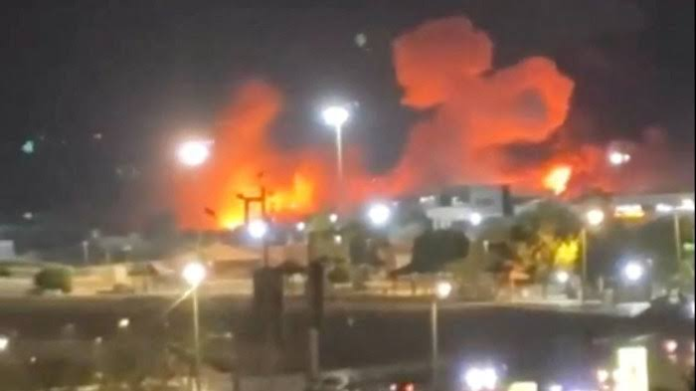
Three weeks after Washington and Tehran signed a memorandum of understanding meant to convert a fragile ceasefire into something durable, the process has not merely stalled; it has broken down into open fighting.
On Wednesday, July 8 at the NATO summit in Ankara, President Donald Trump told reporters he believed the ceasefire was “over,” dismissing further engagement with Tehran as a waste of time and describing Iran’s leadership in contemptuous terms.

His comments came hours after the two sides traded strikes overnight, following days of escalating attacks that neither Washington nor Tehran now bothers to deny. What was billed two months ago as the start of a settlement has instead collapsed into the very hostilities it was designed to end.
The immediate trigger was an attack on three commercial vessels transiting the Strait of Hormuz. The United States responded with a large retaliatory strike, hitting more than eighty targets across Iran, including air defence systems, command networks and the small boats used by the Revolutionary Guard to threaten shipping.
Iran’s response was to strike at the American security architecture in the Gulf directly, targeting US-linked interests in Kuwait and Bahrain. Iran’s foreign ministry called the American strikes a violation of the memorandum signed on June 17; Washington’s position, delivered by Trump himself, was that Iran’s attack on the tankers was the original breach.
Both governments are, for now, blaming the other for ending an arrangement that had already shown signs of exhaustion.

The immediate trigger for recent strikes was an attack on three commercial vessels transiting the Strait of Hormuz. The United States responded with a large retaliatory strike, hitting more than eighty targets across Iran, including air defence systems, command networks and the small boats used by the Revolutionary Guard to threaten shipping
The market reaction has been immediate and telling. Oil tanker traffic through Hormuz, which had been running at roughly triple the pre-ceasefire average, has effectively stopped.
Brent crude jumped more than five per cent to around 78 dollars a barrel, its highest level in two weeks, and US equity markets fell sharply on the news. The US Treasury has withdrawn the waiver that had permitted Iran to sell its oil, removing at a stroke the one tangible economic benefit Tehran had drawn from the ceasefire period.

Trump, for his part, has said further strikes are “very probably” coming, and has raised the prospect of reinstating the naval blockade that the June memorandum was meant to lift.
None of this should be read as a sudden rupture so much as the visible failure of a process that had been going nowhere for weeks. In the fortnight after the memorandum was signed, nothing had moved. No funds were released, no sanctions lifted, no clarity offered on transit rights through Hormuz.
What looked at the time like two capitals waiting for the other to blink first has now tipped into the confrontation both had spent two months claiming to avoid. The underlying gap between them was never really about oil, funds or shipping lanes. It was about time, and each side was always running out of a different kind of it.
For Trump, the clock is political and unforgiving. Roughly 18 months into what is constitutionally his final term, he has no future election to bank a deal against. If an agreement with Iran was not sealed on terms he could sell as a win, it likely never would be, and that urgency has arguably now curdled into impatience of a different, more dangerous kind.
Reports weeks earlier of Iranian officials travelling to Doha, ostensibly to meet Qatari mediators, had already sent his envoys Steve Witkoff and Jared Kushner rushing to the region, only for Tehran to deny any bilateral meeting had been scheduled. A negotiator who reveals how badly he wants a deal has already surrendered leverage, and Trump’s abrupt declaration in Ankara suggests that patience, not the deal itself, was always the scarcer resource in Washington.
None of this should be read as a sudden rupture so much as the visible failure of a process that had been going nowhere for weeks. In the fortnight after the memorandum was signed, nothing had moved. No funds were released, no sanctions lifted, no clarity offered on transit rights through Hormuz
Iran operates on a different calendar altogether. Its regime does not face the accountability of a midterm election or a term limit, and it has learned, over decades of sanctions and confrontation, that survival is best served by waiting.
The Islamic Republic can let talks drift, and even absorb strikes, without paying the domestic price a democratic government would. The precedent is instructive: the original nuclear deal, the JCPOA, took five years of negotiation among Iran and the P5+1 before it was signed in 2015, only for Trump to withdraw from it in 2017.
Expecting a comparable settlement, covering both a long-term nuclear framework and the surrender of enriched stockpiles, to be concluded within two months of a ceasefire following the killing of Iran’s Supreme Leader in February was always optimistic.
Iran has also emerged from the wider conflict less cowed than Washington may have hoped. Its military has taken real damage, but the regime is intact and, if anything, more hardline than before.
Tehran’s calculation appears to have been that dialogue served its interests chiefly because sanctions relief and restored oil exports would give the economy room to breathe, not because it felt compelled by force. That is a materially a different posture from capitulation, and it goes some way to explaining why Iran was willing to risk a return to strikes rather than move first on Washington’s terms.
For Trump, the clock is political and unforgiving. Roughly 18 months into what is constitutionally his final term, he has no future election to bank a deal against. If an agreement with Iran was not sealed on terms he could sell as a win, it likely never would be, and that urgency has arguably now curdled into impatience of a different, more dangerous kind
Washington’s difficulty is compounded by pressure from multiple directions, pressure that has not disappeared with the resumption of hostilities. Gulf states, wary of their own energy infrastructure and now directly targeted in Kuwait and Bahrain, have every reason to lean harder on Trump to contain the escalation.
European governments have offered little support for renewed military action. At home, the costs of a reignited war will be harder to justify to a public focused on inflation, and Trump’s own aides have signalled that talks could continue even as strikes resume; a contradiction that reflects Washington’s uncertainty about how far to press an advantage it is not certain it holds.
Lebanon remains an unlikely fulcrum in the broader contest, largely unresolved by the collapse in the Gulf. Iran’s concern there runs deeper than sentiment. Hezbollah is widely understood to have Revolutionary Guard personnel embedded within its ranks, and any serious degradation of the group would weaken Tehran’s regional reach considerably.
That is why Iran had made a Lebanese ceasefire, with Israeli withdrawal, a near non-negotiable precondition even before this week’s events, even as Israel signalled its intent to retain a presence in parts of the country.
Iran operates on a different calendar altogether. Its regime does not face the accountability of a midterm election or a term limit, and it has learned, over decades of sanctions and confrontation, that survival is best served by waiting
The Strait of Hormuz dispute, now the proximate cause of the breakdown, was never a minor technical matter. The June memorandum called for Iran to reopen the strait while the United States lifted its naval blockade, but Tehran wanted ships to seek its permission before transiting and objected to vessels hugging the Omani coastline to avoid its waters.
Hormuz is Iran’s single greatest source of leverage over the global economy, and no government in Tehran was ever going to relinquish practical control over it merely because an agreement’s wording implied otherwise. That the first shots came near the strait is not a coincidence; it is where Iran’s leverage and America’s exposure meet most directly.
Underlying all of this is a single, more fundamental deficit: trust. Neither side was willing to make the first concrete move in the weeks after the memorandum was signed, each fearing the other would pocket the gain and stall on its own commitments.
A military hotline existed to manage incidents, but there was no mechanism to sequence and verify the implementation of the memorandum’s terms. That absence has now been exposed in the worst possible way.
Qatar, which hosted and facilitated the indirect talks so far, may still be the party best placed to bridge the gap, provided both capitals want one bridged. Whether that is still true, with strikes reportedly being weighed again, is the question that will determine whether this becomes a pause in a wider war or its reopening.
The collapse of the memorandum does not necessarily signal the end of diplomacy. Rather, it underscores a lesson repeatedly borne out in international politics: agreements reached in haste rarely endure unless both sides see value in implementing them.
The immediate future is therefore unlikely to be defined by either full-scale war or lasting peace. More plausibly, the region will witness a familiar pattern of calibrated military action, economic pressure and intermittent diplomacy, with each side seeking to improve its bargaining position without crossing the threshold into an uncontrollable conflict
The ceasefire created a pause in hostilities, but it did not narrow the strategic distance between Washington and Tehran. Without an agreed sequence of reciprocal steps, every delay became a source of suspicion and every incident a potential trigger for renewed confrontation.
The immediate future is therefore unlikely to be defined by either full-scale war or lasting peace. More plausibly, the region will witness a familiar pattern of calibrated military action, economic pressure and intermittent diplomacy, with each side seeking to improve its bargaining position without crossing the threshold into an uncontrollable conflict.
The real contest is no longer over military capability, which both understand, but over political resolve and strategic endurance.
Ultimately, this episode is a reminder that successful diplomacy depends as much on patience as on power. Military force can compel attention and sanctions can impose costs, but neither can substitute for the slow, deliberate work of building sufficient confidence to sustain an agreement. Until Washington and Tehran find a way to reconcile their profoundly different political timelines, every ceasefire will remain less a settlement than an intermission between successive rounds of confrontation.

The writer, a PVSM, AVSM, VSM has had an illustrious career spanning nearly four decades. A distinguished Armoured Corps officer, he has served in various prestigious staff and command appointments including Commander Independent Armoured Brigade, ADG PP, GOC Armoured Division and GOC Strike 1. The officer retired as DG Mechanised Forces in December 2017 during which he was the architect to initiate process for reintroduction of Light Tank and Chairman on the study on C5ISR for Indian Army. Subsequently he was Consultant MoD/OFB from 2018 to 2020. He is also a reputed defence analyst, a motivational speaker and prolific writer on matters of military, defence technology and national security. The views expressed are personal and do not necessarily carry the views of Raksha Anirveda





