


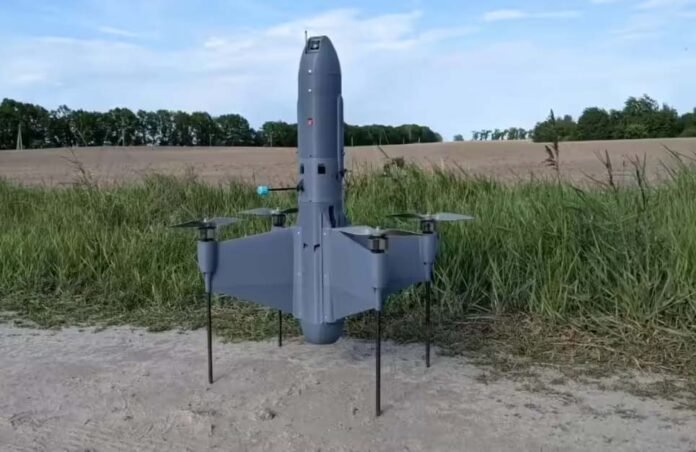
MUMBAI. Indian defence stocks witnessed renewed buying interest as Paras Defence and Space Technologies Limited announced a landmark technology licensing agreement. The Mumbai-headquartered company has entered into an exclusive Intellectual Property (IP) License Agreement with Tandem Defense LLC, a wholly owned subsidiary of US-based Autonomous Power Corporation (popularly known as “Powerus”).
The contract officially grants Paras Defence, the exclusive rights to manufacture and commercialise the cutting-edge Guardian-1 Interceptor counter-drone system within the domestic Indian market. Following the regulatory exchange filing, investor sentiment shifted heavily into positive territory, driving Paras Defence shares up by nearly 9% during intraday trading on the National Stock Exchange (NSE).

Neutralising Low-Cost Aerial Threats
The geopolitical landscape has shifted dramatically with the weaponisation of low-cost, commercial quadcopters and first-person view (FPV) drones. The Guardian-1 Interceptor, developed extensively by Powerus, was designed specifically to counter this asymmetric aerial threat.
Unlike traditional passive jamming systems, the Guardian-1 is a high-speed, battery-powered kinetic interceptor. It functions as a rapid-deployment counter-UAV (Unmanned Aerial Vehicle) asset that can track, chase down and physically neutralise incoming rogue drones before they reach critical infrastructure or military installations.
Strategic Terms and Indian Localisation
Under the stringent guidelines of the 12-month renewable agreement, Powerus has granted Paras a non-transferable and non-sublicensable license to utilise its core IP solely inside India. Paras Defence has clarified that the transaction does not involve any related parties or shareholding swaps, making it a clean, technology-driven partnership.

To maximise the impact of this technology transfer, Paras Defence has been authorised to appoint domestic partners to streamline IP management, specialised manufacturing, and regional sales operations. This localisation strategy aligns seamlessly with the Indian government’s Aatmanirbhar Bharat mandates, ensuring that final assembly and subsequent servicing happen entirely on the Indian soil.
A Layered Approach to Anti-Drone Warfare
Paras Defence is not a newcomer to the electronic warfare arena. The company already commands a presence in the local market via its subsidiary, Paras Anti-Drone Technologies, which recently launched an integrated, soldier-portable Manpack Drone Detector and Handheld Jammer for frontline troops.

The integration of the American Guardian-1 system provides Paras with a vital “hard-kill” mechanism. While its existing inventory excels at “soft-kill” measures like radio frequency (RF) jamming and GPS spoofing, the high-speed Guardian-1 interceptor introduces physical elimination capabilities. This allows the company to pitch a comprehensive, multi-layered anti-drone shield to the Indian Armed Forces, paramilitary units, and critical infrastructure operators like airports and oil refineries.
The partnership comes at a time when Paras Defence’s financial health is showing visible expansion, with the company recently reporting a net profit rise to over ₹89 crore for the previous fiscal year.
Market analysts point out that while the financial terms of the licensing deal remain undisclosed, the strategic access to proven US defence-tech places Paras in an enviable position for upcoming Ministry of Defence (MoD) procurement tenders. As the global demand for effective counter-UAS platforms spikes, the capacity to rapidly manufacture localised, high-speed interceptors could transform Paras Defence into a core exporter in the South Asian aerospace and defence corridor.






