


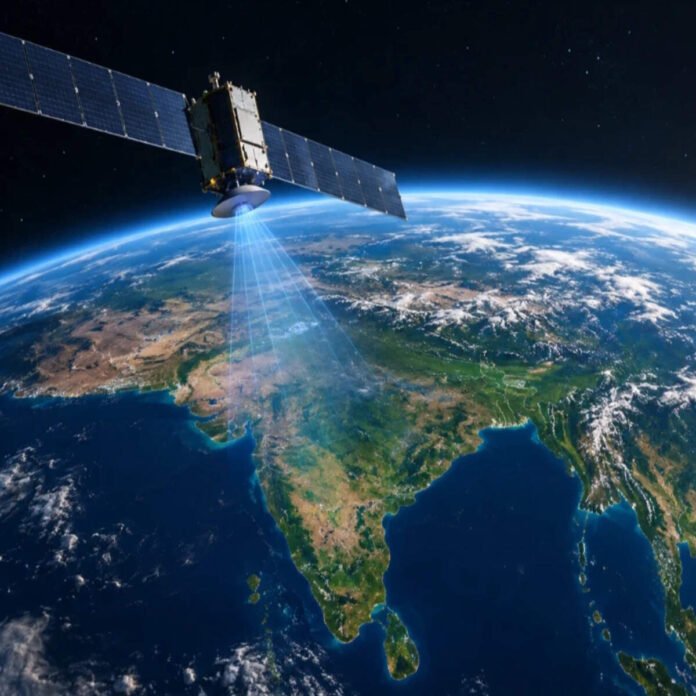
The Indian Space Research Organisation (ISRO) launched the navigation satellite aboard its GSLV-F18 rocket from the Satish Dhawan Space Centre in Sriharikota at 11.51 pm on October 30. The spacecraft was successfully injected into a geosynchronous transfer orbit, the initial stage of its journey towards its designated operating position. Its launch adds a key component to Navigation with Indian Constellation (NavIC), India’s regional satellite-navigation system.
NVS-03 carries an indigenously developed rubidium atomic clock alongside procured clocks. ISRO chairman V Narayanan said two indigenous clocks were already functioning in orbit and that the new satellite carries the third. Precise timing is essential to satellite navigation: receivers use the time taken for signals to travel from satellites to calculate distances and determine a position. A timing error can therefore translate into a location error.

The mission also advances NavIC’s next-generation capabilities. NVS-03 adds the L1 signal to the L5 and S-band signals used by the system. L1 is intended to improve compatibility with civilian navigation devices, including smartphones and wearables that support the signal. But the satellite’s launch alone does not mean NavIC will immediately become available on every consumer device; users also need compatible hardware, while the spacecraft must complete its orbital manoeuvres and enter service.
NavIC is designed to provide positioning, navigation and timing services across India and an area extending about 1,500 kilometres beyond the country’s borders. Unlike global systems such as GPS, it is a regional service under Indian control. It has applications in transport, tracking and other civilian activities, as well as strategic uses where an independent source of navigation and timing can reduce reliance on systems operated by other countries.
The launch comes after setbacks in rebuilding the constellation. Before NVS-03, NavIC had three operational satellites, fewer than the four needed for standalone positioning, according to reporting ahead of the mission. NVS-02, launched in January 2025, failed to reach its intended operational orbit after a problem prevented its propulsion system from firing. ISRO’s corrective measures following that anomaly were incorporated into preparations for NVS-03, the agency said before launch.
That makes the distinction between reaching transfer orbit and becoming operational important. NVS-03 still has to use its onboard propulsion to move from the elliptical transfer orbit into its assigned orbit. Only after the satellite reaches its slot, is checked and begins providing navigation signals can it contribute fully to the working constellation. The successful rocket injection is a major mission milestone, but not the final step in restoring satellite-based positioning services.

The GSLV-F18 mission was the 20th flight of India’s Geosynchronous Satellite Launch Vehicle. Narayanan said the turnaround between successive GSLV missions was 56 days, the shortest achieved by ISRO. The launch also continued the second-generation NVS programme, which is intended to augment and sustain NavIC. Five satellites-NVS-01 through NVS-05-are envisaged for the series, with added signals and other improvements.
For India, NVS-03 represents progress on two fronts: an indigenous timing technology in orbit and a new satellite for a navigation network that has faced technical and operational challenges. The next test will be the spacecraft’s transition to its operational orbit and its performance there. Its success would strengthen NavIC’s resilience and bring the country closer to dependable, independent regional navigation and timing services.







