


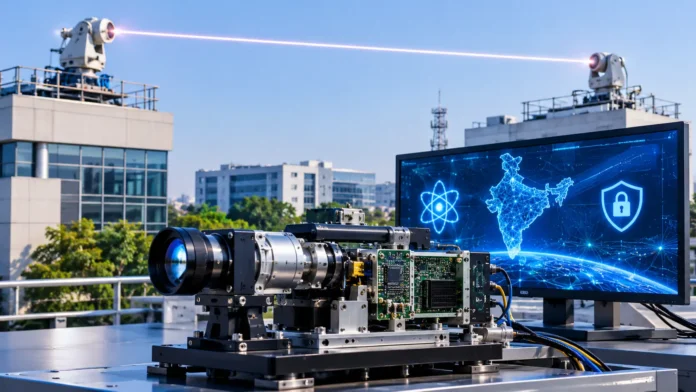
New Delhi. Indian company Nav Wireless Technologies, known as NavTech, says its OpticSpectra 10G QKD system can transmit data at speeds of up to 10 gigabits per second over free-space optical links of up to five kilometres. The company introduced the platform at India Mobile Congress 2026, positioning it for telecom, defence and other security-sensitive applications.
The system combines free-space optical communication (FSO), which sends data through the air using a directed light beam, with quantum key distribution (QKD), a method for generating and sharing cryptographic keys. Unlike fibre-optic links, FSO does not require a cable to connect the endpoints. That could make it useful for temporary connections or places where installing fibre is difficult, slow or costly.

NavTech says the system is intended to complement, not replace, fibre, radio-frequency and satellite networks. It identifies telecom infrastructure, defence networks and strategic facilities as potential users. The company has not publicly disclosed in the announcement whether the stated speed and range have been independently tested, what operating conditions apply, or when commercial deployments might begin.
The product’s performance claims also need to be considered alongside the practical demands of optical links. A free-space system needs a clear path between transmitter and receiver, and precise alignment to keep the beam on target. Weather can affect reliability: research on FSO systems identifies fog, rain, snow and atmospheric turbulence as factors that can weaken the received signal or interrupt a link. That makes backup connectivity and site-specific testing important considerations for operators assessing a deployment.
QKD is designed to distribute encryption keys, not encrypt user data by itself. It uses quantum properties to help detect interference with the key exchange, but its real-world security depends on equipment, implementation and integration with the wider network. The US National Security Agency cautions that QKD is only a partial solution: it does not authenticate the source of a transmission on its own, and requires specialised hardware and an authenticated channel.
Those caveats matter because the announcement describes the product as “QKD-enabled” without providing technical details on the protocol, key-generation rate, authentication method, security evaluation or interoperability with existing equipment. Nor does it describe how the link would maintain service during adverse weather or whether an alternative path would take over. These are among the questions telecom operators and defence customers would typically need answered before considering a system for critical traffic.

The launch comes amid wider interest in domestic telecom and photonics technology. India Mobile Congress 2026, held at Yashobhoomi in New Delhi from October 7 to 10, featured themes including connectivity, cybersecurity, quantum technologies and digital infrastructure.
NavTech said its aim is to move photonics research into practical systems, with co-founder and chief technology officer Hardik Soni describing the product as an India-developed platform for strategic and telecom networks.

The system’s proposed niche is therefore specific: a high-capacity, line-of-sight connection where fibre is inconvenient and security requirements justify specialised equipment. Its commercial relevance will depend not only on the headline speed and reach, but on verified performance, service availability, integration costs and the safeguards surrounding QKD.
Until those details are available, OpticSpectra 10G QKD is best understood as a new product announcement – and a potential addition to the network toolkit – rather than a proven substitute for established infrastructure.






