


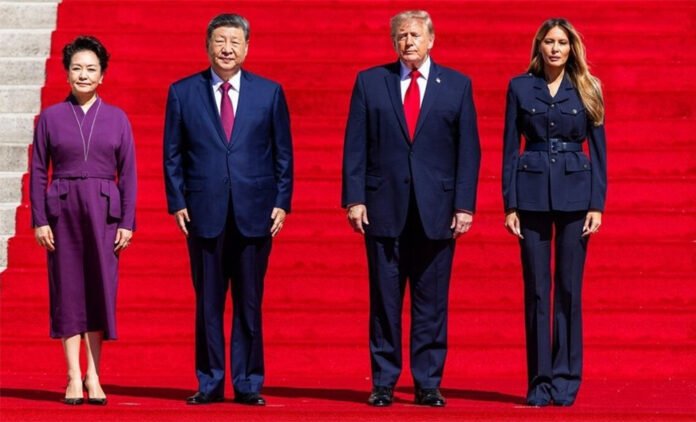
The high-profile bilateral state visit of Chinese President Xi Jinping to the United States has generated global headlines; countries around the world are brainstorming steps necessary to navigate the relationship between these two behemoths. For India, the situation is no different. New Delhi enjoys high-stakes relationships with both powers; while the United States is an important strategic partner, China is a key trade and strategic commodities client.
This underlines the delicate and highly complex nature of New Delhi’s current relationship portfolio with both countries, thereby highlighting the need for developing a nuanced analysis on this matter.

Outcome of the Visit
While the visit did see America rolling out the red carpet for Xi, history is witness to the fact that visits that are often high on symbolism and ostentatious display are generally low on substance. Along such expected lines, no big breakthroughs were announced. Trump and Xi agreed to extend their no-tariff policy on $30 billion of the burgeoning trade; China pledged to buy more American goods to narrow the trade deficit, which Washington has long flagged. Both countries also called for a resolution of the Strait of Hormuz deadlock at the earliest and agreed that no country should impose tolls on ships transiting an important waterway, which they highlighted as a global commons.
Trump and Xi agreed to extend their no-tariff policy on $30 billion of the burgeoning trade; China pledged to buy more American goods to narrow the trade deficit, which Washington has long flagged
However, thorny issues such as Taiwan and AI remained unresolved. While China called on Trump not to aid the ‘separatist forces’ in Taiwan, particularly a planned arms sale, America remained silent. On AI, both countries continue to hold diametrically opposite views. While China seeks to regulate the growth of AI capabilities in light of recent revelations from across the tech and governmental spectrums about AI acquiring increasingly autonomous capabilities, high enough to hack into companies, government websites, among others, Trump has made it clear that he won’t be putting the brakes on further AI innovation, as doing so would mean ceding the AI leadership of the world to China, despite vociferous calls from prominent tech executives to put a leash on the innovation in AI.
What Can India Make of This?
Even though both countries continue to disagree on a multitude of issues, the managed spectacle of the state visit can be gauged as the probable first sign of a potential rapprochement between them. This may signal the potential commencement of what many thinkers have called ‘G2 world order’.
A G2 order may prompt the US to ignore India’s security concerns regarding China’s border transgressions. To make matters worse, Washington can turn a blind eye to Beijing’s aggressive assistance to Pakistan — a state sponsor of terrorism against India
While such a situation may give India a breather in terms of the certainty of global supply chains as far as the supply of critical minerals and collaborative efforts in securing uninterrupted supply of hydrocarbons through the Strait of Hormuz are concerned, it may contribute to another major issue: undermining of India’s security position. A G2 order may prompt Washington to ignore India’s security concerns as far as China’s border transgressions are concerned. To make matters worse, Washington can turn a blind eye to Beijing’s aggressive assistance to Pakistan — a state sponsor of terrorism against India.

On trade, while this G2 order may halt an aggressive tariff war, multinational corporations may continue to be risk-averse, thereby applying the China +1 strategy, which in turn necessitates India to step up its game in improving the investment climate in the country.
What Must India Do?
While it is quite difficult for New Delhi to preclude the possibility of a G2 world, what we can do is enhance our national capabilities. This involves several strategies:

The first step we can take is to expand the horizons of the Production-Linked Incentive (PLI) scheme beyond the consumer electronics sector to other high-value sectors such as specialised steel, green tech, and Active Pharmaceutical Ingredients (API) for incentivising production. In addition, port and logistics reform needs to be carried out in tandem to improve the operational efficiency of our investment ecosystem.
If India wishes to play a truly independent role in international politics and emerge as a potential third pole to the two superpowers, we need to act fast, adapt deftly, and anticipate threats assiduously
The second step should aim at leveraging existing agreements and forging new bilateral pacts for developing jet engines, semiconductor design, and new defence innovations like drones, particularly autonomous drones. This should be complemented with the development and deployment of dual-use infrastructure along the Line of Actual Control (LAC) and maritime surveillance in the Indian Ocean Region (IOR) to bolster our combat capabilities vis-à-vis China and Pakistan.
Last but not least, we can export our digital public infrastructure stack to the Global South and to the like-minded countries of the Global North so that we can project ourselves as an alternative to American tech monopolies and Chinese techno-authoritarian models.
If India wishes to play a truly independent role in international politics and emerge as a potential third pole to the two superpowers, we need to act fast, adapt deftly, and anticipate threats assiduously.

The writer is a doctoral candidate in Political Science at Mahatma Gandhi Central University. The views expressed are personal and do not necessarily reflect the views of Raksha Anirveda





