


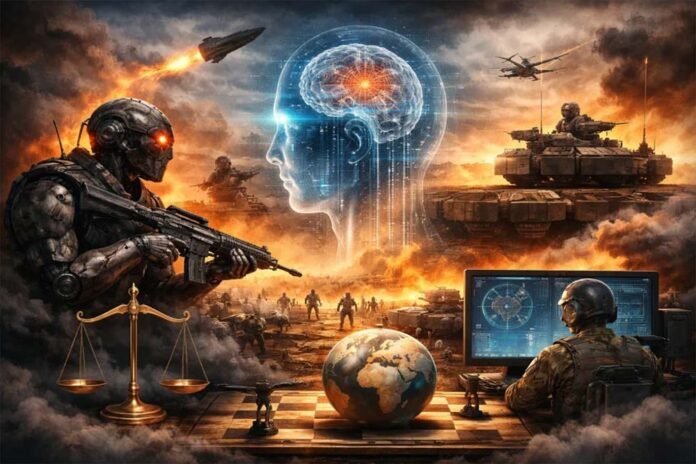
The most dangerous decision in the next major war may not be made by a machine. It may be made by a human who has been given only seconds to decide.
For a decade, the debate over military artificial intelligence has fixated on ‘killer robots’: weapons that select and engage targets without human intervention. That concern is legitimate. But it has obscured a quieter and arguably more consequential shift. AI is now woven into how militaries perceive threats, sort intelligence, and recommend responses. The danger is less autonomous warfare than automated escalation: the steady erosion of human judgement under timelines too compressed for judgement to operate.

AI is now woven into how militaries perceive threats, sort intelligence, and recommend responses. The danger is less autonomous warfare than automated escalation: the steady erosion of human judgement under timelines too compressed for judgement to operate
Keeping a human in the loop, in other words, does not keep humans in control.
Consider how fast the loop has become. Ukraine’s Delta battlefield management system fuses drone video, radio intercepts, and satellite imagery into a single picture and parcels out targets across thousands of drones. Ukrainian commanders say it has cut the time from detection to strike from roughly 20 minutes to between three and five, creating kilometres-wide kill zones where anything that moves can be found and hit within seconds. Kyiv is now testing SPECTR, an AI assistant built to help commanders digest battlefield data and plan operations faster still.
Ukraine is fighting for its survival, and speed has saved Ukrainian lives. That is precisely the point: the incentive to accelerate is real, rational, and overwhelming. A human remains formally responsible for each strike. What is shrinking is the interval in which that human can think independently.
Elsewhere, the interval has shrunk almost to nothing. Investigative reporting on Israel’s Lavender system in Gaza, drawing on intelligence officers’ accounts, described a database that at one stage flagged some 37,000 Palestinians as suspected militants. Officers reportedly spent as little as 20 seconds on each target, often confirming little more than that the person was male. One said he had “zero added-value as a human, apart from being a stamp of approval.” The Israel Defence Forces rejects this account, insisting that AI does not designate targets and that humans make every final decision. Even so, the dispute exposes the problem: procedural human control can coexist with a near-total absence of deliberation.

The UN General Assembly adopted its first resolution on AI in the military domain only in December 2024. In July, opening the first UN Global Dialogue on AI Governance in Geneva, Secretary-General António Guterres insisted that some decisions must remain human forever, above all the decision to take a life
At the far end of the spectrum, the human has stepped out entirely. On July 6 this year, a Russian Molniya drone struck a gas station in Zaporizhzhia, killing three civilians, among them a 19-year-old university student. According to a New York Times investigation drawing on Ukrainian air defence commanders and forensic examiners, operators launched the drone towards the station, but its onboard software, running on an Nvidia Jetson Orin module that sells commercially for a few hundred dollars, chose the final aim point itself. It carried no radio antenna, and because the module was unencrypted, investigators could read the terrain imagery stored on it. Kateryna Bondar of the Centre for Strategic and International Studies called it the first documented case of civilians killed by a Russian drone using fully autonomous targeting.
These are battlefield cases. The strategic stakes are larger. Research published by SIPRI in 2025 warns that military AI need not sit inside nuclear weapon systems to affect nuclear escalation: non-nuclear applications can compress decision timelines, and opaque algorithmic recommendations can bias leaders towards action in a crisis. The International Committee of the Red Cross has warned in parallel that AI decision-support tools, for all the data they process, introduce unpredictability and automation bias, turning operators into rubber stamps rather than independent judges.

Some decisions must be protected from algorithmic acceleration. Nuclear command and control is the clearest red line. The US, the UK, and France have committed to keeping humans in control of decisions on nuclear employment. That commitment should become universal
The risk is also unevenly distributed. A small club, including the United States, China, Israel, Russia, Ukraine, the United Kingdom, and South Korea, fields high-end AI targeting at scale. A wider circle, among them India, Iran, Pakistan, Saudi Arabia, Türkiye, and the UAE, has both the means and the motive to follow. Uneven testing, data, training, and safeguards mean some will deploy systems they cannot fully audit or confidently override.
Governance is trailing. The UN General Assembly adopted its first resolution on AI in the military domain only in December 2024. In July, opening the first UN Global Dialogue on AI Governance in Geneva, Secretary-General António Guterres insisted that some decisions must remain human forever, above all the decision to take a life. The principle is right. The battlefield is outrunning it.
Three rules would help.
First, some decisions must be protected from algorithmic acceleration. Nuclear command and control is the clearest red line. The United States, the United Kingdom, and France have already committed to keeping humans in control of decisions on nuclear employment. That commitment should become universal, and it should extend to the early-warning and decision-support systems that feed such choices, not merely the final order.
States need an AI-era hotline. Cold War crisis channels rested on a simple insight: misunderstanding between adversaries can be as dangerous as deliberate aggression. When AI-enabled systems warn of imminent hostile action, states need rapid, human-to-human means of verification
Second, states need an AI-era hotline. Cold War crisis channels rested on a simple insight: misunderstanding between adversaries can be as dangerous as deliberate aggression. When AI-enabled systems warn of imminent hostile action, states need rapid, human-to-human means of verification. Rivals still share an interest in ensuring that corrupted data, algorithmic error, or a misread signal does not start a war.
Third, accountability must never disappear inside an algorithm. If an AI-assisted recommendation contributes to an unlawful or catastrophic decision, “the system recommended it” cannot end the inquiry. Governments choose to deploy these tools. Militaries write the doctrine. Commanders exercise authority. The more capable the machine, the clearer the human chain of responsibility must become. As Guterres put it, “machines can inform, but humans must decide, and answer.”
None of this is an argument against military AI. It can sharpen early warning, support humanitarian operations, and help leaders make sense of chaotic crises. Rejecting it outright is neither realistic nor necessarily desirable.
Meaningful human control should not be measured by whether a person sits somewhere in the chain of command. It should be measured by whether that person can still understand, question, delay, and ultimately reject what an algorithm recommends
The challenge is subtler. Humanity has spent generations building institutions that insert time between political disagreement and irreversible violence. Diplomacy creates time. Mediation creates time. Hotlines create time. Even the slow procedures of international law matter partly because they force governments to justify decisions before the consequences become permanent.
AI carries the opposite instinct: remove delay, predict sooner, respond immediately. That collision between machine speed and political restraint may become one of the defining security dilemmas of this century.
Meaningful human control should not be measured by whether a person sits somewhere in the chain of command. It should be measured by whether that person can still understand, question, delay, and ultimately reject what an algorithm recommends.
The states that master military AI will gain power. Mastery alone will not make them wise. In the age of artificial intelligence, one of humanity’s most important security mechanisms may prove to be something deeply unfashionable in the technology industry: the ability to pause.

The writer is an expert on geopolitics, national security, and counter-terrorism; and he regularly contributes his subject thought-leadership and academic commentary with several publications in newspapers, journals, and periodicals. He works with investigative agencies, regulatory bodies, financial institutions and enterprises, providing strategic and regulatory advisory. The views expressed are personal and do not necessarily carry the views of Raksha Anirveda





