


Modern conflicts in Eastern Europe and the Middle East have highlighted a severe economic asymmetry in air defence: armed forces are frequently forced to fire multi-million-dollar interceptors to neutralise inexpensive, mass-produced unmanned aerial vehicles (UAVs).
To solve this critical magazine-depth and cost imbalance, European defence consortium MBDA unveiled the Counter Mass Interceptor (CMI). Designed specifically as an affordable effector for Counter-Unmanned Aerial Systems (C-UAS) missions, the CMI operates alongside the high-performance Advanced Short Range Air-to-Air Missile (ASRAAM) in a ground-launched configuration.

By pairing cost-optimised CMI missiles with higher-end ASRAAM effectors on a single mobile platform, defence operators gain a tiered engagement capability – preserving expensive interceptors for fast jets and cruise missiles while neutralising low-cost drones with economically sustainable munitions.
Technical Specifications & Layered Defence Architecture
The CMI missile is tailored to engage Class 1, Class 2 and Class 3 drones, as well as low-flying helicopters and sub-sonic cruise missiles, at ranges exceeding 6 kilometres.
The Counter Mass Interceptor (CMI) and the Surface-Launched ASRAAM (SL-ASRAAM) serve distinct, complementary roles in a layered air defence system.
In terms of primary target sets, the CMI is optimised for Very Short-Range Air Defence (VSHORAD), specifically targeting Class 1 to Class 3 unmanned aerial vehicles (UAVs), loitering munitions and light helicopters. In contrast, the SL-ASRAAM handles Short-Range Air Defence (SHORAD) against higher-tier threats, such as high-speed combat aircraft, cruise missiles and heavy UAVs.

Structurally, the CMI is a lighter, more compact missile, featuring an effector mass of approximately 53 kg and an overall system length of 2.3 metres. The SL-ASRAAM is noticeably larger and heavier, with an effector mass of around 88 kg and a length of 2.9 metres.
Their propulsion and engagement envelopes reflect these size differences. The CMI utilises a 122 mm solid rocket motor to engage threats at ranges exceeding 6 km, whereas the SL-ASRAAM employs a dual-burn solid rocket motor capable of reaching targets between 10 km and 20 km away.

For guidance, the CMI relies on an infrared seeker and passive tracking combined with a proximity fuse. The SL-ASRAAM uses a high-resolution Imaging Infrared (IIR) focal plane array, providing advanced target acquisition and tracking against complex aerial threats.
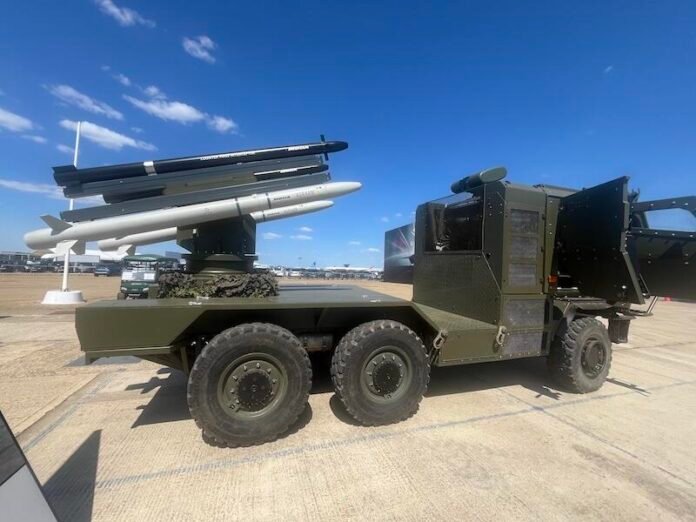
The complete system is integrated onto a Supacat 6×6 high-mobility tactical vehicle equipped with a Moog Flexible Mission Platform (FMP) turret. This setup allows mixed loads – such as two heavy ASRAAMs alongside two or more CMI launch canisters – giving unit commanders immediate operational flexibility without changing platforms.
Evolution of the Raven Mobile SHORAD Platform
The operational concept behind pairing surface-launched ASRAAMs with tactical light trucks traces its origin to Task Force ‘Kindred’ – a rapid UK Ministry of Defence initiative that delivered the “Raven” air defence vehicle to Ukrainian armed forces.
While the initial Raven variants featured two fixed ASRAAM rail launchers repurposed from aircraft stockpiles, feedback from combat operational environments underscored two pressing needs:
- Higher missile capacity per launcher vehicle, and
- A complementary, lower-cost missile to deal with continuous swarms of reconnaissance and kamikaze drones.
The introduction of the CMI transforms the Raven platform into a comprehensive, multi-tiered short-range air defence system capable of operating autonomously or integrating into MBDA’s wider Sky Warden counter-drone network.
Deployment Horizons and Market Outlook
MBDA emphasises that the CMI is designed to be platform-agnostic, enabling integration into ground tactical vehicles, uncrewed surface vessels (USVs), or fixed containerised modules for critical infrastructure protection.
The company indicated that the CMI-integrated platform could be ready for operational deployment within 18 to 24 months, pending final flight testing, contract awards and production scaling.
As NATO and allied armed forces restructure their air defence doctrines around drone-heavy battlefields, low-cost interceptors like the CMI are set to become essential assets in maintaining battlefield air supremacy.






