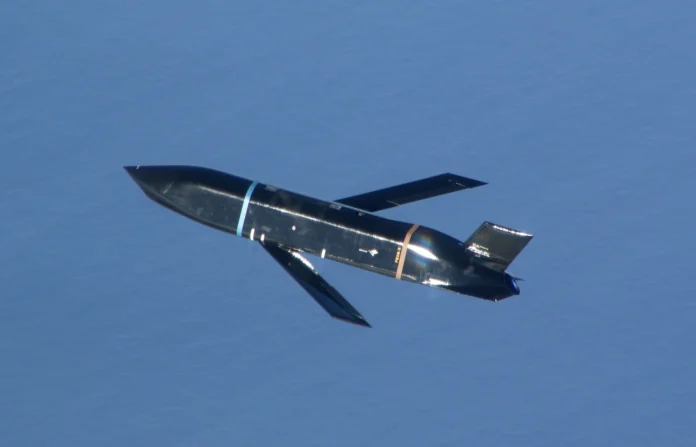
ORLANDO, Florida: Lockheed Martin successfully fired two production representative Long Range Anti-Ship Missiles (LRASM) from a U.S. Air Force B-1B on May 23. Lockheed Martin’s Long Range Anti-Ship Missile successfully completed another dual-missile test, demonstrating its ability to provide critical capabilities to warfighters.
In the event over the Sea Range at Point Mugu, California, a U.S. Air Force B-1B from Dyess Air Force Base, Texas, released the pair of LRASMs. The missiles navigated through all planned waypoints, transitioned to mid-course guidance and flew toward the moving maritime target using inputs from the onboard sensors. The missiles then positively identified the intended target and impacted successfully.

“The success of this second dual-LRASM test event speaks volumes,” said David Helsel, LRASM program director at Lockheed Martin Missiles and Fire Control. “As LRASM moves toward early operational fielding for the U.S. Air Force and U.S. Navy, the weapon system continues to demonstrate critical capabilities that our warfighters need.”
LRASM is designed to detect and destroy specific targets within groups of ships by employing advanced technologies that reduce dependence on intelligence, surveillance and reconnaissance platforms, network links and GPS navigation in contested environments. LRASM will play a significant role in ensuring military access to operate in open ocean/blue waters, owing to its enhanced ability to discriminate and conduct tactical engagements from extended ranges.
LRASM is a precision-guided, anti-ship standoff missile based on the successful Joint Air-to-Surface Standoff Missile – Extended Range. It is designed to meet the needs of U.S. Navy and U.S. Air Force warfighters in contested environments. The air-launched variant provides an early operational capability for the U.S. Navy’s offensive anti-surface warfare Increment I requirement to be integrated onboard the U.S. Air Force’s B-1B in 2018 and on the U.S. Navy’s F/A-18E/F Super Hornet in 2019.