


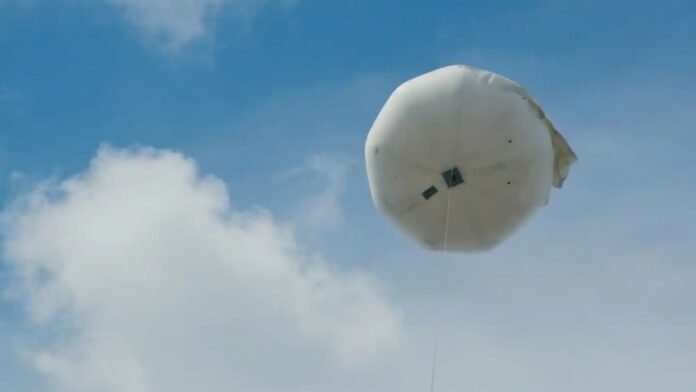
NEW DELHI. In a major breakthrough for India’s domestic military technology ecosystem, the Indian Institute of Technology (IIT) Delhi, in collaboration with the Defence Research and Development Organisation (DRDO), successfully demonstrated an indigenously developed tactical aerostat system. This low-cost, lighter-than-air platform marks a definitive step forward in securing Indian airspace and frontiers, combining academic research with industrial execution through an indigenous deep-tech startup.
A Powerful High-Altitude Platform
An aerostat is essentially a massive, tethered balloon filled with a gas lighter than air, serving as an elevated aerial platform. Unlike conventional airborne systems, this newly unveiled tactical aerostat can ascend to an unprecedented altitude of 20 kilometres. By operating at such extreme heights, the system overcomes the geographical limitations of ground-based radar and line-of-sight communication networks, allowing for an incredibly expansive area of coverage.

According to IIT Delhi Professor Bhupen Singh Bhatola, who heavily guided the development process, the system acts as an indispensable eye in the sky. It can easily be fitted with a wide variety of advanced payloads, including high-definition surveillance cameras, infrared (IR) detectors, and complex communication transponders. Whether tracking border movements or establishing emergency communications, its deployment versatility provides the armed forces with a highly adaptable asset.
Breaking the Import Monopoly
Historically, high-altitude tactical aerostats used by the Indian Armed Forces were heavily reliant on expensive foreign imports, primarily sourced from the United States. Recognising the strategic vulnerabilities of relying on international supply chains for critical surveillance infrastructure, DRDO spearheaded an initiative to internalise production.
The primary hurdle lay in fabricating the advanced, weather-resistant material capable of enduring the harsh atmospheric conditions found at 20 kilometres above sea level. IIT Delhi took-up this material science challenge, designing a robust fabric capable of handling intense UV radiation, pressure differentials, and extreme thermal fluctuations. To bridge the gap between academic innovation and mass manufacturing, Dr Neeraj Mandlekar, who trained extensively during the research project, founded a domestic startup to master the specialised skill of shaping, sealing, and assembling this high-tech material into its final aerodynamic form.
Drones vs Aerostats: The Structural Edge
While military drones have dominated global defence headlines, researchers emphasise that tactical aerostats offer distinct structural and operational advantages. Drones rely on continuous fuel consumption or battery life to stay airborne, limiting their operational window to hours or a few days. In sharp contrast, the aerostat relies entirely on buoyancy to remain aloft, allowing it to stay stationed over a target area for weeks on end with minimal operational expenditure.

Furthermore, aerostats are capable of hoisting significantly heavier and more complex payloads than mid-sized tactical drones. This makes them ideal for prolonged maritime reconnaissance, high-density communication relaying, and heavy logistical support operations across rugged terrain.
Expanding Horizons Into the Civilian Sector
While the immediate application remains rooted within the defence and national security domains, developers see a highly lucrative market for the system in the civilian sector. Future versions of this technology could be widely deployed for disaster management tracking, real-time forest fire monitoring, environmental mapping, and providing temporary cellular connectivity during large-scale network outages. This successful tripartite collaboration between elite academia, state-backed defence research, and young startup enterprises serves as a definitive blueprint for the future of the Indian innovation.







