


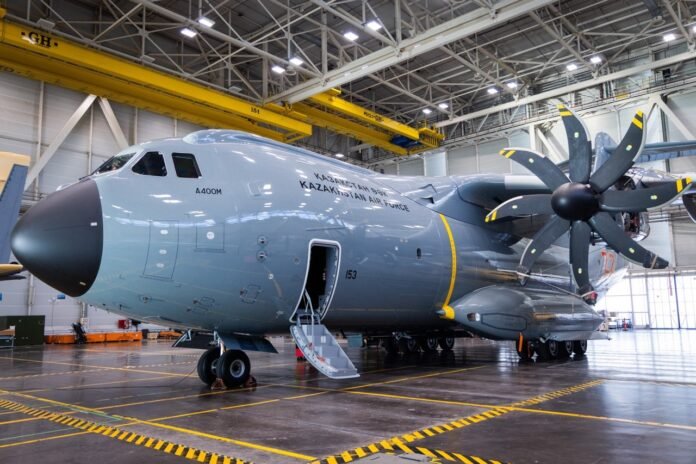
Airbus Defence and Space has published a photograph of the second A400M in Kazakhstani livery. The aircraft is built and undergoing technical acceptance. It is the second of two ordered in 2021; the first arrived in December 2024.
A System, Not Just Another Aircraft
The significance goes beyond one more airframe. Kazakhstan has methodically assembled a military transport capability, starting with the C-295 in 2013. The fleet now numbers 11, flown by the Air Force and the National Security Committee’s Aviation Service. The A400M adds a heavy tier, giving the country the C-295 for a wide range of tactical missions and the A400M for tasks demanding far greater range, payload and volume.

From Workhorse to Heavy Transport
The C-295 has proven a workhorse, in line with global experience: 41 operators in 37 countries, more than 300 aircraft ordered and over 610,000 flight hours accumulated. Kazakhstan gained a proven platform and a base of crews and technical expertise around it.
Kazakhstan has completed its two-tier air mobility framework with the acceptance of its second Airbus A400M heavy airlifter. Paired with 11 C-295 medium transports, the new fleet gives the country’s Armed Forces unprecedented regional range, payload capacity and operational independence
The A400M is the logical next step. It carries up to 37 tonnes, including oversized equipment, covers up to 8,000 kilometres at speeds up to 802 km/h, and can operate from short and unprepared runways. By the Ministry of Defence’s assessment, one A400M sortie matches the transport volume of roughly six C-295 sorties. The change is qualitative as well as quantitative.
 The First A400M Has Already Proven Its Value
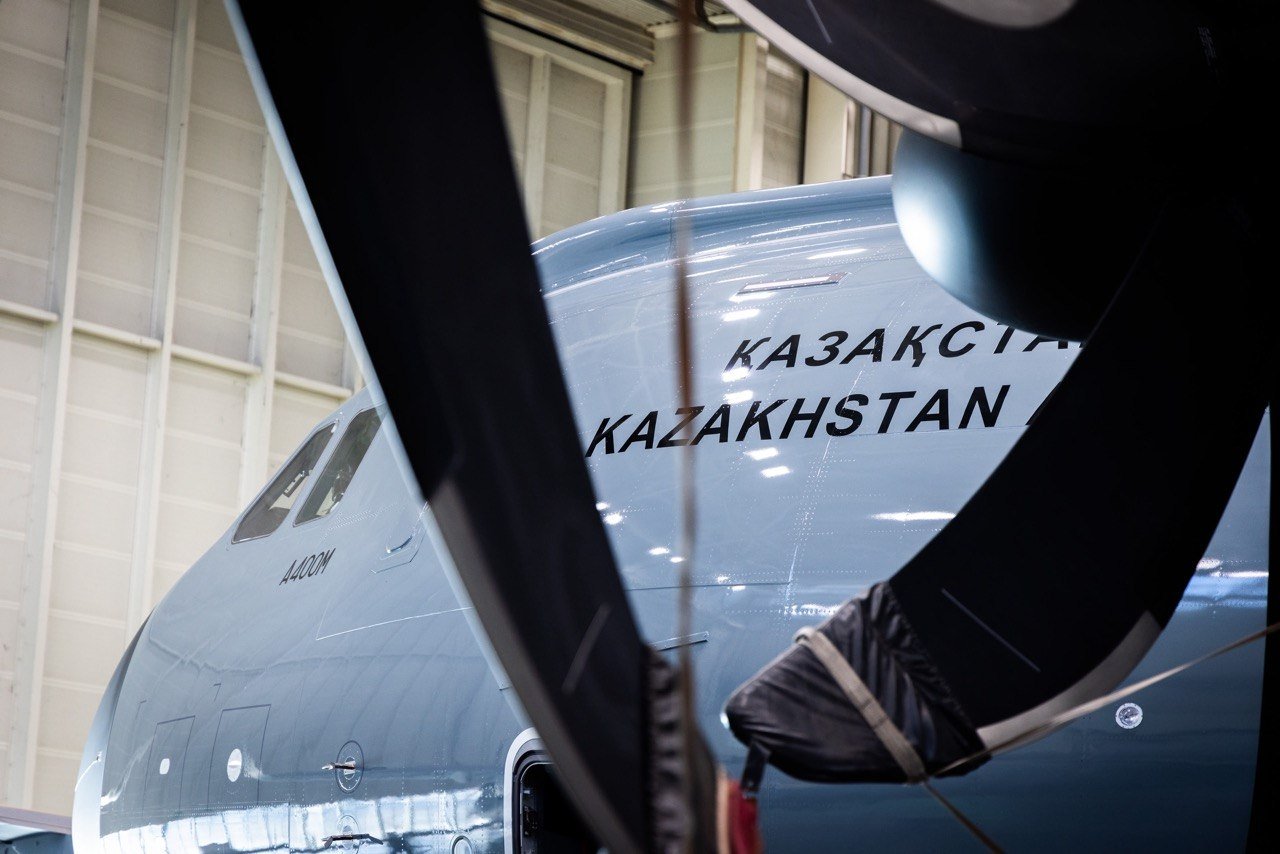
The second aircraft joins a system that is already working. Kazakhstani crews trained in Spain, then continued in Kazakhstan with Airbus specialists, flying routes to Taldykorgan, Balkhash, Aktau and Atyrau. The aircraft has since carried more than 500 tonnes of cargo, including humanitarian aid for Afghanistan, according to the Ministry of Defence. It also flew 70 peacekeepers home to Almaty after their UN service on the Golan Heights. This shows military transport becoming an independent instrument of foreign and defence policy: Kazakhstan no longer depends exclusively on outside assets to redeploy its contingents over long distances.
Designed to support the Airborne Assault and Special Operations Forces, Kazakhstan’s combined fleet guarantees rapid response in austere environments. From highway landings in Mangystau to large-scale supply drops during major military exercises, the C-295 and A400M ensure complete tactical flexibility
Boosting the Airborne Assault Troops
Airborne forces and military transport form a single system, and rapid delivery is as vital as trained units. The C-295 is already used for paratrooper training; in one event more than 200 personnel jumped from it, allowing larger airdrop volumes than helicopters. The A400M raises the ceiling, designed to carry up to 116 paratroopers and to drop personnel and cargo by air. That opens the way to moving significant forces over long distances.

Integration with other branches is also underway. In the “Desant-2025” exercise, involving more than 3,000 Airborne Assault Troops personnel, aircraft and helicopters of various types took part and C-295s delivered ammunition, medical supplies and food.
 Reach for Special Operations Forces
Special Operations Forces need to reach remote areas quickly and be resupplied, often from airfields with limited infrastructure. Kazakhstan is already working on this: during the “Altyn Zhebe” inspection, a C-295 landed for the first time in the Armed Forces’ history on a motorway section used as an airfield in Mangystau Region. The A400M extends the same concept in range and volume, widening the radius of operational mobility for both Special Operations and Airborne forces.

As the ninth nation to adopt the A400M, Kazakhstan integrates its defence forces into an established global fleet operating across ten countries. Supported by well-trained domestic crews and technical specialists, the Armed Forces are fully prepared to maximise the platform’s strategic potential
An Established International Platform
Kazakhstan became the ninth A400M operator. The aircraft now serves in ten countries, including Germany, France, the United Kingdom, Spain, Turkey, Belgium, Luxembourg, Malaysia, Kazakhstan and Indonesia. In July 2026, Airbus reported that the global fleet had passed 135 aircraft and 270,000 flight hours. It is used in routine logistics, international operations, humanitarian missions and major multinational exercises. Kazakhstan is receiving an established system, not an experimental one.
Why Geography Demands It
Vast distances, remote military facilities, the need for troop mobility and participation in peacekeeping all require rapid redeployment of people, equipment and cargo. Under these conditions, a heavy transport element of its own has strategic value. Kazakhstan chose the right path by keeping the mastered medium class and supplementing it with a heavy one. The 11 C-295s and two A400Ms form an echeloned structure: the C-295 handles day-to-day tactical work, the A400M the heaviest and longest-range tasks, and together they are more flexible than either alone.
Overall, the second A400M is the natural outcome of consistent policy. In a decade, Kazakhstan has moved from building a C-295 fleet to establishing a full heavy transport element. It has trained aircrews and engineering personnel, and the first A400M has already shown its worth, from heavy cargo and humanitarian supplies to UN peacekeeping support. This combination makes Kazakhstan possessing the most developed military transport component in Central Asia in its mix of medium and heavy airlift, and one of the region’s leaders in air mobility.
The writer is a retired colonel and military expert. The views expressed are personal and do not necessarily carry the views of Raksha Anirveda





