


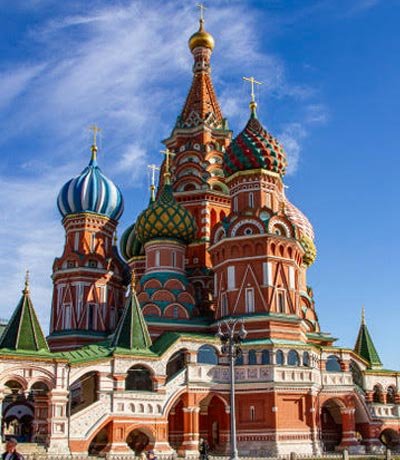
Saint Basil’s Cathedral rises like a vision from a medieval fairytale, its onion domes swirling in brilliant reds, greens, blues, and gold against the skyline of Moscow. Built in the 16th century, the cathedral blends symmetry with playful asymmetry, making it appear almost surreal. Its beauty lies not only in its vibrant colour
s and intricate patterns, but also in the way each dome tells its own story, creating a sense of mystery and wonder.

Situated at the Southern end of the Red Square, it captures both the spiritual soul and the historic grandeur of Russia. The great Russian academician Dmitry Sergeyevich Likhachev, one of the Soviet Union’s foremost cultural historians, observed memorably that St Basil’s Cathedral is “the essence of a grandiose architectural embodiment of a purely Russian character,” a judgment that resonates as powerfully today as, when it was first made.
A Victory Carved in Stone
Saint Basil’s Cathedral is not only a striking monument, but it also reflects the civilisational depth and the consciousness of Russia itself. With its colourful domes, Orthodox symbolism and fortress-like presence, it embodies the fusion of faith, empire, sacrifice and endurance that has shaped Russian history for millennia.
It reflects the legacy of medieval Russia, and the long continuity of a unique civilisation that was once called ‘The Third Rome’[i] and distinguishes itself as both, European and uniquely Asian.
The story of St Basil does not begin with an architect’s drawing, but with a triumph on the battle field. The Khanate of Kazan, posed a constant and a multidimensional threat to the Russian state from the East for many reasons.

Situated at the Southern end of the Red Square, it captures both the spiritual soul and the historic grandeur of Russia. The great Russian academician Dmitry Sergeyevich Likhachev, one of the Soviet Union’s foremost cultural historians, observed memorably that St Basil’s Cathedral is “the essence of a grandiose architectural embodiment of a purely Russian character,” a judgment that resonates as powerfully today as, when it was first made
Firstly, the Kazan khans regularly raided Russian lands to capture prisoners, who were then sold into slavery in Eastern markets. Secondly, Kazan occupied a strategically important position on the Volga River, allowing the Khanate to control a key trade route linking Russia with the East. Thirdly, they created political instability by aligning with Crimean Khanate and Ottoman Empire both, rivals of Moscow.
In October 1552, Tsar Ivan IV, better known in history as Ivan the Terrible, achieved one of the most decisive victories of his reign by capturing Kazan, the capital of the Khanate of Kazan.

Its capture secured Moscow from the East. The Russian Orthodox publication Pravmir (Православие и мир), records that Ivan before the commencement of the military campaign, had made a solemn vow to God that, should he be granted victory over Kazan, he will build a temple that Russia had never seen before.
The siege of Kazan concluded on the Feast of the Intercession of the Virgin, an auspicious coincidence that the Tsar interpreted as irrefutable proof of divine sanction.
Initially, seven wooden churches were constructed on the site of present-day St Basil, each dedicated to a saint on whose feast day a significant battle of the Kazan campaign had been won.
Construction of the definitive stone cathedral began in 1555, and it was completed on 12 July 1561, a date confirmed only during restoration work in 1957, when archaeologists discovered the founding inscription (khramozhdannaya nadpis’) beneath layers of later paintwork.
The story of St Basil does not begin with an architect’s drawing, but with a triumph on the battle field. The Khanate of Kazan, posed a constant and a multidimensional threat to the Russian state from the East for many reasons
Incidentally, it was the last great stronghold of Tatar-Mongol power on Russia’s eastern frontier and was the first Muslim region included into the Muscovite tsardom, establishing the multicultural nature of the Russian state.
The Architecture: Order and Harmony Within Apparent Chaos
The cathedral was entrusted to two celebrated Russian architects, Barma and Postnik Yakovlev. As William Craft Brumfield, foremost authority in the West on Russian architecture, in his landmark volume A History of Russian Architecture (Cambridge University Press, 1993), documents, their design represented a radical departure from every established tradition of Russian religious building.
It was probably a synthesis of Byzantine structural memory, Muscovite’s decorative instinct and possibly Italian Renaissance influence, yet reducible to none of these. The domes are arranged in a complex yet balanced composition, creating an impression of order emerging from diversity and movement.
There are many legends associated with the long history of St Basil’s Cathedral. According to one legend, Ivan blinded the architects after the completion of the work, so they could never surpass the masterpiece that they had created at his behest.
However, Postnik Yakovlev demonstrably continued his career after St Basil’s, participating in the construction of the Annunciation Cathedral in the Moscow Kremlin, the Kazan Kremlin and other major buildings. Another legend states that Napolean was awestruck by the beauty of the Cathedral and wanted to take it to Paris and when he could not, wanted to destroy it with cannons. However, mysterious rain soaked the gunpowder, laying waste his plans.
The siege of Kazan concluded on the Feast of the Intercession of the Virgin, an auspicious coincidence that the Tsar interpreted as irrefutable proof of divine sanction. Initially, seven wooden churches were constructed on the site of present-day St Basil, each dedicated to a saint on whose feast day a significant battle of the Kazan campaign had been won
To the untrained eye, St Basil’s appears gloriously chaotic, a tumbling, swirling mass of towers and domes that follows no rational plan. However, the architecture of the Cathedral is unique and inimitable. Despite the apparent complexity, the building is distinguished by symmetry and harmony.
On a powerful base, there is an ensemble of nine independent pillar-shaped churches. They are united into a single whole by two galleries; the inner one, which runs around the central church, and the external bypass gallery around all nine churches.
In the southeast corner of the cathedral there is a tent bell tower of the XVII century. Each of the eight outer chapels has been dedicated to a saint, venerated on the feast days of the key battles of the Kazan campaign, making the entire edifice simultaneously a church and a war memorial of extraordinary complexity.
The idea of the concept belongs to the Russian Orthodox monk Philotheus (Filofei) of the 16th century, who in letters to Grand Prince Vasili III coined the phrase ‘The Third Rome’. The core idea was based on a theological and political prophecy that stated “Two Romes have fallen, the third stands, and there will be no fourth.” He viewed Moscow as the last stronghold of true Orthodoxy after the fall of Rome and Constantinople.
In Eastern Orthodox Christianity, “holy fools” were ascetics who deliberately acted as if they were insane, rejected worldly wealth and social norms, and lived as wandering beggars in pursuit of humility and spiritual devotion. Despite often facing mockery and hardship, they were believed to possess prophetic insight and sometimes openly criticised rulers and the sins of society.
The St Basil is included on the UNESCO World Heritage List because of its exceptional historical, cultural, and architectural significance. Today, the cathedral is open to both locals and foreigners and offers special guided tours for children.
The central tower, dedicated to the Intercession of the Virgin, rises to a height of 47.5 metres and is topped by a tent-shaped roof (shatyor) rather than a dome.
The cathedral’s official name is the Cathedral of the Intercession of the Virgin by the Moat (Sobor Pokrova Presvyatoy Bogoroditsy, chto na Rvu), a reference both to its liturgical dedication and to the Kremlin defensive moat that once ran beside it.
The popular name “St Basil’s” came later, attached to it through the chapel added over the grave of Vasily the Blessed in 1588. Vasily the Blessed (1468–1552) was a renowned Russian Orthodox saint and “holy fool” (yurodivy) who lived during the reign of Tsar ‘Ivan the Terrible’. He is celebrated for his eccentric asceticism, prophetic abilities and bold willingness to condemn the Tsar for his brutality.
To the untrained eye, St Basil’s appears gloriously chaotic, a tumbling, swirling mass of towers and domes that follows no rational plan. However, the architecture of the Cathedral is unique and inimitable. Despite the apparent complexity, the building is distinguished by symmetry and harmony
The Domes: Shape, Symbolism, and Spectacle
One aspect of Saint Basil’s Cathedral that captures the world’s imagination are its extraordinary domes. Technically classified as onion domes (lukovichnye glavy), they bulge dramatically outward before tapering to a sharp ascending point. Their silhouette evokes a leaping flame rather than a vegetable.
Another feature that immediately arrests the eye is the decoration of the domes. No two domes are alike. Across the nine domes, each with its own architectural art, one encounters spiralling helices, bold chevron zigzags, raised diamond lozenges, ribbed fluting and intricate geometric lattices.
In Russian Orthodox chromatic theology, as detailed by the Likhachev Foundation (Fond Likhacheva), the dome of a church is understood to symbolise the head of Christ or the vault of heaven itself, with its colour expressing the nature of the dedication; gold for divine glory, blue for the Mother of God, green for the Holy Spirit. The multiplicity of vividly differentiated domes at St Basil’s is thus a theological proclamation as much as an aesthetic spectacle.
The cathedral did not cease to grow after its consecration in 1561. A significant addition came in 1588, when a tenth chapel was constructed at the north-eastern corner to house the relics of Vasily (Basil) the Blessed (Vasiliy Blazhenny), the Russian Orthodox yurodiviy, or “holy fool”
Centuries of Addition and Transformation
The cathedral did not cease to grow after its consecration in 1561. A significant addition came in 1588, when a tenth chapel was constructed at the north-eastern corner to house the relics of Vasily (Basil) the Blessed (Vasiliy Blazhenny), the Russian Orthodox yurodiviy, or “holy fool”.
The chapel was ordered by Ivan’s son, Tsar Fyodor Ioannovich, following Vasily’s official canonisation in 1586. Before the Vasily chapel was added, the main cathedral was unheated and functioned primarily as a memorial structure, with services held only in warm weather. The addition of the heated Vasily chapel made daily worship possible year-round.
In 1672, the chapel of St Ioann Blazhenny was added adjacent to the Vasily chapel, further enriching the ensemble. By 1683, the previously independent chapels had been unified into a single cohesive cathedral complex, a decisive architectural consolidation that transformed a collection of adjacent churches into the unified ensemble that stands today.
In 1583, the cathedral suffered the first devastating fire and a second major fire struck in 1737, requiring extensive restorations. Each of these successive additions and restorations represented a fresh cultural act of ownership and every era claiming continuity with the founding moment of imperial and religious triumph.
More than four-and-a-half centuries after its completion, St Basil’s Cathedral remains what Ivan the Terrible intended it to be, ‘a monument of extraordinary power and beauty that speaks to Russia’s identity at its deepest level’
An Eternal Flame at the Heart of Russia
More than four-and-a-half-centuries after its completion, St Basil’s Cathedral remains what Ivan the Terrible intended it to be, ‘a monument of extraordinary power and beauty that speaks to Russia’s identity at its deepest level’.
Brumfield, examining the cathedral as a work of architectural history, calls it the defining monument of medieval Russian architecture, the moment when Russia’s builders transcended every external influence and achieved something wholly, inimitably their own. Its onion domes, each unique in pattern, each radiating in colour, each aspiring skyward like a frozen flame, continue to astonish every visitor who visits the Red Square and encounters the structure for the first time.
In a world of glass towers and engineered symmetry, St Basil stands as an enduring reminder that architecture, at its greatest, is not merely the art of building, it is the art of making the divine visible on earth.

The writer, Kirti Chakra, AVSM, VSM, is an Indian Army veteran. He has also served as the Indian Military Attaché in Moscow. He is the Founding Director and CEO of ThorSec Global. An accomplished scholar, he specialises in Geopolitics with a focus on Russian Studies and is currently pursuing his PhD in the field, further enriching his depth of knowledge and global perspective. He can be reached at deepakmehra67@yahoo.co.uk and deepak.mehra@thorsecglobal.com. The views expressed are of the writer and do not necessarily reflect that of Raksha Anirveda





