


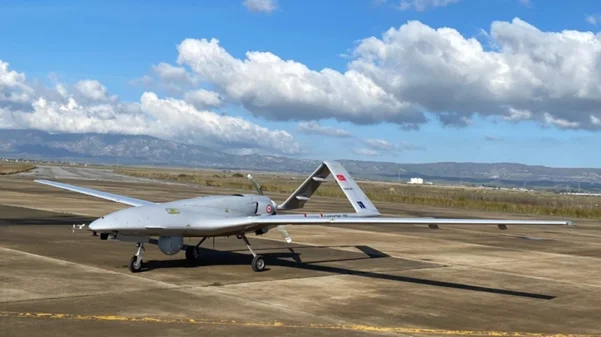
Tel Aviv: Iran’s UAV can no longer be seen as secondary weapon systems that can merely “harass, gather intelligence and deter.” Rather, they have grown into a major weapon system that when applied properly can be a game-changer by themselves, as potent as the new generation of precision rockets and missiles of the Islamic Republic.

The concerns voiced by Israel’s Prime Minister and Minister of Defence are justified and timely.
“It can only be hoped that Israel’s defence establishment will learn from the experience of others and will rapidly deploy the required offensive and defensive means to prevent Iran’s UAVs from tipping the military balance in the region,” says Uzi Rubin, an Israeli senior expert on missile defence in his research paper that was published by Jerusalem Institute for Strategy and Security.
“Iran has been developing and expanding its Unmanned Air Vehicles fleets ever since the 1980s. They now comprise a wide spectrum of types that range in size and function from aircraft size, high flying reconnaissance UAVs to small, low-cost “suicide” ones. Until fairly recently, Israel’s military regarded the threat from Iran’s UAVs – either operated by Iran’s armed forces or by their proxies in the region – as a minor component of the overall military threat, compared to the major strategic threat from Iran’s fleet of ballistic missiles and its proxies’ rockets deployed in Iraq, Syria, Lebanon, Yemen, and Gaza.”
According to Rubin apparently, Iran’s UAVs have evolved into an issue of concern for the US administration too. A recent Wall Street Journal article, titled “Iran Armed Drone Prowess Reshapes Security in the Middle East” discloses that “Teheran uses off the shelf materials to manufacture armed drones that challenge the US and its allies in the region.” The article proceeds to quote unnamed sources in Europe, the United States, and Israel who say that Iran’s fast-expanding capabilities to design, manufacture and deploy UAVs “Are altering the balance of power in the region.”

The Israeli senior analyst says that the proficiency of Iran’s UAVs and their operators have been demonstrated repeatedly in the region ever since the onset of the war in Yemen in 2014. Iran’s UAVs operate in the skies of Saudi Arabia, the Persian Gulf, Iraq, and Syria. They have been extensively used in a broad spectrum of operations, including retaliation against ISIS bases, battlefield support of the Assad regime forces in their campaign to regain control in Syria, in attacking cities, national infrastructures, and oil targets in Saudi Arabia, and in targeted killing of high-ranking officers and officials of the internationally recognized Yemeni government.
Israel has warned the US that Iranian proxies in the Middle East and the Gulf are about to increase “Dramatically” the number of attacks on American targets using new designs of Iranian made armed drones. The proxies, mainly the Houthi rebels in Yemen and cells of Hezbollah in Syria, have recently received new Iranian made attack drones, despite the continuous and very aggressive campaign aimed at destroying the shipments of Iranian made advanced weapons including armed drones being pursued by Israel.


-The writer is an Israel-based freelance journalist. The views expressed are of the writer and do not necessarily reflect the views of Raksha Anirveda





