


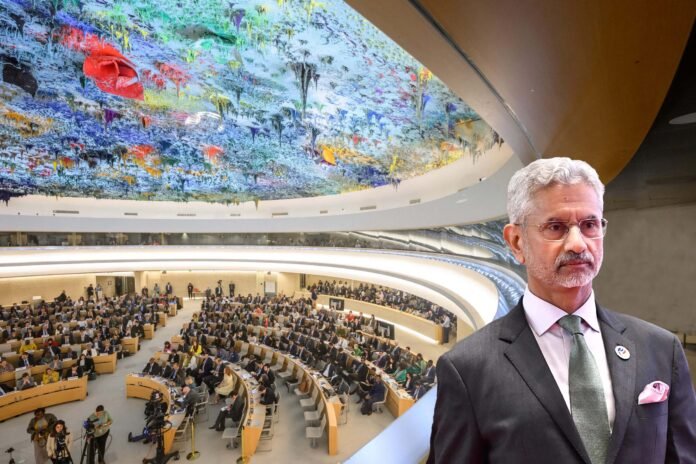
On July 13, External Affairs Minister S Jaishankar will formally launch India’s campaign in New York for a non-permanent seat on the UN Security Council for the 2028-29 term. It is, on paper, a routine diplomatic exercise; India has held such seats eight times before. But the timing and nature of this campaign reveal something more consequential: India is no longer running as the default favourite of the developing world. It is running a contest, and contests can be lost.
The Itinerary Tells the Story
Jaishankar’s schedule this week is instructive. He is visiting Qatar, Bahrain, Kuwait and Oman before travelling to New York on July 13 to launch the campaign, with a further stop in Brussels for the India-EU Trade and Technology Council. This is not exactly a ceremonial lap. It’s more like retail diplomacy, that sustained, country-by-country lobbying that makes it feel New Delhi expects to earn every single vote, rather than just collect them, simple as that.

That instinct is well-founded. India’s seat is for the Asia-Pacific regional slot, and it will not go uncontested. Tajikistan is also in the mix, and it arrives with a pretty formidable ace, the backing of the 57-member Organisation of Islamic Cooperation. When an entire voting bloc lines up behind a single candidate before the campaign has properly begun, the arithmetic of a UN General Assembly election, where two-thirds of the roughly 190-odd members present and voting must agree, starts to look very different from a coronation.
S Jaishankar will visit Qatar, Bahrain, Kuwait and Oman, with a further stop in Brussels for the India-EU Trade and Technology Council meeting. This is not exactly a ceremonial lap. It is more like retail diplomacy, country-by-country lobbying to earn every single vote, rather than just collecting them
The Kyrgyzstan Warning
If India needed a live demonstration of how fast a presumed advantage can vanish, it happened just weeks ago. On June 3, the General Assembly picked five new non-permanent members for 2027-28, and in the Asia Pacific contest, the Philippines, which is a founding UN member with around four decades on the Council, actually squared off against Kyrgyzstan, a state that had never held a seat after joining the UN in 1992. Kyrgyzstan took the floor on the fourth round, with 142 votes, comfortably over 128, the number needed for a two-thirds majority, while the Philippines ended up with only 49.
What’s striking is that the Philippines had signaled its candidacy as far back as 2013, roughly four years before Kyrgyzstan, and it also locked in ASEAN’s formal support. Still, it slipped and lost pretty clearly.
The General Assembly picked five new non-permanent members on June 3 for 2027-28, and in the Asia-Pacific contest, the Philippines, a founding UN member with around four decades on the Council, lost to Kyrgyzstan, which had never held a seat since joining the UN in 1992. Kyrgyzstan won with 142 votes, while the Philippines received only 49
The lesson for India is blunt: an early campaign launch, historical stature, and bloc endorsement from your immediate region are not, by themselves, sufficient. Analysts pointed to the Philippines’ deepening security alignment with Washington as a factor that worked against it in a secret ballot, a reminder that in UN elections, candidates are read as much through their geopolitical alignments as through their formal qualifications. India, which markets itself precisely on the claim of strategic autonomy and non-alignment with any single bloc, has an argument to make here, but it will have to make it, not assume it.

Why the Global South Narrative Faces a Real Test
For a decade, India has built this international self-image as the credible bridge between the developed and developing worlds, though, yeah, the idea really started getting legs during its G20 presidency in 2023. The 2028-29 election is where that story actually meets a hard ballot count. If India wins comfortably, it confirms years of outreach, and if the margin stays tight, or if India loses votes from Africa, or OIC-aligned blocs, to Tajikistan’s coalition, it will pull up awkward conversations about whether “Global South leadership” becomes real diplomatic capital, or stays, in practice, more like wishful thinking.
The stakes are made heavier by circumstances. India postponed its India Africa Forum Summit in May, citing an Ebola outbreak across multiple African countries. The public health rationale is legitimate, but the postponement also removed a scheduled high-level engagement with a continent that controls roughly a quarter of General Assembly votes
The stakes are also made heavier by circumstances. India postponed its India Africa Forum Summit in May, citing an Ebola outbreak across multiple African countries. The public health rationale is legitimate, but the postponement also removed a scheduled high-level engagement with a continent that controls roughly a quarter of General Assembly votes, at precisely the moment India most needs to be consolidating that support. Whether Tajikistan’s OIC-backed campaign can exploit that gap among Muslim-majority African states remains to be seen, but the timing is not to India’s advantage.

The Permanent Seat Question Sits Behind All of This
None of this campaign activity is really about a two-year term. India has made no secret that its long-term objective is permanent membership on a reformed Council, a goal it pursues together with Brazil, Germany and Japan, as the G4. Every successful non-permanent term becomes another data point in that bigger argument; it is basically evidence that India can build coalitions, act with responsibility, and deserves a permanent voice rather than a rotating seat.
The case for that permanent slot rests on an argument that is at its core about representation finally catching up with what is real. The Council’s five permanent members reflect an allocation fixed in 1945, when India was not yet independent, when most of Africa remained colonised, and when the Global South had no institutional voice at all. Today, India is the world’s most populous nation, one of its largest and fastest-growing economies, and a consistent contributor to peacekeeping operations for decades. The argument India wants to win is not “why does India deserve this,” but “how does a Security Council that permanently excludes South Asia, Africa, and Latin America retain its legitimacy in a genuinely multipolar world?”
If India wins comfortably, it confirms years of outreach, and if the margin stays tight, or if India loses votes from Africa or OIC-aligned blocs, to Tajikistan’s coalition, it will pull up awkward conversations about whether ‘Global South leadership’ becomes real diplomatic capital, or stays, in practice, more like wishful thinking
That is a strong argument. But it runs into the same wall it always has: any Charter amendment requires ratification by all five existing permanent members, each of which holds an effective veto over diluting its own exclusivity. Pakistan continues to organise opposition within the OIC. The “Uniting for Consensus” coalition, Italy, South Korea, and others, continues to prefer expanding elected seats rather than creating new permanent ones, for exactly the reason that doing so would entrench a new hierarchy rather than flatten the existing one.
The Real Test Ahead
What makes the 2028-29 campaign genuinely worth watching is that it will be the clearest recent signal of whether India’s diplomatic weight converts into UN votes when actually contested, not assumed. A comfortable win keeps the permanent-seat argument credible. A difficult one, following so soon after Kyrgyzstan’s upset of the Philippines, would suggest that in today’s UN, blocs and alignments increasingly matter more than stature and history combined. Jaishankar’s packed itinerary this month suggests India’s own diplomats already understand which of those two outcomes they are working to avoid.
The writer is an expert on geopolitics, national security, and counter-terrorism; and he regularly contributes his subject thought-leadership and academic commentary with several publications in newspapers, journals, and periodicals. He works with investigative agencies, regulatory bodies, financial institutions and enterprises, providing strategic and regulatory advisory. The views expressed are personal and do not necessarily carry the views of Raksha Anirveda





