


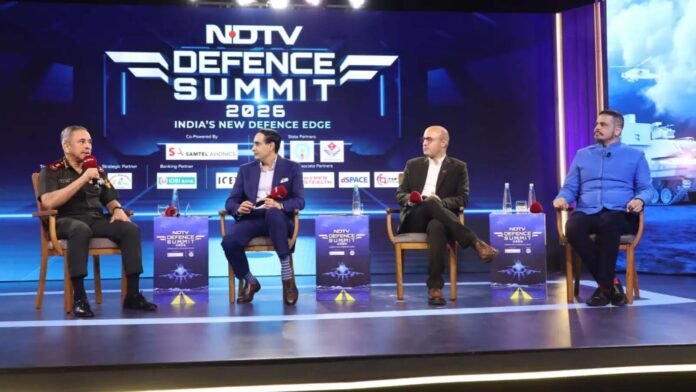
India’s defence establishment has identified technology, industrial capacity and strategic autonomy as the three foundations of future military power, with senior commanders warning that the character of warfare is changing faster than traditional procurement systems can respond.
The message emerged across the NDTV Defence Summit 2026, held on September 27 in New Delhi, where Defence Minister Rajnath Singh, Chief of Defence Staff General NS Raja Subramani, Army Chief General Dhiraj Seth and Navy Chief Admiral Krishna Swaminathan discussed the lessons of Operation Sindoor and the requirements of future conflict. Former Deputy National Security Adviser Pankaj Saran, foreign diplomats, defence companies and space entrepreneurs added a wider strategic and industrial perspective. The summit’s agenda focused on artificial intelligence, drones, space, autonomous systems, jointness among the services and defence manufacturing.

Singh opened the summit with a call for self-reliance “from chips to ships”. He argued that India’s strategic autonomy would depend not only on assembling major platforms but also on controlling the critical technologies and components beneath them, from semiconductors and sensors to complete weapon systems and warships.
“Why buy what can be produced here?” Singh asked, presenting indigenous design, innovation and adaptation as essential to reducing vulnerability to external supply disruptions. He said India’s young engineers and entrepreneurs were already working on artificial intelligence, drones, robotics, quantum technologies, cybersecurity and autonomous systems.
The minister also described modern conflict as increasingly multi-domain, combining contact and non-contact warfare with kinetic, cyber, space and information operations. His argument was that a future battlefield would reward countries able to innovate continuously rather than those that merely acquire advanced equipment from abroad.
Army Chief General Dhiraj Seth placed the Army’s discussion in the context of prolonged, technology-intensive conflict. He described modern wars as “wars with pause”: individual operations may be short, but strategic crises can continue for long periods. In such circumstances, land forces must retain the ability to sustain operations without being constrained by foreign suppliers.

For the Army Chief, land remains the final measure of military success. Technology can shape the battlefield, disrupt an adversary and improve precision, but territory must ultimately be secured and held. He linked that requirement directly to self-reliance, arguing that unconstrained access to ammunition, spares and equipment would determine whether India could maintain combat power during a prolonged confrontation.
The summit’s discussions on Operation Sindoor reinforced that point. Colonel Jayaram M, chief executive of Kalyani Rafael Advanced Systems, said the operation demonstrated the value of precision and the need to scale production. The challenge, he suggested, is to sustain high-quality effects over a longer conflict when India’s manufacturing capacity remains limited.

CDS General NS Raja Subramani said the situation along the China border was stable, but stressed that India would not lower its guard against Pakistan. He attributed stability in Jammu and Kashmir to coordination among the armed forces, police, central armed police forces and intelligence agencies, describing the approach as a whole-of-government effort.
The CDS said Operation Sindoor was a classic demonstration of jointness, with the three services working together. But he also warned that stability should not be confused with the disappearance of threats. The military, he said, remained prepared to respond rapidly and decisively to any misadventure.
His broader warning concerned the expanding battlefield. Persistent surveillance and long-range precision weapons mean that danger is no longer confined to the frontline. “No place anywhere is safe,” he said, pointing to the need for force protection, counter-drone systems and integrated air defence.
The economics of warfare has also changed. General Subramani said it made little sense to use a missile costing $1 million against a drone worth $30,000. India therefore needs layered defences that combine electronic warfare, jamming, soft-kill measures, guns, lower-cost interceptors and high-end missiles. AI, he added, would transform every aspect of the battlefield, but would also create difficult questions of reliability, control and accountability.
That challenge was echoed by industry specialists. Sameer Joshi, chief executive of Newspace, said drone swarming was moving autonomy to a new level by shifting human operators from controlling individual drones to directing groups of machines. He argued that autonomous systems were no longer a distant possibility, although ethical and operational requirements would continue to favour a human role in critical decisions.
Defence Secretary Rajesh Kumar Singh spoke of developing an “AI spine” for the armed forces rather than relying on isolated applications. The objective is to connect data, sensors, command networks and decision-making systems across the services. Such an architecture would allow the military to turn information gathered from satellites, aircraft, drones, ships and ground units into actionable intelligence.
Space emerged as another decisive domain. Skyroot Aerospace founder Pawan Chandana said the sector was moving through a transition in which access to space, launch capacity and sovereign satellite infrastructure would directly influence national security.
Navy Chief Admiral Swaminathan invited private space companies to work with the Navy in “mission mode” to understand military requirements and build indigenous capabilities over the next two decades.
The Navy Chief warned that the Indian Ocean has become one of the world’s most militarised maritime spaces. Between 40 and 50 warships from extra-regional navies are present in the region almost continuously, he said, while ballistic and cruise missiles, unmanned systems and other technologies are widening the threat spectrum.
Conflict far from India’s shores can still affect its economy, supply chains and energy security. Events around the Strait of Hormuz and Bab el-Mandeb have reinforced the need for maritime surveillance, naval readiness and domestic production. Swaminathan said India must become more self-sufficient and build the ability to maintain operations even when global trade routes are disrupted.
He also urged Skyroot to engage with the Navy on sovereign space capabilities, underlining the growing connection between maritime power, satellite communications, navigation, surveillance and launch systems.
Pankaj Saran, a former Deputy NSA and member of the National Security Advisory Board, described Operation Sindoor as a “leap of faith”. He said the operation represented a significant shift in India’s response to the Pakistani threat and indicated the emergence of a new doctrine.
Saran also argued that strategic autonomy had acquired fresh importance amid uncertainty in relations with major powers. Referring to the United States under President Donald Trump, he said Washington’s policy offered India a lesson in the need to preserve independent choices. He warned that alliances could not be treated as permanent guarantees and that India must examine not only how an ally speaks to New Delhi but also how it engages its adversaries.
The message was particularly relevant as India manages partnerships with Russia, France, the United States and other countries without becoming dependent on any one of them.
French Air and Space Force Vice Chief Lieutenant General Dominique Tardif presented France as a long-term partner in the Indo-Pacific. He said France’s interest in the region was rooted in its territories and responsibilities across the Indian and Pacific oceans, including Réunion, New Caledonia, Wallis and Futuna and French Polynesia.
Tardif said French airpower was evolving beyond the development of a new fighter aircraft. Future capability would involve networks, space assets, artificial intelligence, connectivity and cooperation among air, land, maritime and cyber forces. His comments reflected the wider Indo-French emphasis on strategic autonomy and advanced technology partnerships.
Russian Ambassador Denis Alipov, meanwhile, defended the depth of India-Russia defence ties. He said the relationship was not dependent on a single transaction and would continue even if India chose not to acquire the Su-57 fighter. At the same time, he called Moscow’s offer significant because it included technology transfer and access to open-source code.
Alipov described the American F-35 as a capable but excessively expensive aircraft and said any Indian decision would be sovereign. He also argued that the United States would attempt to contain India as it rose as a major power, a claim reflecting Moscow’s broader criticism of Washington’s sanctions and strategic policies.
On the Russia-Ukraine conflict, Alipov said Moscow remained open to practical proposals from India but insisted that any settlement must be durable. He compared Russia’s security concerns in Ukraine with the strategic logic of the 1962 Cuban missile crisis, presenting the conflict as part of a larger struggle over European security.
Industry representatives argued that self-reliance must mean ownership of technology, not merely domestic assembly. Puneet Kaura, Managing Director and CEO of Samtel Avionics, said India could not become a developed nation without building and controlling intellectual property within the country.
Kaura stressed that Indian defence companies needed to develop original technologies for avionics, space systems and military platforms rather than manufacture equipment solely under foreign designs or licences. For Kaura, the strategic value of indigenous capability lies in the ability to upgrade, repair and adapt systems without waiting for external suppliers.
“We will never be a Viksit Bharat till we actually have enough owned-in-India IP,” Kaura said, linking technological ownership directly to national power and long-term defence independence.
Tapan Rishi Bhatnagar, Chief Operating Officer of Saab FFVO India, offered a practical model for how that ambition could be implemented. He said India had reached the stage where it could manufacture complex defence systems and that Saab’s objective was now “making in India for India and for the world”.
The Swedish company is establishing a Carl-Gustaf M4 manufacturing facility in Jhajjar, Haryana – the first plant outside Sweden to produce the weapon. The Carl-Gustaf has been used by the Indian Army for more than five decades, but Bhatnagar said the Indian opportunity extended beyond local production for domestic consumption. Saab wants Indian vendors to become part of its worldwide supply chain and to contribute to systems supplied to international customers.
Bhatnagar also said localisation should not be measured only by the percentage of components manufactured in India. Indian suppliers, he argued, should contribute engineering ideas and propose ways to improve parts and systems, rather than simply reproduce designs supplied by Saab.
Bhatnagar pointed to the relationship between Saab engineers and Swedish suppliers, where feedback from the manufacturing floor can lead to design and process improvements. The company expects Indian suppliers to develop a similar capability, creating faster feedback loops between users, manufacturers and engineers. Such cooperation, he said, could help India move from licensed production and component manufacture towards design participation, product improvement and eventual integration into Saab’s global defence network.
Rafal Modrzewski, co-founder and CEO of Finnish space company ICEYE, focused on the importance of persistent intelligence and rapid access to battlefield information. ICEYE operates a large synthetic-aperture radar satellite constellation capable of collecting imagery in conditions in which conventional optical satellites may be limited, including darkness and cloud cover.
Modrzewski said the company was already a provider to the armed forces when India conducted Operation Sindoor and described the experience as evidence of the value of timely space-based intelligence during military operations.
He argued that future conflicts would increasingly be shaped by the side that could detect, interpret and act first. Near-real-time synthetic-aperture radar imagery, artificial intelligence and multi-sensor satellite constellations could allow commanders to track changes on the ground, identify military activity and support targeting decisions more quickly.
Modrzewski also said the geopolitical interests of India and Europe were closely aligned, making cooperation between ICEYE and India’s armed forces strategically logical. The company is exploring ways to build capabilities in India, an approach that would combine access to advanced satellite intelligence with the development of domestic space-defence capacity.
Together, the three industry perspectives illustrated the different layers of India’s defence-industrial challenge: Samtel’s emphasis on owning intellectual property, Saab’s effort to integrate Indian companies into a global manufacturing and supply network, and ICEYE’s focus on sovereign access to space-derived intelligence. Their common argument was that self-reliance cannot be reduced to assembling imported platforms. It must include indigenous design, industrial scale, supplier participation, software, data and the ability to convert battlefield information into decisions at speed.
Taken together, the summit’s discussions pointed to a broad definition of defence preparedness. India’s future edge will depend not only on fighter aircraft, warships and missiles, but also on chips, software, satellites, launch vehicles, sensors, secure networks and the industrial ability to replace losses quickly.
The central test will now be implementation. India’s leaders have articulated a clear ambition: build a military capable of fighting across land, sea, air, space and cyberspace while retaining control over the technologies that sustain it. Delivering that ambition will require faster acquisition, closer service-industry cooperation, scalable production and partnerships that expand capability without compromising strategic freedom.






