


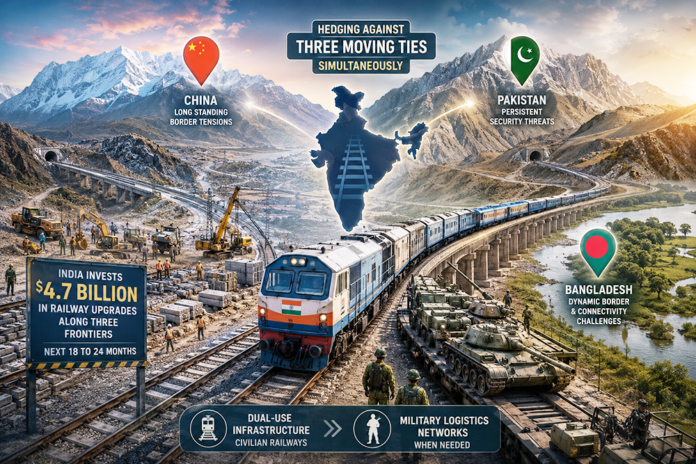
A number has been circulating this week that overstates its own subject by two orders of magnitude: India is not spending $450 billion on border railways. It is spending up to ₹45,000 crore — about $4.7 billion, on railway upgrades along its frontiers with China, Pakistan and Bangladesh over the next 18 to 24 months. That correction matters, because $4.7 billion is a far more realistic number than $450 billion. It is not a moonshot; it is a targeted, time-bound bet on a specific idea — that in an era of hardening borders on three sides, the ability to move trains matters as much as the ability to move troops.
What is Actually Being Built
According to Bloomberg’s reporting, the spending — sourced to officials who were not authorised to speak publicly — will fund new tracks, platforms and network strengthening across Punjab, West Bengal, Himachal Pradesh, Rajasthan, Assam and several northeastern states. That footprint is deliberately comprehensive: Punjab and Rajasthan face Pakistan, Himachal Pradesh and the northeast face China, and West Bengal sits astride the Siliguri Corridor — the narrow, 22-kilometre-wide stretch of land, nicknamed Chicken’s Neck, which is the only land link between mainland India and its entire northeast. The programme is not aimed at a single adversary or theatre. It is aimed at the idea of a frontier itself, wherever it happens to sit.

The footprint is deliberately comprehensive: Punjab and Rajasthan face Pakistan, Himachal Pradesh and the northeast face China, and West Bengal sits astride the Siliguri Corridor, which is the only land link between mainland India and its entire northeast. The programme is not aimed at a single adversary or theatre. It is aimed at the idea of a frontier itself, wherever it happens to sit
The scale, relative to India’s own railway budget, is the real headline: this border push alone will account for close to 22% of all railway infrastructure spending planned nationwide over the next two years, and it comes on top of, not instead of, the $3.4 billion northeastern rail package Bloomberg reported last September, which covered new lines, bridges and tunnels through some of the most difficult terrain in the country. Put the two together and India will have committed upward of $8 billion to frontier rail in roughly a year — a pace that has no recent precedent.
Three Borders, Three Different Problems
What makes the timing notable is that India is not responding to one crisis but hedging against three simultaneously moving relationships. Ties with China have steadied since the deadly 2020 Galwan clash, most visibly in this month’s reopening of border trade through Nathu La and Shipki La — but troop levels along the Line of Actual Control remain well above pre-2020 norms, and Beijing’s own infrastructure build-up on its side of the Himalayas has not slowed. India fought a brief conflict with Pakistan last year, a reminder that the western front can turn kinetic with little warning. And Bangladesh’s 2024 political upheaval has complicated a relationship India had long treated as its most stable, raising fresh anxiety in Delhi about the security of the Siliguri Corridor specifically.
None of these three borders behaves the same way, and that is rather the point. A rail programme flexible enough to serve a cautious thaw with China, a still-hot rivalry with Pakistan, and an uncertain new equation with Bangladesh is, in effect, an insurance policy against the possibility that India cannot predict which of its three difficult neighbours will demand urgent logistics capacity next.
None of these three borders behaves the same way. A rail programme flexible enough to serve a cautious thaw with China, a still-hot rivalry with Pakistan, and an uncertain new equation with Bangladesh is, in effect, an insurance policy against the possibility that India cannot predict which of its three difficult neighbours will demand urgent logistics capacity next
The Dual-Use Logic
Indian officials describe the programme using a specific term: dual-use infrastructure — civilian railways engineered from the outset to double as military logistics networks. High-capacity, all-weather lines through the Himalayas, the Siliguri Corridor and the northeast are meant to cut the time it takes to move troops and equipment to a crisis point, and to provide an alternative to roads that can be blocked by landslides, snow or, in a worse scenario, enemy action. This is not a new concept for Indian planners, but it has rarely been funded at this pace.

The programme builds on projects already delivered. The 272-kilometre Udhampur-Srinagar-Baramulla line, completed in 2025 at a cost of roughly ₹43,780 crore with 36 tunnels and 943 bridges, gave Kashmir its first all-weather rail link to the rest of India. The Bairabi-Sairang line brought Mizoram’s capital, Aizawl, onto the national network in September 2025. The Sevok-Rangpo line, still under construction, is expected to give Sikkim — the state that sits directly behind Nathu La — its first railway connection by December 2027. Plans for an underground corridor through the Siliguri Corridor itself are also under discussion. Each of these projects, individually, reads as a regional development story. Together, they describe a single strategic logic: close the connectivity gaps in exactly the places where India’s map is thinnest and its neighbours are least predictable.
A Smaller Number than China’s Own Bet
It is worth placing India’s figure against the region’s other big railway story. China has spent years advancing plans for a rail corridor connecting Kashgar in Xinjiang to Pakistan’s Gwadar port — proposals that Chinese state planners have at various points valued at tens of billions of dollars, part of the China-Pakistan Economic Corridor that India opposes because it runs through Pakistan-administered Kashmir. Beijing and Islamabad have also separately agreed to finance the multibillion-dollar upgrade of Pakistan’s Karachi-Peshawar line. Judged purely by rupee-for-yuan comparison, India’s $4.7 billion border push looks modest next to China’s regional ambitions. But the two programmes are not really playing the same game: China’s rail diplomacy is about projecting connectivity outward, into Pakistan and Central Asia; India’s is about hardening connectivity inward, into its own contested frontiers. One is offence by infrastructure; the other is closer to defence by infrastructure.

There is also a domestic dividend that deserves equal billing with the strategic one. Rail lines will run through various regions such as Kashmir, Mizoram, Sikkim, the Kinnaur and Kargil valleys, and Assam’s districts that sit at the thin edge of India’s transport map, cut off for months by weather and terrain. Rail access will facilitate faster movement of apples, cement, students and patients
The Limits of a Rail Line
None of this should be read as a guarantee of strategic advantage. Railways take years to build even when fully funded, and a line sanctioned in 2026 may not carry its first train until well into the next decade — the Sevok-Rangpo project, still short of completion after years of tunnelling through unstable Himalayan geology, is a caution against assuming speed. China, meanwhile, has spent close to two decades building rail and road networks on its side of the LAC, giving the People’s Liberation Army a substantial head start in forward logistics that India’s current push is only beginning to narrow. A $4.7 billion, two-year sprint closes part of that gap; it does not close all of it. And infrastructure, however dual-use, cannot substitute for the diplomacy that determines whether a border stays quiet enough for a railway to matter only for freight and pilgrims rather than for troop trains.
There is also a domestic dividend that deserves equal billing with the strategic one. Every line in this programme runs through regions — Kashmir, Mizoram, Sikkim, the Kinnaur and Kargil valleys, Assam’s frontier districts — that have historically sat at the thin edge of India’s transport map, cut off for months at a time by weather and terrain. All-weather rail access does not just move soldiers faster; it moves apples, cement, students and patients faster too. The Udhampur-Srinagar-Baramulla line’s most visible impact so far has been on Kashmir’s ordinary commuters and its fruit exporters, not on any military convoy. A programme justified in the language of deterrence will, in practice, be judged as much by what it does for the price of goods in a border town as by what it does for the speed of a division’s deployment.
What to Watch
The Railway Ministry has not confirmed the plan publicly, and Bloomberg’s sourcing — officials speaking on condition of anonymity — is a reminder that numbers this size can still shift before a budget line is finalised. But even as a proposal, the direction of travel is unmistakable: India is treating rail track as a form of strategic depth, to be built wherever the map looks most exposed, regardless of whether that border is currently cold, thawing or hot. Whether the $4.7 billion figure survives intact or grows further, the underlying wager will not change — that the fastest way to reduce uncertainty on three unpredictable frontiers is to make sure trains, troops and supplies can reach all of them at once.

The writer is an independent researcher. The views expressed are of the writer and do not necessarily reflect the views of Raksha Anirveda





