


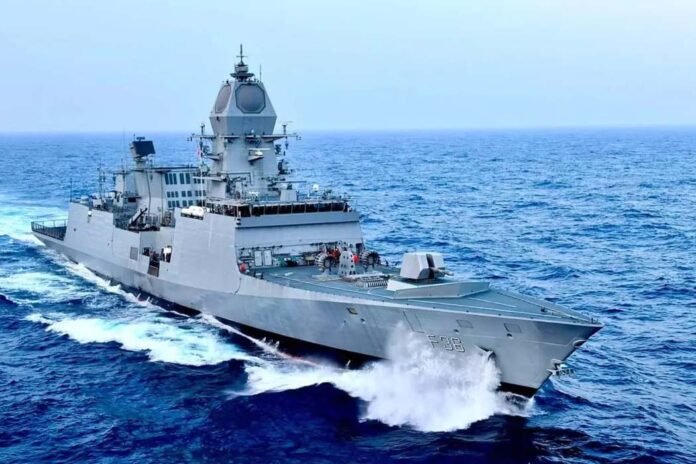
New Delhi. The Indian Navy has issued a request for proposal (RFP) for seven advanced stealth frigates under Project 17B, opening one of India’s largest indigenous warship programmes to competitive bidding.
The programme, estimated to cost around ₹70,000 crore, represents a significant change in the procurement of major naval platforms. Unlike several earlier destroyer and frigate programmes that were allocated through the nomination route, Project 17B will allow eligible Indian shipyards to compete on technical capability and commercial terms.

The RFP is understood to have been sent to Category A shipyards, including Mazagon Dock Shipbuilders Limited (MDL), Garden Reach Shipbuilders and Engineers (GRSE), Goa Shipyard Limited (GSL) and Cochin Shipyard Limited (CSL). The final contract value, however, will depend on the bidding process and the government’s evaluation of the proposals.
Project 17B is planned as the follow-on programme to Project 17A, the Nilgiri-class stealth frigate series. The Navy’s Project 17A programme comprises seven frigates, with four being constructed by MDL in Mumbai and three by GRSE in Kolkata. Designed by the Indian Navy’s Warship Design Bureau, the ships were developed to perform air-defence, anti-surface and anti-submarine missions.
The latest Project 17A milestone came in July 2026, when INS Mahendragiri, the sixth frigate of the class, was commissioned into the Eastern Fleet at Visakhapatnam. The vessel was designed by the Navy and built by MDL, and features more than 75% indigenous content. The remaining Project 17A frigate, INS Vindhyagiri, is being built by GRSE.
Project 17A vessels displace approximately 6,670 tonnes and use Combined Diesel or Gas propulsion. Their combat systems include BrahMos surface-to-surface missiles, the MF-STAR radar, medium-range surface-to-air missiles, a 76-mm naval gun and anti-submarine warfare equipment. They also incorporate advanced electronic warfare and integrated platform-management systems.

The Navy has not publicly released the complete configuration of the Project 17B frigates. However, the new ships are expected to improve on the Nilgiri-class design, with enhanced low-observable features, more capable sensors, advanced combat-management systems and stronger air-defence and long-range strike capabilities.
Reports indicate that the vessels could be equipped with modern vertical-launch missile systems and indigenous electronic warfare suites. BrahMos cruise missiles are also expected to remain part of the wider weapons architecture, although the final fit will be determined through the procurement and design process.

The shift to competitive bidding could have broad implications for India’s naval shipbuilding sector. MDL and GRSE have extensive experience in constructing frontline warships, while GSL and CSL have expanded their infrastructure and capabilities in recent years. Competition could encourage shipyards to improve construction schedules, reduce costs and develop more efficient production methods.
It could also distribute work more widely across the domestic defence-industrial base. Large warship programmes support hundreds of smaller suppliers involved in engineering, electronics, propulsion, fabrication and specialised equipment. Project 17A, for example, involved more than 200 Indian industries and achieved substantial domestic participation.
The Project 17B proposal had already advanced through the defence procurement system. In September 2024, the Defence Acquisition Council granted preliminary approval, or Acceptance of Necessity, for 10 capital-acquisition proposals valued collectively at ₹1.44 lakh crore. The seven-frigate requirement was included among those proposals and was then estimated at approximately ₹70,000 crore.
The RFP now moves Project 17B from planning to the formal tender stage. The Navy’s decision comes as the Project 17A construction cycle approaches completion and as India seeks to expand its blue-water capabilities amid growing strategic competition in the Indian Ocean Region.
For the Navy, the seven new frigates will provide additional platforms capable of escorting carrier groups, protecting sea lanes, conducting surveillance and responding to maritime contingencies. For India’s shipbuilding industry, the programme will test whether multiple domestic yards can compete while meeting the demanding technical, delivery and quality requirements of modern naval construction.






