


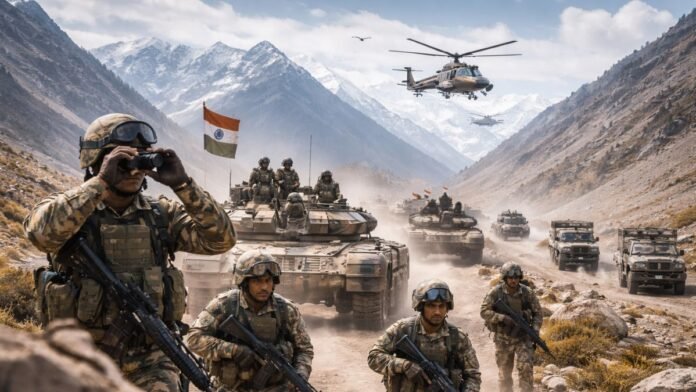
NEW DELHI. In one of the most comprehensive organisational restructurings in its independent history, the Indian Army is set to establish and operationalise its first Integrated Battle Groups (IBGs). These lean, brigade-sized fighting units are designed for rapid mobilisation and high-intensity, combined-arms operations. Originally scheduled for implementation by September, the timeline has been advanced to July 1, reflecting an increased urgency to fortify defence capabilities along the northern and eastern frontiers.
The initial rollout will see the creation of four IBGs and a dedicated fire support group. These entities will be carved out of the Panagarh-based XVII Corps, widely known as the Mountain Strike Corps (MSC), which directly faces China. To ensure top-tier strategic oversight, each of these five new formations will be commanded by a Major General.

Structuring a Lethal, Self-Contained Force
Moving away from the traditional, bulky division-based framework, each new IBG will function as a highly versatile combat force. Comprising over 5,000 troops spread across 12 to 13 distinct units, an IBG will possess all the necessary resources to wage localised warfare independently.
The structural blueprint integrates multiple arms of military operations directly into a single command structure. Each battle group will include:
- Infantry battalions for ground holding and offensive manoeuvres
- Artillery regiments for precise fire cover
- Combat Engineers for tactical mobility and obstacle clearance
- The Corps of Electronics and Mechanical Engineers (EME) for on-field technical support
- The Army Service Corps (ASC) for streamlined logistics
- Dedicated field hospitals to provide immediate medical support
A Brigadier-rank officer is expected to step into the role of Chief Operations Officer within each group to streamline command and control. Meanwhile, the fifth element – the fire support group – will operate directly under the corps headquarters, concentrating heavy artillery platforms and incorporating the Army’s newly raised Divyastra batteries.
Overcoming the Tyranny of Terrain
The fundamental strength of an IBG lies in its mobility. In the rugged, high-altitude landscapes of the Himalayas, traditional mobilisation is notoriously slow. A standard military corps comprises up to a lakh (100,000) troops, requiring weeks to coordinate, transport, and deploy.

By contrast, the compact nature of an IBG allows elements to be deployed within hours, skipping the logistical bottleneck of waiting for an entire corps to assemble. This nimbler posture offers equal utility in both offensive strike roles and immediate defensive operations against unexpected adversarial incursions.
Part of a Global, Modernised Blueprint
The implementation marks the realisation of a vision first proposed nearly seven years ago under a series of restructuring studies initiated by the late Chief of Defence Staff, General Bipin Rawat. While the concept was test-bedded in 2019 along the western border with Pakistan under the IX Corps and validated during the “HimVijay” high-altitude exercises in the eastern sector, this marks its formal, permanent integration into the force structure.

India’s shift to smaller, modular units mirrors broader international military trends. Over the past decade, China’s People’s Liberation Army (PLA) similarly restructured its forces, abandoning legacy divisions in favour of versatile Combined Arms Brigades (CABs) that integrate armour, artillery, and air defence.
The transition to IBGs accompanies other specialised initiatives within the Indian Army, including the raising of Bhairav battalions, Rudra brigades, Divyastra batteries, and Shaktibaan units. Together, these developments represent a definitive pivot toward a capacity-driven, modernised defence model tailored for 21st-century warfare.






