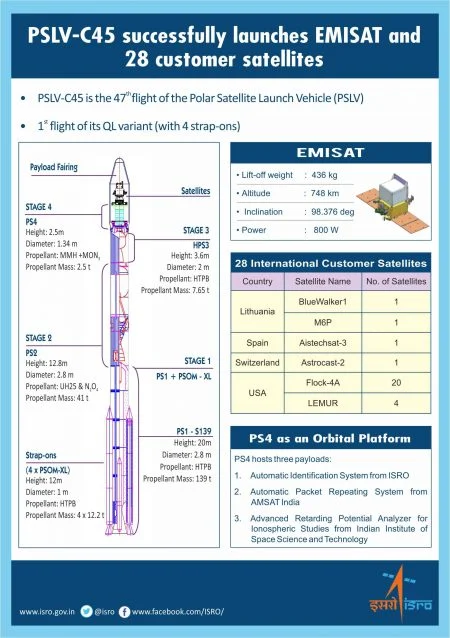
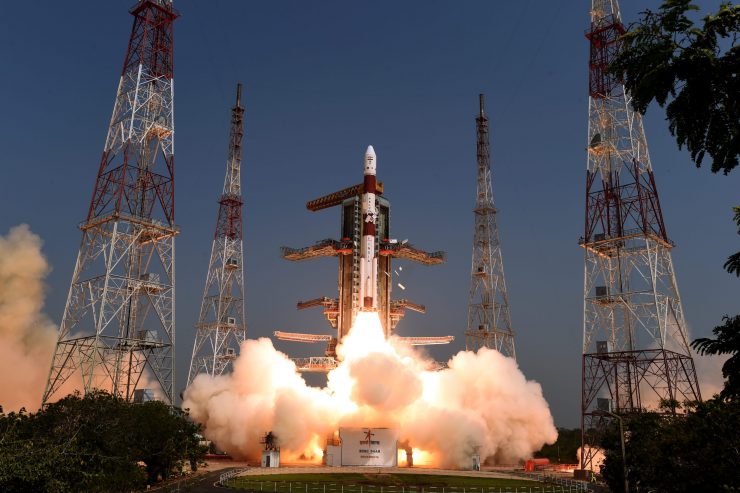
Sriharikota. India’s Polar Satellite Launch Vehicle (PSLV-C45) on April 1 successfully launched EMISAT and 28 international customer satellites from Satish Dhawan Space Centre (SDSC) SHAR in Sriharikota.

This flight marked the first mission of PSLV-QL, a new variant of PSLV with four strap-on motors.
PSLV-C45 lifted off at 9:27 Hrs (IST) from the Second Launch Pad and injected India’s EMISAT into a 748 km sun-synchronous polar orbit, 17 minutes and 12 seconds after lift-off.
After separation, the two solar arrays of EMISAT were deployed automatically and the ISRO Telemetry Tracking and Command Network at Bengaluru assumed control of the satellite. In the coming days, the satellite will be brought to its final operational configuration.

Following the separation of EMISAT, the vehicle’s fourth stage engines were restarted twice to place the 28 international customer satellites precisely into a sun-synchronous orbit of 504 km height. The last customer satellite was placed into its designated orbit 1 hour and 55 minutes after lift-off.
About three hours after lift-off, the fourth stage (PS4) of the vehicle was moved to a lower circular orbit of 485 km after two restarts to establish it as an orbital platform for carrying out experiments with its three payloads.

EMISAT is a satellite built around ISRO’s Mini Satellite-2 bus weighing about 436 kg. The satellite is intended for electromagnetic spectrum measurement.
The 28 international customer satellites, together weighing about 220 kg, are from four countries, namely, Lithuania (two), Spain (one), Switzerland (one) and US (24). These foreign satellites were launched as part of commercial arrangements.
The payloads carried by PS4 are Automatic Identification System from ISRO, Automatic Packet Repeating System from AMSAT, India and Advanced Retarding Potential Analyzer for ionospheric studies from Indian Institute of Space Science and Technology.
ISRO Chairman Dr K Sivan congratulated the launch vehicle and satellite teams involved in the mission.
“Today’s PSLV mission was unique in several ways. It was a four strap-on new variant, the vehicle achieved three different orbits and for the first the PS4 stage is powered by solar panels,” Dr Sivan said. He added that a new PSLV team executed today’s mission.
Dr Sivan also placed on record the significant involvement of the industry in this mission.
So far, PSLV has launched 46 national satellites, 10 satellites built by students from Indian Universities and 297 international customer satellites, including the satellites launched today.
In its next mission, PSLV-C46 will launch RISAT-2B in May 2019.