


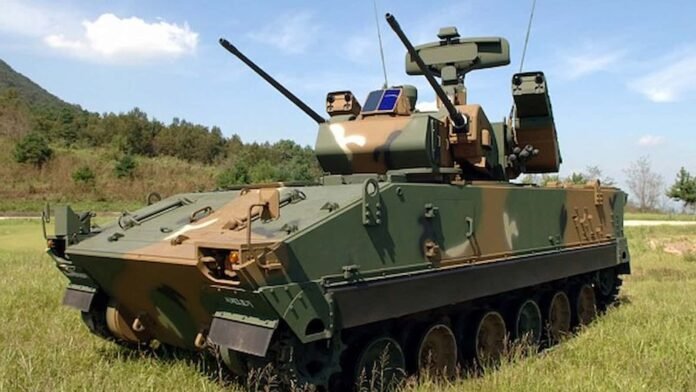
South Korea and India have reopened discussions on a proposed sale of the K30 Biho Hybrid air-defence system, a potential deal that was previously stalled despite being valued at approximately $2.5 billion.
The issue was raised during a meeting of the Joint Commission on Defence and Logistics in New Delhi on September 29. Officials from South Korea’s Defense Acquisition Programme Administration and India’s Defence Ministry reviewed the status of bilateral defence-industry cooperation and discussed ways to advance major projects, including the Biho system

The K30 Biho, manufactured by Hanwha Aerospace, is a self-propelled short-range air-defence platform designed to protect armoured and mechanised formations from low-altitude threats. It combines twin 30-millimetre rapid-fire cannons with surface-to-air missiles, allowing it to engage targets at both close and extended ranges.
The system is intended to counter helicopters, low-flying aircraft, cruise missiles and unmanned aerial vehicles. Its radar and electro-optical sensors can detect and track targets, while its mobile tracked chassis enables it to accompany tanks, infantry fighting vehicles and artillery units in difficult terrain.
India had earlier selected the Biho after evaluation against competing systems. The platform reportedly outperformed Russia’s upgraded Tunguska-M1 and Pantsir systems during trials, and the Defence Acquisition Council approved the proposal in 2021. However, the procurement did not progress to a final contract.
The project’s earlier stagnation was linked to India’s insistence on domestic manufacturing and technology transfer, as well as competition from existing Russian-origin equipment in the Indian military. The renewed discussions suggest that operational requirements may now be receiving greater weight in New Delhi’s acquisition planning.

India’s need for mobile short-range air defence has grown as militaries worldwide confront increasingly widespread use of small drones, loitering munitions and low-cost aerial weapons. Recent conflicts have shown that drone swarms can overwhelm conventional surveillance and interception systems, particularly when attackers use large numbers of inexpensive platforms.
The K30 Biho’s combination of guns and missiles is intended to provide layered protection. The 30-millimetre guns can engage relatively close targets without using expensive missiles, while the missile component extends the system’s reach against faster or more heavily protected threats. The arrangement could help address the cost imbalance often created when high-value interceptors are used against cheap drones.

Reports in India have linked the renewed interest to lessons from Operation Sindoor, during which counter-drone and air-defence capabilities became central to military planning. Analysts have suggested that the Indian Army may seek a fresh Acceptance of Necessity before restarting the acquisition process. However, neither side has announced a final decision, order quantity or contract timeline.
Some reports have estimated a requirement for about 104 systems, with a potential value of $2.5 billion to $2.6 billion. That figure remains an estimate and could change if India modifies its operational specifications, seeks a different level of local production or chooses to combine imported systems with indigenous components.
The talks also covered South Korea’s K9 self-propelled howitzers, which are already operated by the Indian Army. The K9 Vajra-T programme has been produced in India through cooperation involving Hanwha Aerospace and Larsen & Toubro, making it an important example of bilateral defence manufacturing.
Seoul and New Delhi also discussed efforts to revive a 2020 defence partnership roadmap, expand industry and academic exchanges, and identify future areas for joint development. The South Korean side stressed the need to ensure stable progress and operational support for major defence projects.
A revived Biho agreement would deepen defence ties between the two countries while giving India another option for modernising its short-range air-defence network. For South Korea, the deal would extend Hanwha’s growing international defence presence and demonstrate that the company can support large-scale technology-transfer and local-production programmes.
The immediate challenge will be reconciling India’s demand for indigenous production with Seoul’s interest in protecting technology and securing a commercially viable contract. Whether the latest discussions produce a purchase will depend on those negotiations, as well as the Indian Army’s assessment of changing air-defence requirements.






