


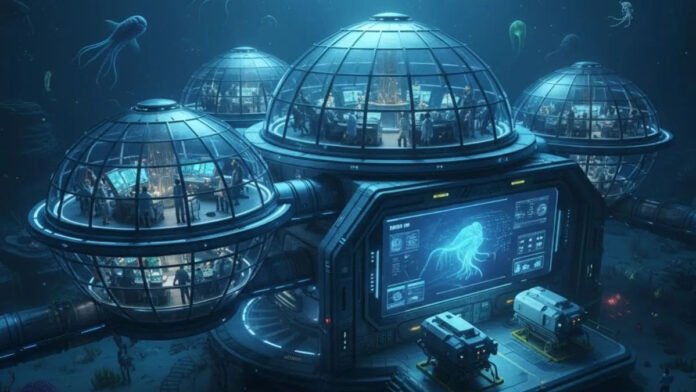
New Delhi: India has unveiled an audacious plan to construct the world’s deepest underwater research laboratory, positioned 6,000 metres (19,700 Feet) beneath the Indian Ocean. This visionary initiative marks a major milestone under India’s Vision 2047 programme, aligning with the centenary of the nation’s independence. The project seeks to redefine humanity’s understanding of the deep ocean and establish India as a global leader in marine science and technology.
The upcoming deep-sea habitat is conceptualised as an oceanic counterpart to the International Space Station, enabling long-duration human operations in extreme underwater environments. To validate the concept, a pilot phase will first deploy a prototype module at 500 metres depth. This preliminary stage will host three scientists underwater for more than 24 hours, testing pressure endurance, life-support systems, and the logistical workings required for sustained habitation in the deep ocean. Success in this stage will clear the path for full-scale construction at 6,000 metres, a depth never before reached by a manned research facility.

The deep-ocean lab’s engineering design represents a fusion of advanced material science and systems innovation. Its hull will be made of pressure-resistant titanium alloys and composite materials capable of withstanding pressures 600 times that at the surface. The laboratory will incorporate transparent viewing panels, offering a 360-degree panorama of the surrounding deep-sea environment. Autonomous life-support systems will regulate oxygen, carbon dioxide, and temperature while independent laboratory modules will permit simultaneous research activities.
Docking bays for submersibles and remotely operated vehicles will enable crew transfer, resupply, and emergency evacuation. A robust underwater communication network will link the station to surface control centres using acoustic transmission and fibre-optic data lines. These systems will transmit real-time scientific data and video feeds to research hubs located onshore.
The habitat will also feature renewable energy integration and modular expandability, making it suitable for multi-mission use and long-term deployment. Together, these elements will allow an uninterrupted human presence at depths previously accessible only to remote instruments.
Scientifically, the project promises transformative discovery potential. The deep-sea habitat will unlock access to uncharted ecosystems and unique life forms thriving under immense pressure and darkness.

Marine biologists will study rare organisms and their adaptations, potentially leading to new insights for biotechnology and regenerative medicine. Pharmaceutical researchers will focus on extracting bioactive compounds from deep-sea microbes, which may inspire next-generation antibiotics and anti-cancer agents. Extreme-environment enzymes could further be applied in industrial biotechnology and materials science.
Geologists and geophysicists will use the platform to investigate tectonic plate interactions, undersea volcanic processes, and mineral deposits across the abyssal plains. These studies could illuminate the dynamics of Earth’s crust and support strategic exploration of critical minerals such as cobalt, nickel, and manganese from polymetallic nodules. Human performance researchers will explore the physiological and psychological challenges of functioning in high-pressure isolation, offering valuable parallels to long-term space missions.

When completed, India’s 6,000-metre lab will set a global benchmark far exceeding the current standard represented by the United States’ Aquarius Reef Base in Florida, which operates at a depth of just 19 metres. No other nation has attempted a manned research station at such profound depths, positioning India at the forefront of oceanic exploration.
This initiative dovetails with the broader Samudrayaan project, under the Ministry of Earth Sciences, which is already developing crewed submersibles capable of descending to similar depths. Together, these programmes embody India’s growing scientific ambition in marine technology, resource assessment, and environmental stewardship.
By 2047, the underwater research station aims to serve as a permanent hub for international collaboration, much like the ISS does in space. It will symbolise the country’s transition from a regional maritime power to a global science and technology leader. The world’s deepest laboratory will not only expand the frontiers of knowledge but also portray India’s commitment to sustainable ocean exploration in the service of humankind’s shared scientific future.






