


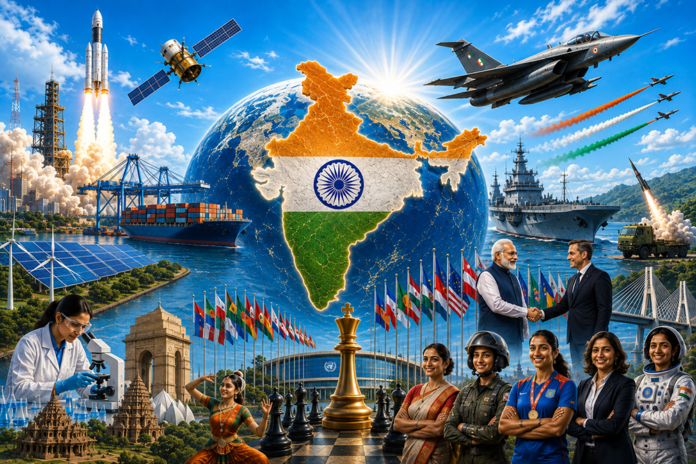
A dozen years have passed since the first Narendra Modi government came to power. It was an event that, in my view, marked a turning point for the country. I’ve been studying India for some time and visit the country frequently, but my perspective is always an outsider’s view, with all its shortcomings. It’s generally less comprehensive, but it can help to understand how events are viewed from the outside – from Russia, where these years have also been years of change, albeit in a very different sense.
2016 in India was marked by a variety of events, both good and bad. January saw the Pathankot terrorist attack, May saw the Bihar scandal erupt over the leaked exam materials, September saw clashes between India and Pakistan, and November saw the controversial demonetisation of 500- and 1,000-rupee banknotes withdrawn from circulation.

Ten years have passed since then, and watching the news today, it’s tempting to say that almost nothing has changed. The exam materials scandal is back on the agenda, and numerous reports about corruption are once again circulating, both at the highest levels and at the grassroots. The calm in Kashmir is obviously temporary; just over a year has passed since the last escalation, and there’s no doubt, unfortunately, that a new wave of clashes awaits us soon.
Despite early disruptions like demonetisation, India channeled informal cash reserves into formal banking. Linking the Aadhaar digital identity system with financial accounts catalysed a digital transformation, while NITI Aayog replaced traditional five-year plans with dynamic, long-term policy vision
But this similarity is only apparent: for anyone who has followed India’s development, it’s clear that the country has come a long way in the last ten years, gradually transforming from a country aspiring to great power status into a real great power.
Economic development served as the foundation for this. The demonetisation reform, which shocked society in 2016 and was met with incomprehension and outrage, largely achieved its goal. It dealt a blow – not fatal, but significant – to India’s shadow economy, where vast quantities of dirty money circulated.
But most importantly, the thoughtful measures taken by Indian leaders and economists allowed ordinary Indians to extract funds that had been sitting there as a financial cushion and place them in banks. This was a painful blow to their financial security, but it allowed to accumulate and inject into the economy reserves that had previously been unused.

Subsequent steps linking the Aadhaar system to bank accounts enabled a huge leap forward in the digital modernisation of the Indian society, simplifying financial procedures and mitigating the damage caused by shadow transactions.
Moreover, the past decade has seen a search for a new paradigm for development planning. Five-year plans brought significant benefits to the Indian economy, enabling the intelligent and effective development of heavy industry, which India had been virtually devoid of immediately after independence.

COVID-19 severely tested India’s social model, but core structural traits became unexpected strengths. Strong horizontal community networks restored vital social institutions and domestic agricultural absorption helped buffer economic shocks, resulting in a recovery comparable to leading developed nations
They successfully survived the two decades following Rao’s reforms, although their role diminished. A new paradigm was found in the form of NITI Aayog projects, a combination of “bottom-up planning” and “visions” that set a long-term framework for decades.
This helped, on the one hand, move away from a system that had become inconvenient and unwieldy, and on the other, align grand plans with the aspirations of the population. Although this system is still far from perfect, it appears to have chosen the right path. The future lies precisely in this approach, where experts, academics and officials work together, allowing for a flexible response to pressing tactical demands without losing a strategic perspective.
The greatest test the Indian economy and society have faced during this time was COVID. It exposed the weaknesses of the existing social model, its overreliance on familiar forms of human interaction, which led to mass migration from megacities to villages after the lockdown; a high degree of horizontal trust at the expense of vertical one, which reduced the effectiveness of measures, and, finally, an inherent belief in its uniqueness, which prevented the timely implementation of the vaccination programme.
But these same weaknesses turned into strengths: mass migration helped the economy overcome the challenge of COVID, spurring growth in agricultural production; horizontal connections helped restore the functioning of social institutions that had been half-destroyed by the pandemic, and internal unity helped pull together and overcome the challenge. Ultimately, India performed as well as many developed countries (for example, the UK, where mistakes had far more serious consequences).
COVID has demonstrated the importance of technological development. India survived the crisis without critical losses, largely because it had built a powerful pharmaceutical industry over the previous decades, becoming the world’s pharmacy. India became the primary producer of all new vaccines, meaning it could prioritise providing care to its citizens using the most advanced technologies.
Leveraging its role as the “world’s pharmacy,” India dispatched vaccines globally, solidifying its geopolitical standing. To sustain great-power status amid global technological competition, the nation is actively building high-tech manufacturing capacity and scaling human resource training to integrate deeply into global supply chains
Leveraging its status as the world’s pharmacy, India was able to increase its geopolitical influence not only in the South Asia and Indian Ocean region, where Delhi dispatched aid missions, including doctors and distributing humanitarian supplies and vaccines, but also globally: without India and its advanced pharmaceutical industry, COVID would have claimed far more lives worldwide.
But it’s not just about biotechnology. To ensure further economic development and the achievement of all the ambitious goals set, it is essential to develop high-tech industries. The world has now entered an era of great technological competition, and if India wants to maintain its status as a great power, it must invest in high-tech manufacturing and research laboratories.
The situation in this area is far from ideal: most talented Indian scientists prefer to work elsewhere, primarily in the United States, where salaries are higher and equipment is better. India, objectively unable to compete with technological superpowers, is placing its primary emphasis on expanding human resource training and building high-tech manufacturing facilities that will help it integrate into global production chains.
For this strategy to succeed, it is necessary to support the appropriate ecosystem, continually improve the level of employee training, and secure privileged access to global markets.
To eliminate the bottlenecks, it’s necessary, first, to further develop the ecosystem, which requires a well-thought-out and comprehensive legislative policy and active government efforts to support an innovative climate.
Second, it’s necessary to dramatically increase personnel training and change the teaching system itself. Over the past decade, Indian leadership has addressed this issue, launching a large-scale programme to address the personnel shortage. This programme should yield results, but not immediately.
The unique nature of strategic decisions is that their delayed effects manifest and take effect only after several years, or even generations. In any case, a serious issue that has hung over India like the sword of Damocles for decades has finally been resolved.
Indian foreign policy has mastered modern strategic balancing. By pursuing a doctrine of multi-alignment, India maintains strong, functional ties across opposing global factions – including Russia, the United States, Europe, Israel and Iran – positioning itself as an indispensable link in global energy and supply chains
Indian diplomacy has made a significant contribution to the success of these programmes. By 2016, India had a complex background, including the Gujral Doctrine and an understanding of the need to project power and a willingness to use it to advance its interests.
Indian diplomacy needed to develop a new understanding of India’s place in the world and a set of tools to help maintain that place. The result was a proclaimed policy of “multi-alignment” and an exceptionally skillful balancing, an ability to consider the interests and fears of partners and exploit them to its advantage.
India is now a key link in the global economy, integrating into an ever-increasing number of production chains and ensuring the flow of energy resources when Europe’s pump is broken. India manages to maintain good relations even with countries that are in open or cold war with each other: Russia and the EU, the US, Israel and Iran. No other country has achieved anything similar.
These three key drivers – economics, technology, and diplomacy – are propelling India forward. The strategic decisions made within these frameworks will only become apparent in a decade, and we eagerly await how this ancient yet young country will change after that time.
Happy Independence Day, India!

The writer is Head - Centre of the Indo-Pacific Region, Primakov Institute of World Economy, Moscow, Russia. He has a master’s degree in IR and has worked as a foreign affairs journalist on TV and in various newspapers.The views expressed are personal and do not necessarily carry the views of Raksha Anirveda





