


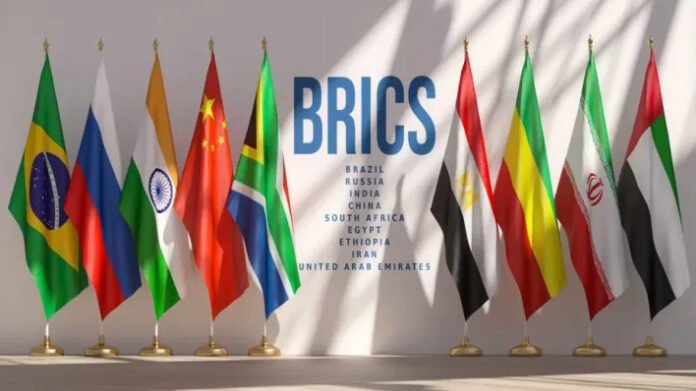
After successfully organising the G-20, India set out some non-negotiables, emphasising that despite headwinds in the global order, there is an urgent and strong need for strategic partnerships and de-hyphenations to rise above narrow global politics and build a rule-based, shock-resilient global order aimed at peace and progressive, sustainable development. Three years ago, India successfully sent this strategic message in the shadow of the Russia-Ukraine war, and now India is set to deliver a renewed message with a broader vision for upholding global security and stability. But it must also ensure that the Summit emerges from the shadow of hard-power polarisation and is projected as a real success.
BRICS: The West’s Biggest Challenger?
The BRICS Summit 2026, under India’s chairmanship, is scheduled for September 12-13, while a series of Sherpa and ministerial meetings have been taking place for weeks. BRICS economies account for over 1/3 of the global economy. BRICS is known as a commodity powerhouse due to its dominance in global production, accounting for 45% of the world’s agricultural production value, and as a group of major oil and gas producers, including Saudi Arabia, Iran, and the UAE. The bloc commands a massive share of global energy resources.

Keeping the current situation in West Asia in mind, this summit can be seen as a significant strategic realignment against the US and the West. BRICS aims to reduce dependence on the dollar by creating resilient trade corridors, such as the International North-South Transport Corridor (INSTC), to protect global logistics in political instability and to diversify the supply chain for the Global South
Keeping the current situation in West Asia in mind, this Summit can be seen as a significant strategic realignment against the US and the West. One of the key pillars of BRICS is de-dollarisation, with the primary aim of reducing dependence on the dollar by creating resilient trade corridors, such as the International North-South Transport Corridor (INSTC), to protect global logistics in the event of political instability and to diversify the supply chain for the Global South. BRICS also aims to bypass Western-led financial dominance by establishing the New Development Bank (NDB), which serves as a funding body for developing economies and a contingent reserve arrangement in the event of a currency crisis. Therefore, it is a platform that focuses on a multipolar world order and acts as a collective voice that pushes for fairer representation to balance the scales relative to the influence of the G7.
India’s Grand Strategy
India has placed strategic autonomy at the centre of its approach to navigating the changing global order. This strategy must rest on multi-vector diplomacy and diversification, focusing on moving beyond fixed superpower orbits while remaining engaged with them to advance its interests. While lessons have been learned from the shortcomings of the Non-Aligned Movement, strategic autonomy has now evolved into a broader grand strategy through which India deploys both hard and soft power to assert and negotiate its security and strategic interests.
India is well aware that BRICS will serve as a platform to move beyond routine diplomatic engagement and pursue deeper diversification. This entails shifting away from transactional buying-and-selling relationships towards co-creation of technologies, issue-based alignments, and more meaningful engagement with minilateral and multilateral frameworks. This is evident in a growing capacity to take calculated risks in the economy and commerce. A gradual shift from shallow engagements to leveraging ties to build durable partnerships will deepen India’s grasp of the region and open more doors for global expansion.
India has placed strategic autonomy at the centre of its approach to navigating the changing global order. This strategy must rest on multi-vector diplomacy and diversification, focusing on moving beyond fixed superpower orbits while remaining engaged with them to advance its interests
BRICS: India’s Economic and Strategic Lever
India’s 2026 Presidency of the BRICS summit presents an opportunity to transform BRICS from a consultative forum into a catalyst for economic resilience. By advancing trade diversification, financial innovation, technology partnerships, and supply-chain security, India can reinforce its strategic autonomy in an increasingly fragmented global order. Adding economic and diplomatic plus points to the current foreign policy will not only open doors to a regional upper hand but also put India right among the global superpowers.

India’s chairmanship provides agenda-setting leverage to institutionalise economic cooperation. Such cooperation mobilises capital, technology, markets, and production networks, thereby strengthening India’s comprehensive national power.
BRICS 2026: India’s Strategic Perspective
India’s BRICS vision is not only based on a basic agenda and global spotlight but also on making multilateralism more formidable and creating space to shift it from a plurilateral forum.

The vision and theme set by India revolve around four pillars: First, Resilience, which focuses on strengthening economic, social, and institutional resilience to navigate global uncertainties, supply chain disruptions, health challenges, and climate risks. Second, innovation involves deploying new and emerging technologies, such as digital public infrastructure, fintech, AI, and knowledge sharing, to enable effective service delivery for future-ready growth. Third, Cooperation, which deepens multilateral engagement among BRICS members through enhanced policy coordination, development finance, trade facilitation, reforms in global institutional governance, and people-centric partnerships. And fourth, Sustainability, where accelerating collective efforts towards climate action, green finance, energy transitions, and sustainable development will align national and global priorities. Together, these four pillars form a collective coil that will bind the Global South’s approach in the international arena.
Instead of drawing BRICS into a hard-power contest that fuels anti-West sentiments, India can instil a strategic message that emphasises the importance of multipolarity and a rule-based global order, while providing space for the Global South to address global challenges ranging from unilateral protectionism, such as tariffs and green adjustment mechanisms, to security challenges
Instead of drawing BRICS into a hard-power contest that fuels anti-West sentiments, India has an opportunity to instil a strategic message that emphasises the importance of multipolarity and a rule-based global order, while providing space for the Global South to address global challenges ranging from unilateral protectionism, such as tariffs and green adjustment mechanisms, to security challenges. It can also offer practical development solutions, such as vaccine equity, digital inclusion, and climate finance, along with reforms in global institutions like the UN, World Bank & IMF to strengthen emerging economies without formal military alliances.
BRICS Chairmanship provides India with an opportunity to strengthen faith in the push for global stability, diversification, and peace, and to gain considerable negotiating leverage that will benefit India’s strategic autonomy, both directly and indirectly. India’s vision is capable of positioning it as a rising strategic power, while also reminding the world of global realities and offering ways to navigate them, setting a diplomatic benchmark and firmness in its belief in Vasudhaiva Kutumbakam.

The writer is a journalist at a leading media house with a keen interest in policy research, strategic affairs, international relations, and security. She has experience in digital journalism, media management, and a government think tank. She holds a Master's degree in Digital Media and Journalism. The views expressed are personal and do not necessarily reflect the views of Raksha Anirveda





