


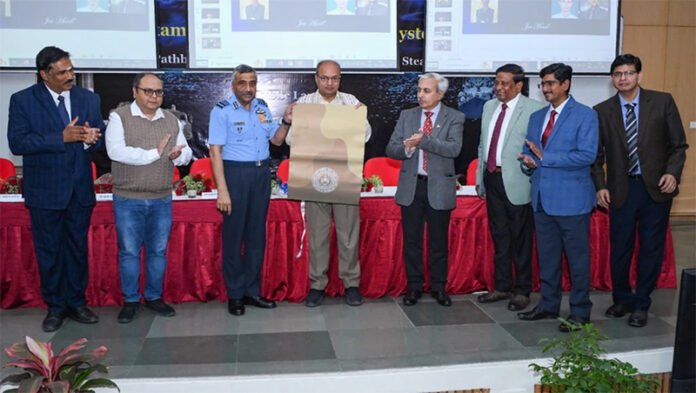
New Delhi: The Indian Institute of Technology Kanpur (IITK) has made a significant leap forward in stealth technology with the unveiling of its revolutionary Metamaterial Surface Cloaking System (Anālakṣhya MSCS). This cutting-edge innovation is poised to transform defence and national security capabilities, providing India with a major advantage in countering modern surveillance technologies, particularly Synthetic Aperture Radar (SAR) systems.
The Anālakṣhya MSCS, developed by a team of leading researchers at IIT Kanpur, including Prof Anantha Ramakrishna (Dept. of Physics), Prof Kumar Vaibhav Srivastava (Dept. of Electrical Engineering), and Prof J Ramkumar (Dept. of Mechanical Engineering), is designed to offer near-perfect wave absorption across a broad electromagnetic spectrum. This innovative metamaterial is capable of rendering objects virtually invisible to SAR imaging, a key tool in modern military surveillance.

The system’s unveiling was marked by a ceremony attended by top defence and academic leaders. Among the key speakers were Air Marshal Ashutosh Dixit, Air Officer Commanding-in-Chief of the Indian Air Force’s Central Air Command, and Lieutenant General Cherish Mathson, who both highlighted the strategic importance of the technology. Air Marshal Dixit praised the ingenuity behind the system, stating, “This revolutionary camouflage technology represents a bold leap forward in countering one of the greatest operational challenges militaries face today: the pervasive and precise reach of modern intelligence, surveillance, and reconnaissance systems.”
The Anālakṣhya MSCS marks a critical advancement in multispectral stealth capabilities. Its design addresses several operational challenges in modern warfare by providing a new level of protection against radar-guided missiles and surveillance systems. The material’s broadband microwave absorption properties offer a comprehensive solution for shielding military assets from detection across various frequency ranges. This is especially vital in scenarios where conventional stealth technology might fail to provide adequate protection.
“This technology is a game-changer for military movements,” said Air Marshal Rajesh Kumar, highlighting the global strategic significance of the innovation. “In technologically contested environments, battlefield transparency can slow down operations, and this material provides the edge we need to stay ahead.”
The system’s development was a collaborative effort involving IIT Kanpur’s faculty and their team of research students, including Gagandeep Singh, Dr Kajal Chowdhary, and Dr Abhinav Bhardwaj, among others. It was tested extensively in laboratory and field conditions from 2019 to 2024 to ensure its efficacy in diverse operational settings. Over 90% of the materials used in the Anālakṣhya MSCS are indigenous, underlining India’s growing self-reliance in defence technologies.

Prof Manindra Agrawal, Director of IIT Kanpur, expressed his pride in the achievement, saying, “IIT Kanpur’s commitment to advancing defence technology is exemplified by this remarkable material with exceptional stealth properties. We are confident that this innovation will have a lasting impact on strengthening our defence forces.”
The technology has been licensed to Meta Tattva Systems Pvt. Ltd., a company tasked with its manufacturing and deployment, marking an important step toward mass production. The Indian Armed Forces are already in the process of acquiring the system, recognising its vital role in enhancing national security and operational efficiency.

Lt General Cherish Mathson also praised the foresight behind the project, stating, “When we realised in 2019 that the biggest threat to military movements was SAR, it was clear that this ground-breaking invention at IITK was the answer. This innovation aligns perfectly with the vision of our Prime Minister, showcasing India’s technological prowess.”
The Anālakṣhya MSCS is not only a technological marvel but also a testament to the successful collaboration between academia, defence forces, and the private sector. It is a shining example of India’s growing defence manufacturing capabilities, which are increasingly aligned with the nation’s “Make in India” and “Aatmanirbhar Bharat” initiatives. The system’s development also highlights the country’s potential to lead in the global defence technology race.

Raksha Anirveda's editorial desk team brings in the collective experience of creative professionals - a fine mix of senior copy editors, writers, proofreaders and designers. Working as a team, they continuously create, manage, and curate content to sustain the magazine's profile and reputation in line with market trends and achieve magazine's goal.





