Bengaluru: Physics and ESE researchers at the Indian Institute of Sciences (IIS) here have developed a scalable and user-friendly platform to carry out advanced quantum experiments.
Quantum computers can solve certain computational problems much faster than ordinary computers by using specific quantum properties. The basic building blocks of such machines are called quantum-bits or qubits. Qubits can be realised using several physical platforms such as nuclear spins, trapped ions, cold atoms, photons, and using superconducting Josephson circuits. Several such qubits operate in the microwave frequency domain, and require specialised room temperature microwave electronics for control and readout of the quantum states of the qubits.

However, there lies a challenge when it comes to connecting classical electronics to these qubits. The qubits need high frequency (GHz) electromagnetic signals for control and readout pulses in the order of a few tens of nanoseconds. The traditional setup for generation and capture of such signals is often costly and complex with many components. This can be addressed by developing a specific FPGA-based system that brings the functionality of all the traditional equipment on to a single board. However, with such developments, three main challenges need to be kept in mind: generation and capture of the high-fidelity microwave signals, scalability, a user-friendly interface.
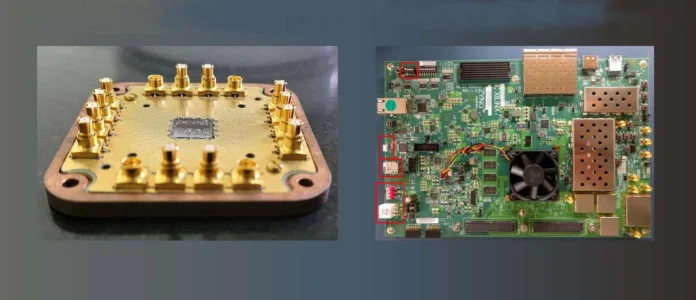
In a new study, researchers from the Departments of Physics and Electronic Systems Engineering, IISc, have addressed these challenges with the development of Scalable Quantum Control and Readout System (SQ-CARS), using Xilinx RFSoC FPGA board. The team tested their SQ-CARS system by conducting different experiments with superconducting transmon qubits and benchmarked it against the traditional setup.
“SQ-CARS is quite a versatile electronics platform which has been extensively tuned up for speed, scale, complexity and cost, while measuring multi-qubit devices in the microwave domain,” says Vibhor Singh, Associate Professor in the Department of Physics, IISc, and one of the authors. “To the best of my knowledge, it is the first of its kind deep-tech effort from India.”
With SQ-CARS, the researchers have developed a scalable and user-friendly platform for physicists to carry out advanced quantum experiments at a fractional cost (more than 10x reduction in the cost) and huge reduction in terms of size.

“The core challenge in practical quantum computer development is integrating a large number of qubits with control and readout electronics. This work lays the foundation for scalable indigenous quantum processors,” says Chetan Singh Thakur, Associate Professor in the Department of Electronic Systems Engineering, IISc, one of the authors.